49 works in this view — arrow keys or swipe to move between them.
Dance in Art
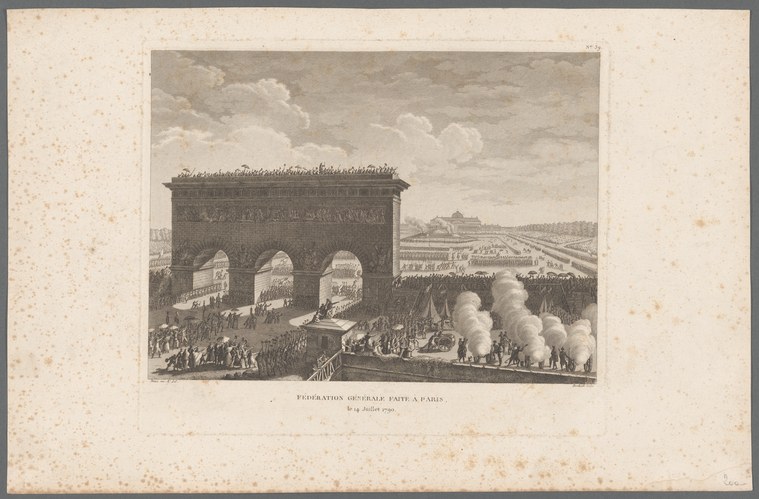
Fédération générale faite à Paris: le 14 Juillet 1790
Unknown artist
- Collection:
- Prints depicting dance
- Source:
- New York Public Library
- Rights:
- Public domain — free to use, share and adapt.
- Recorded as:
- Public Domain
This engraving captures an extraordinary historical moment when popular celebration, civic ritual, and the visual language of power converged in revolutionary France. For dance historians, it documents how the body politic was imagined and staged during the French Revolution—not as choreography but as the undifferentiated mass movement of a people united in common purpose. The work shows how dance and celebration were inseparable from nationalist ideology and public ceremony in this period.
What you are looking at
A monumental neoclassical gateway dominates the left side of the composition, its massive rusticated arch framing a densely packed crowd of figures gathered in the space before it. The structure, topped with a crenellated parapet and ornamented frieze, appears to be a triumphal or ceremonial arch. Smoke or incense rises from the right side of the scene in thick plumes, suggesting ritual activity or celebration. The crowd fills the foreground and middle distance, with figures in late 18th-century dress—breeches, coats, and cocked hats visible among the mass. Beyond the arch, a formal landscape opens out with what appears to be fortifications or public buildings visible on the horizon. The sky is rendered with dramatic clouds lit from above, giving the scene an almost theatrical luminosity. The overall impression is of a large-scale public ceremony or festival, with the architecture and the gathering both emphasizing civic importance.
The dancing
The figures are rendered at small scale and in compressed perspective, making individual dancers difficult to discern. They appear to move in clusters and processional arrangements rather than in coordinated couple-dances or formation. No clear holds or frame are visible; the bodies seem to mill and congregate rather than execute steps. The smoke rising from the right suggests activity—perhaps the burning of ceremonial objects or military salutes—that may accompany the gathering but is not itself dance movement.
The dance depicted
This engraving commemorates the Fédération générale held on 14 July 1790 in Paris—the first anniversary celebration of the storming of the Bastille, during the French Revolution. The scene depicts a mass civic gathering rather than a choreographed dance, though the title's use of the word 'fédération' (federation) refers to the ceremonial federation of the National Guard and civic bodies. Any dancing present is likely to be popular or folk dance, celebration, and revelry among the crowd rather than formal theatrical or ballroom dance. The scale of the composition—the overwhelming architecture and dispersed crowd—emphasizes the political and patriotic nature of the event over its choreographic content.
How it was made
This is an engraving, identifiable from its fine parallel line-work, tonal modulation through cross-hatching, and the precise linear rendering characteristic of copper-plate engraving. The technique allowed for wide distribution of this image of the civic spectacle; engravings were the primary means of circulating images of major public events to a broad audience across France and Europe in the revolutionary period. The formal, documentary quality of the engraving—its careful perspectival construction and architectural precision—gives the image an air of official record-making.
About this work
This engraving documents a pivotal moment in French revolutionary culture: the Fédération générale of 14 July 1790, a mass public gathering at the Champ de Mars in Paris that united the various armed forces and civic bodies of the new nation. While the work depicts a public celebration that almost certainly included popular dancing and festive movement, it is organized as a political and architectural spectacle rather than as a dance scene. The monumental gateway, the dispersed crowd, and the ritual smoke emphasize civic communion and patriotic ceremony. The image belongs in a gallery of dance in art because it records how the revolutionary French visualized collective movement and celebration at a moment of profound social transformation—as a merging of individual bodies into the mass body of the nation itself.
How to look at it
The composition uses the monumental arch as a framing device to organize the chaos of the crowd. Notice how the perspectival lines of the arch draw the eye into the depths of the scene and toward the gathering beyond. The smoke on the right pulls the eye away from the formal architectural structure toward evidence of ritual action and heat. The tiny scale of the figures emphasizes the scale of the event and the architecture, making individual bodies and movements nearly impossible to distinguish—which is precisely the point: this is about collective movement and the surrender of individual identity to civic unity. The artist chose to emphasize the architectural and political frame of the celebration rather than its choreographic or festive dimensions.
The period
The Fédération générale of 1790 was conceived as a supreme civic ritual uniting all branches of the new French military and administrative bodies in a single spectacular gathering. The event took place on the Champ de Mars, and tens of thousands of participants and observers were present. Visually, it drew on the language of neoclassical architecture and republican virtue, as well as on older traditions of royal ceremony and processional spectacle. Revolutionary authorities understood such mass gatherings as both practical military reviews and as theatrical performances of national unity. The engraving genre itself was essential to the Revolution's visual culture: engravings allowed rapid circulation of images of key events, making them available to a much wider public than paintings could reach. This particular work is one of several engravings documenting the 1790 fédération, and it was likely produced for popular consumption and political propaganda.
Where it lives
The work is held in the NYPL Prints collection as part of a larger group of engravings depicting dance and celebration. It is catalogued as a print depicting dance, though the visual evidence suggests it is primarily a record of political ceremony.
Questions about this work
Did people actually dance at the 1790 Fédération générale?
Yes, contemporary accounts describe festive dancing, music, and celebration among the crowds gathered on the Champ de Mars. However, this engraving emphasizes the formal, architecturally framed spectacle rather than the popular celebration. The smoke and crowding in this view suggest ritual and gathering more than choreographed movement.
Why is the engraving so focused on architecture rather than the people?
The monumental gateway (likely representing a temporary triumphal arch erected for the occasion) symbolized republican virtue and civic order. Revolutionary visual culture used architecture to frame and validate political action. By foregrounding the arch, the engraver asserts that this gathering was a disciplined, ordered civic ritual, not mere popular revelry.
What does 'fédération générale' mean in this context?
The fédération was a ceremonial federation of the National Guard units and civic bodies from across France, gathering in Paris to pledge loyalty to the new nation and constitution. Held on the anniversary of the Bastille's storming, it was designed as a spectacle of national unity and military power.
What kind of dancing would have happened at such an event?
Beyond the formal ceremony itself, the crowds would have engaged in popular or folk dancing, particularly the minuet and contredanses that were standard in late 18th-century French culture. The scale of this engraving makes such details invisible, emphasizing instead the mass gathering as a political statement.
More dance artwork





