49 works in this view — arrow keys or swipe to move between them.
Dance in Art
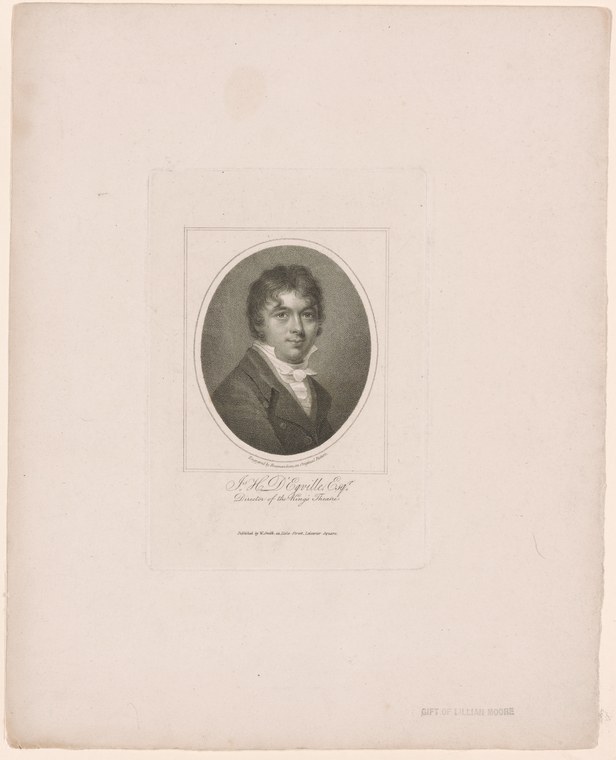
Js. H. D'Egville, esqr., director of the King's Theatre
Unknown artist
- Collection:
- Prints depicting dance
- Source:
- New York Public Library
- Rights:
- Public domain — free to use, share and adapt.
- Recorded as:
- Public Domain
D'Egville was the single most powerful voice in English dance during the critical decades when Romantic ballet was establishing itself; this portrait documents the man who decided what London would see and how it would be staged. For dance historians, the image serves as a visual anchor for a figure whose influence on technique, aesthetics, and institutional practice was enormous but whose legacy is often overshadowed by his Continental counterparts.
What you are looking at
This is a stippled engraving of a young man shown in bust format, set within an oval frame against a plain background. He wears a dark coat with a white collar and cravat typical of early 19th-century formal dress. His dark, curled hair is styled fashionably for the period. The engraving is finely worked with careful attention to the modeling of his face and the texture of his clothing. Below the oval portrait frame, a dedication reads "Js. H. D'Egville, esqr., director of the King's Theatre," establishing the sitter's identity and professional position. The work is a formal commemorative portrait typical of theatrical management portraiture of the Regency era.
The dancing
The figure is shown as a head-and-shoulders portrait, not in active dance posture. His body faces three-quarters toward the viewer, with a composed, dignified bearing befitting a theatre director rather than a dancer or choreographer in motion. There is no dance-specific body position, weight distribution, or arm gesture visible.
The dance depicted
This is a portrait of James Harvey D'Egville, the celebrated choreographer and director of the King's Theatre (Her Majesty's Theatre) in London's West End during the Regency period. D'Egville was one of the most important figures in early 19th-century British ballet and theatrical dance, credited with establishing ballet as a serious art form in England and with staging ambitious productions that brought Continental choreography and dancers to London. While this portrait does not depict him dancing or teaching, it documents a key figure whose artistic decisions shaped the theatrical dance that was performed during this era—principally Romantic ballet and the French pantomime-ballet tradition that dominated London stages in the 1810s-1820s.
How it was made
This is an engraving, likely a stipple engraving given the delicate dotted technique visible in the modeling of the face and the soft gradation of tones. Stipple engraving was the preferred medium for formal portraiture in the Regency era, particularly for commemorative theatrical prints intended for public circulation. The technique allowed for fine tonal control and a polished appearance suited to a subject of social standing. The work would have been widely distributed among London's theatrical and literate public, suggesting D'Egville's prominence in cultural life.
About this work
This is a formal portrait engraving of James Harvey D'Egville, the dominant figure in early 19th-century English theatrical dance. D'Egville's tenure as director of the King's Theatre (1814–1837) made him the arbiter of what London audiences saw on stage in ballet and pantomime-ballet. Though the image itself does not show dance, it documents a man whose artistic choices—his productions, his casting of Continental dancers, his adaptation of French ballet technique to English stages—directly shaped the Romantic ballet and theatrical dance that his contemporaries experienced. The portrait's formal character and its circulation as a print reflects D'Egville's status as a public figure whose work in dance was culturally significant enough to warrant professional portraiture.
For historians of dance and the theatre, this image represents a gap between the portrait as a historical document and the art form it commemorates. D'Egville appears here not as a practitioner but as a tastemaker and institutional authority. Yet understanding his career—his championing of ballet technique, his integration of mime and narrative, his role in establishing ballet as a legitimate London institution—is essential to understanding what theatrical dance became in Britain.
How to look at it
This is a formal institutional portrait, not a record of dance movement. The viewer should recognize it as a document of theatrical authority: it was created to circulate D'Egville's likeness among the London public and to commemorate his position. The fine engraving technique and the formal oval frame signal his status. The inscription below names him and his office; without it, one would not know this man's significance to dance history. This reminds us that portraits of choreographers and directors are often our only visual evidence of figures who shaped dance through institutions and decisions rather than through their own bodies.
The period
This portrait was made during the Regency era (approximately 1811–1820), a period of unprecedented expansion in London's theatrical culture and a moment when ballet was transitioning from an ornamental entertainment to a more central art form. D'Egville's appointment as director of the King's Theatre in 1814 coincided with the post-Napoleonic wars and the re-opening of Continental cultural exchange, allowing him to import French and Italian dancers and choreographers. During this period, the standard of dance technique in London rose dramatically. The 1815–1835 years saw the early development of Romantic ballet aesthetics—an interest in supernatural and fantastical subjects, an emphasis on the female dancer, and increasing technical virtuosity—though the full Romantic flowering (as exemplified by works like La Sylphide, 1832) came slightly later. D'Egville's productions bridged the older pantomime-ballet tradition and the emerging Romantic style.
Where it lives
This work is held in the New York Public Library's prints collection dedicated to dance imagery. It is a circulating print, likely produced in London during D'Egville's management of the King's Theatre and disseminated among theatregoers, patrons, and collectors of theatrical prints.
Questions about this work
Who was James Harvey D'Egville?
D'Egville (c. 1786–1863) was a French-born choreographer and dancer who became the director of the King's Theatre (now Her Majesty's Theatre) in London from 1814 to 1837. He was instrumental in establishing professional ballet as an art form in England, importing Continental dancers and choreography and raising technical standards. He created ballets, taught, and managed the theatre's dance operations during a formative period.
Why is a portrait of a director in a gallery about dance?
D'Egville's decisions about what dances to stage, which choreographies to present, and how to train and cast dancers directly shaped what dance was performed and seen in London. He was not merely an administrator but an artistic visionary whose taste defined an era. Institutional figures who control aesthetic output are integral to dance history, even if they do not appear in motion on the stage.
What does the inscription mean?
"Js. H. D'Egville, esqr., director of the King's Theatre" identifies the sitter by his professional title and position. This was a common format for theatrical prints in the Regency era, making the subject's role immediately clear to viewers.
More dance artwork





