49 works in this view — arrow keys or swipe to move between them.
Dance in Art
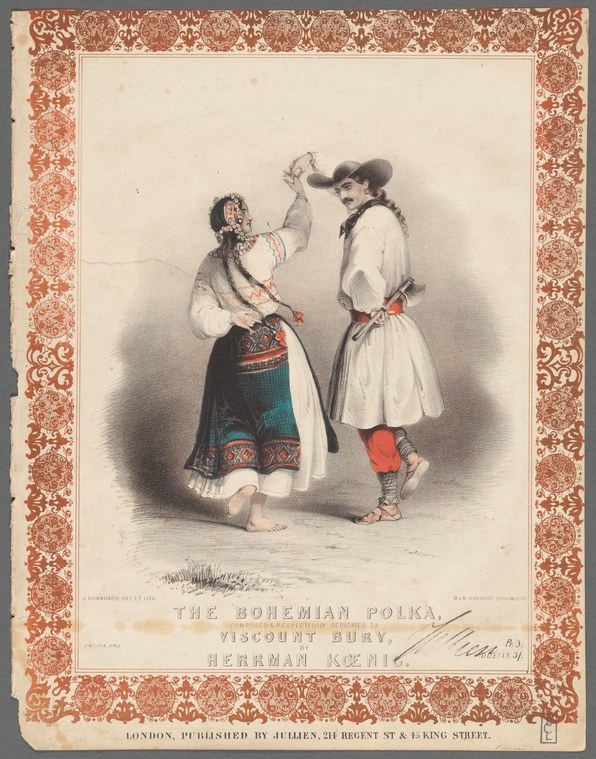
The Bohemian polka, composed & respectfully dedicated to Viscount Bury, by Herrman Koenig
Unknown artist
- Collection:
- Prints depicting dance
- Source:
- New York Public Library
- Rights:
- Public domain — free to use, share and adapt.
- Recorded as:
- Public Domain
Polka prints are a primary source for understanding how European folk dances were transformed into international social phenomena in the nineteenth century. This image shows the dance in its 'authentic' folk form while simultaneously being a commercial product designed to sell sheet music and to appeal to consumers eager to learn fashionable steps—a tension that shaped how dance moved between cultures.
What you are looking at
Two women in folk costume perform a Bohemian polka together on a plain stage, their bodies caught in the dynamic energy of the dance. The woman on the left wears a white embroidered blouse with puffed sleeves and a dark skirt with a distinctive woven or brocaded band at the hem; she has her right arm raised and extended, her body angled toward her partner. The woman on the right, similarly dressed in white with a red accent at the hip, faces her with a complementary arm position. Both dancers are barefoot or in soft shoes, their postures upright and engaged. The composition is tightly framed against a pale ground, with their figures rendered in tonal shading that gives them volume and presence. An ornate red and cream decorative border frames the entire composition, typical of commercial dance prints of the period.
The dancing
Both dancers stand in a partnered position characteristic of Central European folk dance, with arms raised and extended toward each other at roughly shoulder height. Their bodies are turned slightly inward, creating a dynamic diagonal orientation. The weight appears to be carried lightly, suited to the quick, bouncing action of polka. The raised arms and forward lean suggest the moment mid-turn or mid-step, captured at a point of rhythmic lift rather than a grounded moment.
The dance depicted
This is a Bohemian polka, as the title confirms. The polka was one of the most popular social dances of the nineteenth century, originating in Bohemia in the 1830s and spreading rapidly across Europe and North America. By the 1840s–1860s, it became a fixture of ballrooms and dance halls at every social level. The image shows the polka in its folk context, with dancers in traditional Bohemian dress rather than ballroom evening wear. The raised-arm position and the lightness of the frame are consistent with folk polka technique, which emphasizes buoyancy and quick footwork in a 2/4 or cut-time meter. The print itself suggests this was a popular parlor piece—a musical composition published to capitalize on the dance's fashionability.
How it was made
This is a hand-colored lithograph or engraving, likely a commercial music-cover or standalone dance print, as indicated by the decorative border and the inscription at the base. The catalogue record does not specify the medium; the image itself shows tonal modeling achieved through lithographic crayon or engraving burr, with hand coloring applied to the clothing and border in red and earth tones. The technique allowed for mass reproduction and affordability, making such prints a standard medium for promoting dances and musical compositions to middle-class households. The care devoted to the border ornament and the inclusion of composer credit suggests this was a commercial publication sold through music sellers and print shops.
About this work
This is a commercial print commemorating a Bohemian polka composed by Herrman Koenig and dedicated to Viscount Bury. It belongs to the vast category of nineteenth-century dance prints that served as both musical advertisements and visual records of how dances were performed and understood in their day. The print captures the polka in its folk context, showing traditional Bohemian dress and the partnered, upper-body-focused technique of the vernacular dance. These prints are windows into the social life of dance: who danced, what they wore, and how the dance was marketed to new audiences far from its place of origin.
How to look at it
Notice the raised arms and the lightness of the posture: this is not a heavy or grounded dance, but one that bounces and turns quickly. The artist has captured the dancers at a moment of lift and engagement, not rest. The folk costumes—the woven skirt borders, the puffed sleeves, the barefoot stance—are as much the subject as the dance itself: the print asserts that this is a 'folk' or 'national' dance, not a ballroom invention. The decorative border frames the figures like precious objects, elevating a peasant dance to the status of a collectible image. Consider what the print is selling: not just the steps, but the fantasy of encountering 'authentic' Bohemian culture in your London drawing room.
The artist
The artist is not recorded in the catalogue. The print was published by Julien of London (Regent Street and King Street), a major London music and print publisher of the mid-nineteenth century. Julien was known for issuing both serious concert music and popular dance music, often in elaborately decorated formats designed to appeal to middle-class collectors. The work was likely created by an in-house or commissioned illustrator working in Julien's production workflow.
The period
The polka emerged in Bohemia in the 1830s and became a sensation across Europe and America in the 1840s and beyond. By the time this print was made, the polka was everywhere—in concert halls, dance halls, drawing rooms, and street celebrations. It represented both the exoticism of Eastern European folk culture and the modernity of a fast, energetic, democratized dance that required no formal training. The 1840s–1860s saw an explosion of such prints and sheet music, as publishers capitalized on the appetite for new dances. At the same time, Bohemia itself was gaining cultural prestige in Western Europe as a source of 'authentic' folk material, and folk costumes were increasingly romanticized and pictured in urban middle-class contexts.
Where it lives
The print is held in the New York Public Library's collection of prints depicting dance. It was published by Julien of 246 Regent Street and 1 King Street, London, a major commercial music and print publisher. The print served as both a cover for or advertisement of the sheet music and a standalone image for collectors of dance imagery.
Dance in this work
Questions about this work
What is a polka?
A polka is a lively couple dance in 2/4 time that originated in Bohemia (modern Czechia) in the 1830s. It spread rapidly across Europe and America, becoming one of the most popular social dances of the nineteenth century. The polka is characterized by quick, bouncing steps and a spirited, energetic quality. This print shows it in its folk context, though by the nineteenth century it was danced in ballrooms, concert halls, and street celebrations at every social level.
Why are the dancers barefoot?
The barefoot stance emphasizes that this is a folk or peasant dance, performed in its 'authentic' Bohemian context rather than in a ballroom. Folk dancers often danced barefoot or in soft slippers. By showing bare feet, the artist signals the dance's rural or 'national' origins, even though the print itself is a commercial urban product designed for London consumers.
Who was Herrman Koenig?
Herrman Koenig is credited as the composer of this polka. Little is recorded about him beyond the attributions on surviving prints. He was one of many minor composers who wrote polkas and other dance music for publication and commercial sale during the 1840s–1860s, when such dances were immensely popular. Composers often dedicated works to aristocrats or prominent figures to enhance the work's prestige.
What does it mean that it's dedicated to Viscount Bury?
Dedicating a composition to a titled or prominent person was a common marketing practice. It lent prestige to the work and often suggested a personal or professional connection to the dedicatee. The dedication would have appeared in the printed score as well. It does not necessarily mean Viscount Bury danced this particular polka, but rather that his name added credibility and fashionability to the composition.
More dance artwork





