49 works in this view — arrow keys or swipe to move between them.
Dance in Art
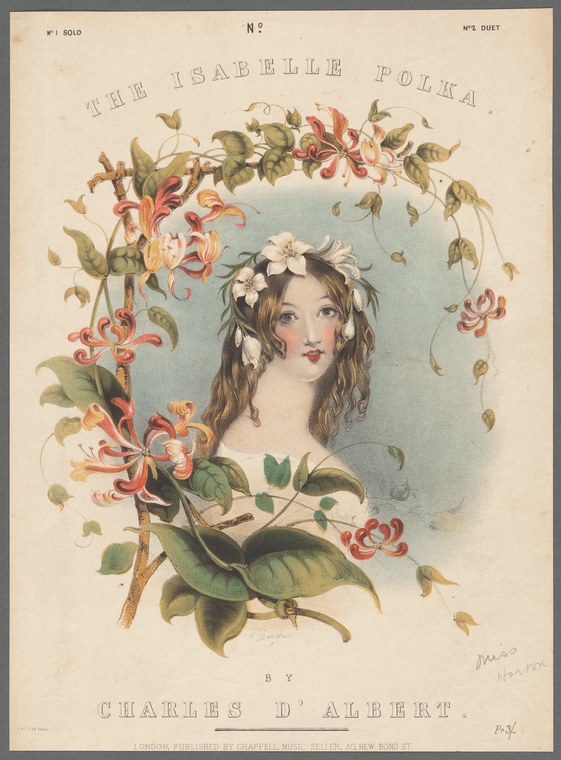
The Isabelle polka, by Charles d'Albert
Unknown artist
- Collection:
- Prints depicting dance
- Source:
- New York Public Library
- Rights:
- Public domain — free to use, share and adapt.
- Recorded as:
- Public Domain
This image reveals the gap between the actual sociability and vigor of the polka—a fast, exuberant couple dance—and how it was marketed to respectable domestic audiences. It shows how 19th-century popular culture used sentimental feminine imagery to mediate between the body's movement and the parlor's propriety, and it preserves a moment when sheet music covers were major forms of visual culture and design.
What you are looking at
A young woman's head and shoulders emerge from an ornate frame of flowering vines rendered in soft watercolor tones of coral, cream, and green. She wears white flowers woven into her dark hair and gazes upward with a gentle, dreamy expression. The composition is tightly focused on her face, which occupies the center of the oval frame formed by the climbing plants; butterflies flutter among the blossoms. The background shifts from pale blue at the crown to cream at the sides, creating an intimate, almost ethereal space. The overall effect is decorative rather than narrative—this is a portrait of refined sensibility dressed in the ornamental language of 19th-century popular music covers.
The dancing
A single seated or bust-length figure, shown from the shoulders up. Her head is tilted slightly upward in a posture of gentle reverie or rapture. The arms are not visible. The styling—the flowers, the pale complexion, the softly parted lips—suggests the idealized feminine beauty of the mid-19th century, rendered in a manner designed to appeal to the sentimental tastes of middle-class audiences.
The dance depicted
This is not a depiction of dance in motion. The title *The Isabelle Polka* indicates this is promotional imagery for a piece of dance music—a polka published under that name by Charles d'Albert. The Polka was a lively, spirited ballroom dance in 2/4 time that swept through Europe and America in the mid-19th century. This cover image, however, does not show dancers or choreographic movement; instead it presents an idealized feminine face and figure as the visual embodiment of the music itself. The work reflects a common commercial practice of the era: framing popular dance music through sentimental portraiture of genteel femininity rather than through actual depiction of the dance.
How it was made
This is a hand-colored lithograph, printed and colored to suggest the softness of watercolor. The delicate floral framing, the gradations of pale color, and the printing mark "London Publishing & Engraving Music Seller, Jane's Place St" visible at the bottom are consistent with mid-19th-century lithographic sheet music covers. Lithography allowed for mass production at a cost accessible to middle-class households with pianos, and the hand-coloring—visible in the subtle variation of tone—made each copy distinctive and attractive enough to display or keep as a collectible.
About this work
This is the cover of a published polka, one of the most popular ballroom dances of the 19th century. Rather than depicting dancers, it presents a sentimental portrait of femininity—a young woman in a state of gentle reverie, surrounded by flowers. The work exemplifies how dance music was marketed to genteel audiences not through images of actual dancing bodies, but through idealized representations of beauty and feeling. The polka was a democratic dance, danced by all social classes, yet this commercial image addresses itself to the refined tastes and domestic aspirations of the middle class. It is a document of how dance music was packaged, consumed, and imagined in the Victorian home.
How to look at it
Note the upward gaze and the posture of reverie: the cover sells not the dance itself but the feeling it supposedly evokes—romantic rapture, delicate sentiment. The ornamental frame of flowers is not incidental; it transforms the portrait into a decorative object for the parlor wall or piano, lending the polka cultural legitimacy. Compare this approach to contemporary dance instruction manuals and other sheet music covers: some show dancers in motion, others use heraldic or classical imagery. This one chose sentiment and ornament. That choice tells you something about who was expected to buy and play this music.
The artist
Charles d'Albert was a prolific composer and arranger of popular dance music for the mid-19th-century publishing market. The attribution on the title to Charles d'Albert as composer is consistent with the era's music publishing conventions. The cover artist is not recorded. The work's design—floral frame, central portrait, delicate hand-coloring—is typical of London music-cover design of the 1840s–1860s, when lithographic printing made illustrated covers a standard commercial feature.
The period
The polka emerged in Bohemia in the 1830s and became a global craze by the 1840s. Unlike the stately waltz, which dominated aristocratic ballrooms, the polka was danced by all classes and both men and women with equal prominence. It represented a moment of social democratization in ballroom dance. Yet simultaneous with this broadening was a intensification of genteel culture: the Victorian era saw the rise of the respectable middle class, domestic music-making, and the piano as a symbol of refinement. Sheet music covers like this one mediated between these two worlds—marketing a popular, vigorous dance through the language of drawing-room sentiment and feminine beauty.
Where it lives
This is a lithographed sheet music cover from the mid-19th century, held in the New York Public Library's collection of prints depicting dance. It bears a London publisher's mark. Sheet music covers of this era are significant artifacts of visual and dance culture, widely produced and circulated but rarely preserved systematically; this collection represents an important effort to do so.
Questions about this work
Did people actually dance the polka looking like this?
No. The polka was a fast, sprightly couples' dance done in closed position with quick, bouncing steps. Both partners were actively engaged. This cover shows a dreamy, solitary woman—an image of feeling, not of dancing. The cover sold the music by appealing to sentimental fantasy rather than showing what the dance actually looked like.
Was this a famous dance?
The polka was one of the most famous and widely danced ballroom dances of the mid-to-late 19th century. It originated in Bohemia and swept through Europe and America, danced at balls, assemblies, and in private homes. This particular piece—*The Isabelle Polka*—was one of many thousands of polka compositions published during the craze.
Why are there butterflies in the flowers?
Butterflies were a standard motif in Victorian decorative design, signaling nature, beauty, lightness, and transience. In the context of a romantic dance cover, they reinforce the ethereal, emotional mood the designer wanted to evoke.
More dance artwork





