49 works in this view — arrow keys or swipe to move between them.
Dance in Art
Jullien's American polka; Jullien's celebrated polkas, no. 12
Unknown artist
- Collection:
- Prints depicting dance
- Source:
- New York Public Library
- Rights:
- Public domain — free to use, share and adapt.
- Recorded as:
- Public Domain
The polka was a democratizing force in nineteenth-century social dance—it was easier to learn than the minuet or quadrille, faster-paced, and thrilling to perform. Jullien's name and his American venture made him a key figure in bringing European ballroom fashion to the expanding American middle class. This print is direct evidence of how dance was packaged, marketed, and made glamorous through print culture.
What you are looking at
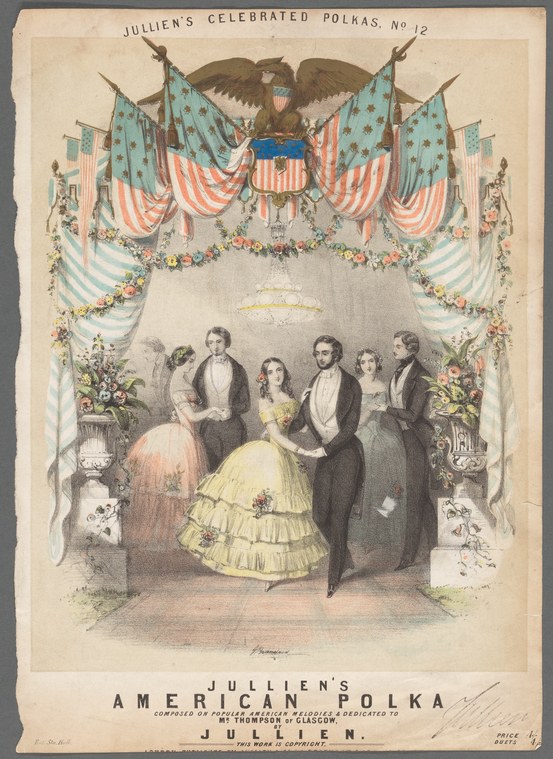
A formal social dance scene set in an ornate interior, likely a ballroom or elegant parlor. Six figures in mid-nineteenth-century dress occupy the center of the composition: a woman in a prominent yellow crinoline skirt (center-right, caught mid-motion), a woman in russet or brown dress (left), and four men in dark coats and trousers. The setting is framed by elaborate patriotic drapery—swags of red, white, and blue fabric with a shield bearing an eagle at the top, and floral garland swags below. The interior is furnished with potted plants and urns, and lit from above. The figures are arranged as if mid-dance, with the woman in yellow appearing to be turning or pivoting while others stand in attendance or hold positions suggesting the progression of a formal dance.
The dancing
The woman in yellow skirt is the focal point, her body angled and skirt voluminous as if caught in a turn or pivot—a characteristic moment in mid-nineteenth-century couple dances. The other figures stand upright in formal posture; several of the men appear to be in or approaching closed ballroom hold with female partners. The woman in brown on the left shows forward momentum. All figures maintain the vertical carriage and composed upper bodies typical of ballroom dance of this era, though the exact configuration of holds is partly obscured by the period clothing and the print's composition.
The dance depicted
This is a polka, as stated in the title. The polka was a Bohemian dance that became a craze in Europe and America during the 1840s–1860s, characterized by a lively 2/4 time signature, bouncing stepping action, and a spiraling or turning progression around the floor. This particular print, titled "Jullien's American Polka," references Louis Antoine Jullien, a French conductor and dance composer famous for popularizing ballroom dances in America in the 1840s–1850s through published dance scores and orchestral arrangements. The patriotic framing suggests this is an "American" variant or Jullien's adaptation for American audiences, celebrating the polka's adoption into American social dance culture.
How it was made
This is a hand-colored lithographic print, identifiable by its characteristic soft edges, the way color sits on the surface in discrete areas without fine line work, and the pale cream ground typical of nineteenth-century lithography. Lithography allowed rapid reproduction of dance instruction images and popular social scenes for a mass audience; this print was likely produced for distribution with Jullien's published dance music or as a standalone souvenir of a fashionable dance. The coloring (gold, blue, red) is applied by hand or in separate chromolithographic passes, suggesting either a premium production or hand-finishing after printing.
About this work
This is a promotional or instructional image for "Jullien's American Polka," a branded social dance published by or associated with Louis Antoine Jullien during his immense popularity in America in the mid-nineteenth century. The polka was one of the defining social dances of the 1840s–1860s, a couple dance performed in ballrooms and at public balls. The print documents not just the dance itself but the spectacle surrounding it: the formal dress, the patriotic ceremony of a public ball, and the celebrity of the dance master—in this case, Jullien, whose name and brand were synonymous with modern, fashionable ballroom dancing.
As a lithographic print, this object is part of the vast material culture of dance instruction and promotion in the nineteenth century. Such prints circulated widely, hung in dance studios and homes, and accompanied printed music, functioning as visual advertisement, instructional reference, and souvenir of participation in fashionable society.
How to look at it
Notice the moment chosen: the woman in yellow is caught mid-pivot or mid-turn, her crinoline skirt swept outward—the polka's characteristic spinning momentum is visible in the fabric. The composition frames her as the star of the scene, with the other dancers attending. The patriotic drapery and formal setting elevate the polka from a parlor novelty to a national spectacle. The print's title and Jullien's name are the primary text, making this as much a celebrity endorsement as a dance record. Look for the upright carriage of the figures and the apparent engagement of the couple nearest the center—this is ballroom propriety, not free or playful movement.
The artist
The artist is not recorded in the catalogue, but the print is marked as part of Jullien's "Celebrated Polkas" series (no. 12), suggesting it was produced by a publishing house or printing firm working under Jullien's brand or license. Jullien himself (1812–1860) was a French conductor, composer, and impresario who made his reputation partly through his compositions for quadrilles, polkas, and other ballroom dances, and partly through his touring orchestras. He visited America extensively (1853–1856) and became celebrated for popularizing continental ballroom fashion. The prints in his series were likely created by commercial lithographers in Paris or London, possibly including Jules Pelcoq or other artists working in Jullien's orbit, though confirmation would require further research.
The period
The polka emerged in Bohemia in the 1830s and swept across Europe and America in the 1840s and 1850s with extraordinary speed. It represented a break with earlier ballroom decorum—faster, more energetic, and more obviously flirtatious than the stately quadrille or cotillion. By the time Jullien was promoting the polka in America (early 1850s), it was already the dominant social dance in cosmopolitan cities. The patriotic framing of this print (the American eagle and flag) reflects the rapid Americanization of the dance; what had been exotic and European became assimilated into American nationalism and middle-class identity. In the visual arts, the mid-nineteenth century saw an explosion of lithographic prints documenting and promoting fashionable dances, often hand-colored and distributed widely as both instruction aids and status symbols.
Where it lives
This print is held in the New York Public Library's collection "Prints depicting dance," catalogued as part of Jullien's Celebrated Polkas series (no. 12). It represents the kind of mass-produced dance imagery that was circulated to both studios and consumers during the height of Jullien's fame and the polka's popularity in America.
Dance in this work
Questions about this work
Who was Jullien and why was his name on dance prints?
Louis Antoine Jullien (1812–1860) was a French conductor and composer who became famous for his orchestral concerts featuring dance music. He composed quadrilles and polkas for ballroom use and toured America extensively in the 1850s, making him a celebrity in fashionable circles. Prints bearing his name served as endorsements and marketing; his compositions and orchestrations were the product being promoted.
What is a polka and how do you dance it?
The polka is a fast, energetic couple dance in 2/4 time that originated in Bohemia (modern Czech Republic) in the 1830s. Dancers move around the floor in closed ballroom hold with a characteristic hop-and-step pattern that creates a bouncing, turning progression. It became fashionable in Europe and America in the 1840s–1850s and was considered modern, exciting, and slightly daring by older generations.
Why is this titled 'American Polka' if it's a Bohemian dance?
Jullien created variants or arrangements of popular dances and branded them with names and numbers for publication and instruction. 'American Polka' likely indicates Jullien's own composition or orchestration, adapted or marketed for American audiences. The patriotic framing in the print reinforces the idea of the polka as now belonging to American social culture, not a foreign import.
What does the colored drapery and patriotic imagery mean?
The American flag, eagle shield, and ornate drapery frame the dancers in a spectacular ballroom setting and invoke national pride. This visual strategy suggests that ballroom dancing and social refinement were part of American identity and aspiration, not European luxury—an important message for a middle-class American audience.
More dance artwork





