49 works in this view — arrow keys or swipe to move between them.
Dance in Art
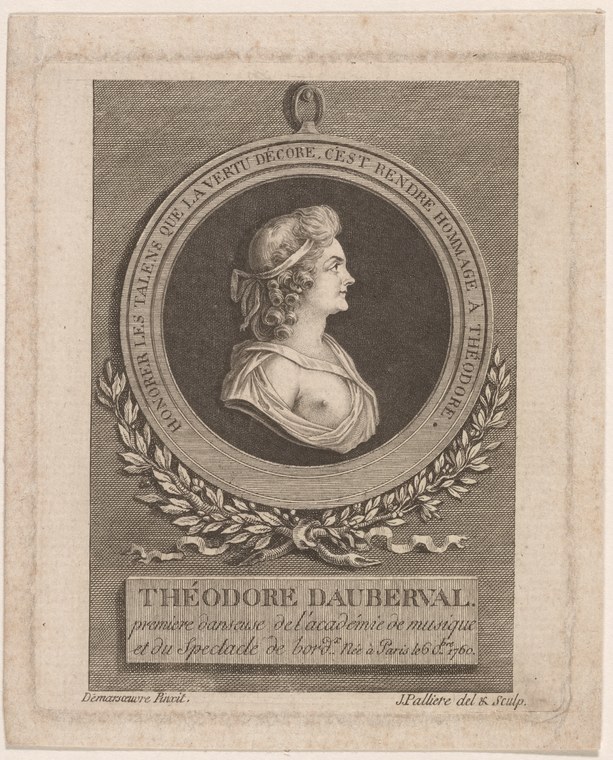
Théodore Dauberval, premiere danseuse de l'Academie de Musique et du spectacle de bordx. Née à Paris le 6 obre. 1760
Unknown artist
- Collection:
- Prints depicting dance
- Source:
- New York Public Library
- Rights:
- Public domain — free to use, share and adapt.
- Recorded as:
- Public Domain
Dauberval's portrait is rare evidence of female professional dancers being recognized and memorialized through engraving in the late 18th century, a period when such public commemoration was unusual for women performers. The inscription emphasizing her position and birthplace suggests she was accomplished enough to merit this formal tribute, offering a name and face to the world of pre-Revolutionary French ballet and providing a record of individual performers whose contributions are otherwise lost.
What you are looking at
This is an engraved portrait bust of Théodore Dauberval, a leading dancer of the Paris Opéra in the late 18th century. The subject is shown in profile within a circular frame, her hair styled in the neoclassical fashion of the 1760s–80s, dressed in a draped garment that reveals the shoulder in the manner of antique sculpture. Below the medallion runs a dedicatory inscription in French identifying her as "première danseuse de l'Academie de Musique et du spectacle de bordx" (principal dancer of the Academy of Music and Bordeaux theater), with her birthdate as 6 October 1760 in Paris. The portrait is ornamented with a classical wreath of laurel and olive branches at its base, framing the bust with symbols of artistic achievement. The engraving is executed in fine parallel lines characteristic of mid-to-late 18th-century reproductive prints, with careful attention to light and shadow to model the face and create depth.
The dancing
The subject is depicted as a facing-right profile bust, a formal and dignified presentation. No active dance movement or pose is shown; this is a commemorative portrait rather than a representation of performance. The classical drapery and arrangement of the hair emphasize her status as an accomplished professional performer, aligned with neoclassical ideals of nobility and refinement rather than the theatrical exuberance that might characterize a scene of actual dancing.
The dance depicted
Théodore Dauberval (born 1760) was a prominent dancer at the Bordeaux theater and the Paris Opéra during the late 18th century. As a "première danseuse," she would have performed in the ballet repertoire of the era, likely in roles requiring both technical skill and dramatic presence. The inscription's deliberate emphasis on her position and birthplace indicates she was well-known enough to merit publication in engraved form. However, this portrait contains no visible evidence of the specific style or technique of her dancing—it is an honorific image rather than a choreographic one, designed to celebrate her professional status during the height of the Enlightenment and early Romantic ballet.
How it was made
This is a line engraving, identified by the characteristic fine parallel hatching visible throughout the composition. The technique is typical of French reproductive prints of the 1760s–80s, designed for circulation among educated audiences and in dancers' records. The engraver's signature ("Desmaisons fecit" lower left, "Mullatre del & Sculp." lower right) indicates the division of labor standard in 18th-century print production: one artist designed the original, another engraved it. This method allowed for relatively inexpensive production and wide distribution, making it an ideal medium for commemorating professional performers who lacked the wealth or royal patronage to commission oil paintings.
About this work
This engraving documents Théodore Dauberval, a principal dancer at the Bordeaux theater and Paris Opéra around 1760–80, at the height of the pre-Revolutionary theatrical world. It is a formal commemorative portrait rather than a scene of dance in action, but it is precious precisely because it records a professional dancer—a woman of recognized skill and status—at a moment when few such performers were granted individual portraiture. The neoclassical framing and antique styling of the bust reflect the intellectual climate in which late 18th-century ballet was developing, moving toward the dramatic and mythological subject matter that would define Romantic ballet. This print is part of a genre of dance documentation: the promotional or memorial engraving of celebrated performers, a practice that establishes them as figures of cultural importance and allows their likeness to circulate beyond the theater.
How to look at it
Look at the care taken in the engraver's rendering of the face and the classical drapery—this is not a hurried or modest portrait, but a deliberate, refined image designed to convey dignity and artistic achievement. Notice the laurel and olive branches, symbols of accomplishment and peace that elevate Dauberval's status to that of an honored artist rather than a mere entertainer. The profile pose is itself a classical convention, echoing antique coins and cameos, and its adoption for a dancer suggests that by the 1760s–80s, leading performers could claim a kind of cultural nobility.
The artist
The engraving is credited to Mullatre (designer and sculptor) and Desmaisons (engraver), both working in the established tradition of French reproductive printmaking in the mid-to-late 18th century. Both names appear in the prints of the period as skilled craftspeople producing commemorative and documentary engravings of notable figures, though neither is particularly well-documented in surviving records. The quality of the work and the formal apparatus surrounding it (the circular frame, the laurel wreath, the dedicatory inscription) suggest this was produced by a professional workshop serving the Parisian cultural establishment.
The period
The engraving dates to the 1760s–80s, a period of rapid change in European ballet. This was the era of Jean-Georges Noverre's reforms advocating for ballet d'action (narrative ballet), the rise of the ballerina as a leading theatrical figure, and the expansion of dance training academies. The neoclassical styling of Dauberval's portrait reflects the broader intellectual turn toward antiquity in art and theater during the Enlightenment. France's Academy of Music (Opéra) was the leading institution for ballet in Europe, and provincial cities like Bordeaux maintained prestigious theaters with their own dance companies, making Dauberval's dual association with both a prestigious local theater and the Parisian stage a mark of high status.
Where it lives
This engraving is held in the New York Public Library's collection of prints depicting dance. It is a reproductive print, likely produced in Paris, and would have been distributed to theaters, patrons, and collectors interested in the celebrated performers of the day.
Questions about this work
Was Théodore Dauberval a real person, or is this a fictional portrait?
Dauberval was a real dancer, identified in the inscription as principal dancer at Bordeaux and born 6 October 1760 in Paris. The specificity of the date and place, along with the formal publication of her portrait, indicates she was a recognized professional performer. However, limited biographical records of her survive beyond this engraving and other period documents.
Why does the portrait not show her dancing?
This is a commemorative or promotional engraving, designed to honor her status and circulate her likeness, not to document her technique or a specific performance. The neoclassical bust format was appropriate for celebrating an accomplished artist; active dance scenes were reserved for narrative or theatrical prints.
What does 'première danseuse' mean?
It means principal or first dancer—the leading female dancer of a theater company, equivalent to a prima ballerina. This title indicates Dauberval held a position of prestige and significant responsibility in the choreography and performance life of her theater.
What was the Paris Opéra like in 1760?
The Paris Opéra (Académie Royale de Musique) was the most prestigious dance institution in Europe, setting standards for technique, repertoire, and training. Dancers who achieved rank there, or who performed at major provincial theaters like Bordeaux's while connected to Paris, held elite status in their profession.
More dance artwork





