49 works in this view — arrow keys or swipe to move between them.
Dance in Art
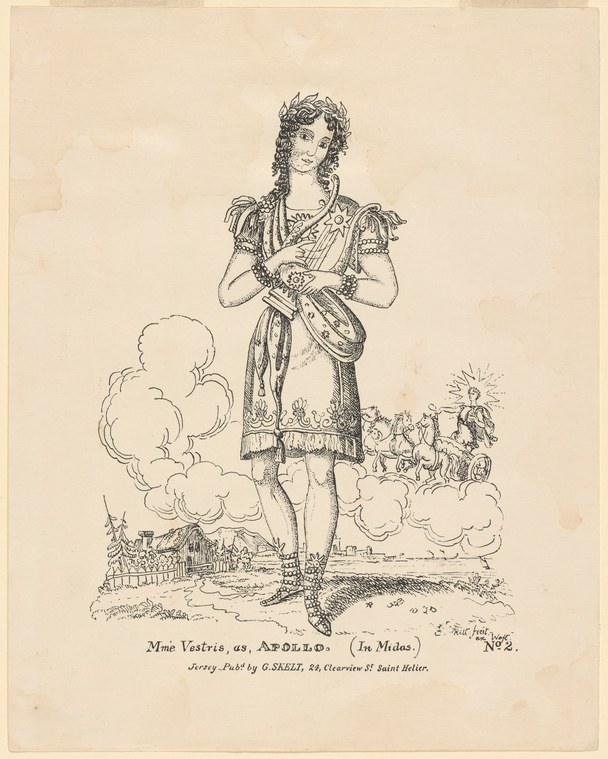
Mme Vestris, as, Apollo. (In Midas)
Unknown artist
- Collection:
- Prints depicting dance
- Source:
- New York Public Library
- Rights:
- Public domain — free to use, share and adapt.
- Recorded as:
- Public Domain
Lucia Elizabeth Vestris was a watershed figure in early-nineteenth-century dance and theater—celebrated for her vivacity, technical skill, and willingness to innovate in roles traditionally dominated by men or played in rigid classical modes. This print documents not her dancing per se but her cultural reach and the way theatrical imagery was commodified and circulated to build and sustain celebrity. For historians of dance, Vestris is essential: she later became a notable theater manager and choreographer, and her career marks the transition from court dance to commercial theater as the primary stage for dance innovation.
What you are looking at
A tall female figure dominates the composition, posed centrally and fronting the viewer with a classical stance. She wears an elaborate Regency-era gown with puffed sleeves and an ornate sash or belt at the waist, her hair arranged in ringlets adorned with what appears to be a crown or laurel wreath. She holds a lyre or similar stringed instrument across her body. The figure stands on a landscape base rendered in light wash; behind and below her is a theatrical scene in miniature—a stage set or diorama showing a crowd of figures, buildings, and billowing clouds of smoke or steam on the left, suggesting dramatic action or spectacle. The entire composition is rendered as a line engraving on aged, cream-colored paper, with the title and artist credit inscribed below in a classical typeface.
The dancing
The central figure stands in a formal, frontal pose with weight distributed evenly, suggesting stillness rather than motion. Her arms are positioned to frame and support the lyre, held diagonally across her torso. Her posture is upright and dignified, her gaze direct. There is a single dominant figure; the crowd in the background scene is rendered too small to read individual bodies or holds. The scale relationship between the foreground and background—the heroic isolation of the lead figure above a miniature stage—conveys authority and symbolic rather than literal dance movement.
The dance depicted
The inscription identifies this as 'Mme Vestris, as Apollo (In Midas),' indicating a theatrical performance of a classical or neoclassical work. Mme Lucia Elizabeth Vestris (1797–1856) was a celebrated Anglo-Italian soprano, dancer, and actress of the London stage in the Regency and early Victorian periods, known for roles in comic opera and ballet. The figure's costume—the lyre, the formal drapery, and the classical styling—suggests a costume drama or mythological theatrical piece. Without access to the full performance record, it is unclear whether this represents a dance role proper or a character in a spoken or sung theatrical work; the pose suggests a dramatic or allegorical presentation rather than an active dance step or sequence. The work appears to commemorate a specific celebrated performance, likely from the 1820s–1830s.
How it was made
This is a line engraving on paper, executed with fine parallel hatching and cross-hatching to build tone and form. The technique allows precise delineation of costume detail—the pleats, embroidery, and texture of the gown are legible—and the miniaturization of the background scene. The engraving process was labor-intensive and expensive, suggesting this was a commissioned or commercially published theatrical souvenir intended for a paying audience, likely sold as a print or included in a theatrical memoir or portrait collection. The aged paper and hand-inscription indicate this is a historical impression, not a modern reproduction.
About this work
This is a commemorative theatrical print documenting a celebrated performance by Mme Vestris, one of the most significant performers of the English musical stage in the early nineteenth century. The work belongs to a substantial tradition of theatrical portraiture—prints and paintings issued to capitalize on the fame of admired singers and dancers—and records both the costume and the dramatic persona associated with a specific role. While it may not depict active dancing, it is inseparable from dance history: Vestris was a dancer as well as a singer, and the mythological subject and classical drapery reflect the aesthetic conventions of Romantic-era theatrical performance, in which dance, music, and spectacle were inseparable. The inscription and format make clear this is a commercial product of the theatrical print trade, circulating among theater-goers and collectors of theatrical ephemera.
How to look at it
The viewer should attend to the scale relationship between the heroic central figure and the miniature dramatic scene below—this is a portrait of a celebrity, not a documentation of a dance step. Observe the costume detail: the fashion of the gown, the styling of the hair, and the attributes (lyre, crown) signal classical or mythological subject matter. The frontal, static pose is characteristic of theatrical portraiture of this period, designed to allow the viewer to admire the costume and the performer's bearing without the movement and blur that would result from depicting action. The aged inscription and hand-coloring (if present) situate this in the lived world of the theater, circulating among theater-goers as a memento.
The artist
The artist is not recorded in the catalogue. The style, inscription format, and execution are consistent with London theatrical print production of the 1820s–1830s; the engraving is likely the work of a commercial theater print workshop, possibly after a drawing by a portraitist or theatrical designer. No signature is visible. Vestris's image was widely circulated in printed form during her career, and multiple versions and variations of her portrait in costume exist in institutional collections.
The period
This print dates to the height of the Romantic era in theater and dance. The early nineteenth century saw the rise of the commercial theatrical print as a vehicle for celebrity and cultural consumption; theater-goers purchased prints of celebrated performers to keep as mementos and display as tokens of fashionable taste. Vestris came to prominence in the 1820s, when ballet was being transformed by the innovations of the Romantic ballet (rising on pointe, ethereal costuming, emphasis on pantomime and spectacle). Mythological and classical subjects remained popular in comic opera and theatrical spectacle even as Romantic ballet moved toward fairy tales and exotic settings. The engraving's classical subject and Regency-era costume reflect the persistence of neoclassical aesthetics in theatrical dress even as Romanticism took hold in narrative and music.
Where it lives
This print is held in the New York Public Library's Prints collection, a major institutional repository for theatrical ephemera and theatrical portraiture. The collection contains thousands of prints of actors, dancers, and singers from the eighteenth to twentieth centuries, originally issued for commercial sale or given away by theaters to build audience loyalty.
Questions about this work
Who was Mme Vestris and why does she appear in a dance collection?
Lucia Elizabeth Vestris (1797–1856) was a celebrated Anglo-Italian performer who worked as a dancer, singer, and actress on the London stage during the Regency and early Victorian periods. She was a notable figure in musical theater and later became a theatrical manager and choreographer. While this particular print depicts her in costume for a classical or mythological role, she was active in dance and theater during a period of major innovation in Romantic ballet.
Is this a picture of Vestris dancing?
No. This is a commemorative portrait print showing Vestris in costume for a specific theatrical role—Apollo, in a work titled 'Midas.' The pose is formal and static, designed to allow the viewer to admire the costume and her bearing. Such prints were commercial products sold to theater-goers as mementos of celebrated performances and performers.
What is the small scene in the background?
The miniaturized stage scene below the main figure appears to represent the dramatic action or spectacle associated with the theatrical work—in this case, likely the story of King Midas from Greek mythology. This compositional device was common in theatrical prints of the period, allowing the artist to situate the portrait within the larger narrative context of the performance.
When was this print made?
The catalogue record does not provide a date. However, Vestris's career in London extended from the early 1820s through the 1850s. Based on the style of the engraving, the fashion of the costume, and the theatrical print conventions visible in the image, this print was likely issued in the 1820s or 1830s, during the height of her fame as a performer.
More dance artwork





