49 works in this view — arrow keys or swipe to move between them.
Dance in Art
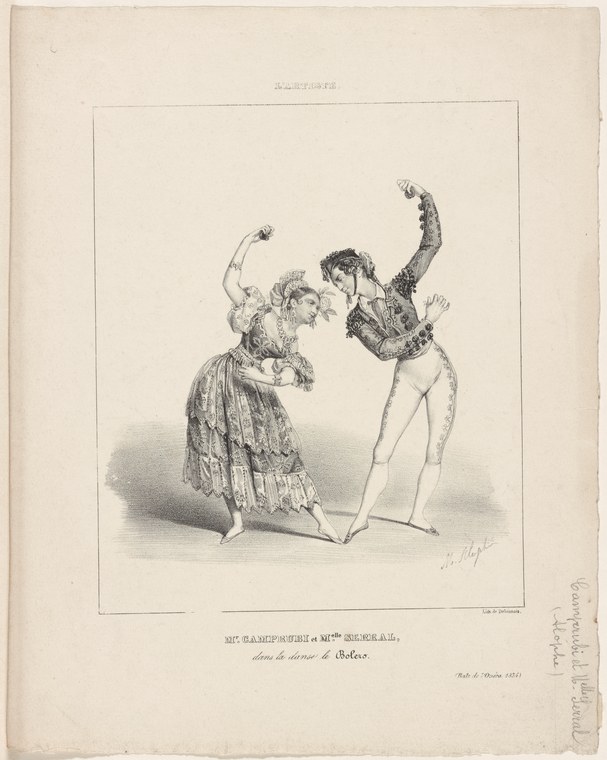
Mr. Camprubi et Melle Serral, dans la danse le Bolero
Unknown artist
- Collection:
- Prints depicting dance
- Source:
- New York Public Library
- Rights:
- Public domain — free to use, share and adapt.
- Recorded as:
- Public Domain
Named dancer documentation from the early 19th century is scarce, and prints that identify both performers and the specific dance being executed are invaluable primary sources for reconstructing ballroom and stage practice of the period. This image shows the Bolero as a theatrical spectacle, not merely a written description, and reveals the intimate, gestural vocabulary of the dance as it was actually performed in its moment of greatest popularity.
What you are looking at
A tightly composed scene of two dancers on an empty stage, rendered in black ink on cream paper. On the left stands a portly older man in draped theatrical costume—a short tunic or skirt with heavily pleated fabric—his round face in profile, both arms raised high and bent. His posture is emphatic, almost mock-heroic. Facing him on the right is a younger, nearly nude male dancer, wearing only fitted hose or tights and minimal upper-body dress. His right arm is raised in a mirror of the older man's pose, his left hand extended toward his partner's torso. Both figures cast soft shadows on the ground, and the framing is intimate—the composition crops tightly around them, emphasizing the intimate confrontation or courtship implied by their paired gesture. The engraving technique allows fine detail in the pleating of cloth and the modeling of flesh through careful hatching.
The dancing
Both dancers maintain an open, face-to-face frame with raised arms that suggest a moment of greeting, salutation, or dramatic appeal rather than a closed ballroom hold. The older dancer's body is compressed and rotund, his gesture theatrical and gestural rather than locomotive. The younger dancer presents a slighter frame, raised on what may be the balls of his feet, his posture more lifted. The pairing suggests a dialogue or interaction—perhaps a comic or chivalrous exchange—rather than synchronized unison movement. The asymmetry in dress and body type implies these are distinct character roles.
The dance depicted
The title identifies this as the Bolero, danced by Mr. Camprubi and Mlle Serral, a Spanish or Spanish-inflected dance of the late 18th or early 19th century. The Bolero was a popular theatrical and ballroom dance of that era, typically characterized by turns, rhythmic footwork, and a more stately or dramatic carriage than the waltz. The gestural, face-to-face engagement and the raised-arm position align with period depictions of Spanish dance, though the comic or burlesque character suggested by the costume disparity hints that this may be a theatrical or staged version of the Bolero rather than a ballroom execution. The near-nudity of the younger figure is characteristic of Romantic-era theatrical practice, particularly in Paris and London, where male and female dancers sometimes performed in minimal costume to display line and movement.
How it was made
This is a finely executed steel or copper engraving, identified by its crisp lines, tonal modeling through parallel hatching, and the characteristic print marks visible at the edges of the composition. The technique allowed for mass reproduction and circulation in periodicals, theater programs, and collectors' portfolios—a marker that this dance and these performers had cultural visibility and commercial value. The print's careful attention to fabric texture and anatomical form suggests it was aimed at a educated theatrical or artistic audience. The inscription at the base, in French, confirms this was published for a French or French-reading market.
About this work
This engraving documents a performance of the Bolero by two named dancers, likely early 19th century, in a moment of theatrical interaction. The Bolero was a major ballroom and stage dance of the Romantic era, Spanish in origin or association, and this image captures its character as both a formal dance and a vehicle for dramatic performance. The print's circulation and high finish indicate it served as a souvenir or publicity document for a specific performance or performers of some renown, preserving a moment in the history of social and theatrical dance that would otherwise be lost. For dance historians, it provides rare documentary evidence of how the Bolero looked in practice and how it was marketed to audiences.
How to look at it
Attend to the raised-arm position and the upright carriage of both figures: this is not a turn or a traveling step, but a moment of gestural interaction, frozen in what appears to be a salutation or dramatic pause. The print captures the theatrical rather than purely balletic quality of the Bolero—its character as a dance of expression and relationship rather than abstract form. Notice too the stark contrast in costume and body type between the two dancers, which hints at the comedic or character-based dimension of the performance. The composition's tightness and intimacy suggest this was a moment of particular dramatic intensity or charm in the performance.
The artist
The engraver is not recorded, but the style and execution suggest a professional print studio working in Paris or London in the early 19th century. The quality of the line work and the theatrical subject matter indicate this was a commissioned work, likely produced for distribution as a theater souvenir or included in a dance or entertainment periodical. Such unsigned theatrical prints were common products of the period's thriving popular press.
The period
The early 19th century was the height of the Bolero's European popularity, concurrent with the Romantic ballet movement and the rise of national or exotic dance forms on the theatrical stage. Spanish and Spanish-inflected dances held particular appeal in Parisian and London society as markers of passion, drama, and sensual expression—a contrast to the ethereal, otherworldly aesthetic of Romantic ballet. The stylized costume and theatrical framing of this print align with the period's fascination with dance as a form of exotic spectacle, while the engraving medium itself reflects the role of the popular press in creating and circulating images of celebrity performers and fashionable entertainments.
Where it lives
This engraving is held in the New York Public Library's collection of prints depicting dance. It appears to be a single-sheet theatrical souvenir or magazine illustration, produced for circulation among theater patrons and dance enthusiasts of the period.
Dance in this work
Questions about this work
What is the Bolero?
The Bolero is a Spanish dance that became enormously popular in European ballrooms and theaters in the late 18th and early 19th centuries. It is characterized by a moderate tempo, three-beat measure, and a mixture of turns and rhythmic footwork. On the theatrical stage, it was often performed as a solo or duet with dramatic gesture and expression, as seen here.
Who were Camprubi and Serral?
The catalogue record does not identify them beyond their names. They were likely professional theater dancers of sufficient renown to merit a published engraving, but no further biographical information is available from this source. The presence of their names on the print indicates they were recognizable to contemporary audiences.
Why is the younger dancer almost nude?
In Romantic-era theatrical practice, particularly in Paris and London, male dancers often performed in minimal costume to display their line, leg, and movement quality. This was standard in ballet and theatrical dance of the period, and reflects the aesthetic values of the time: the body as an instrument to be admired, the dance as a visual spectacle of physical virtuosity.
What technique is this engraving?
This is a steel or copper engraving, a printmaking method that allowed for sharp, fine lines and careful tonal modeling through hatching. The technique was well-suited to theatrical subjects and could be reproduced many times, making it ideal for circulation as a souvenir or in periodicals.
More dance artwork





