49 works in this view — arrow keys or swipe to move between them.
Dance in Art
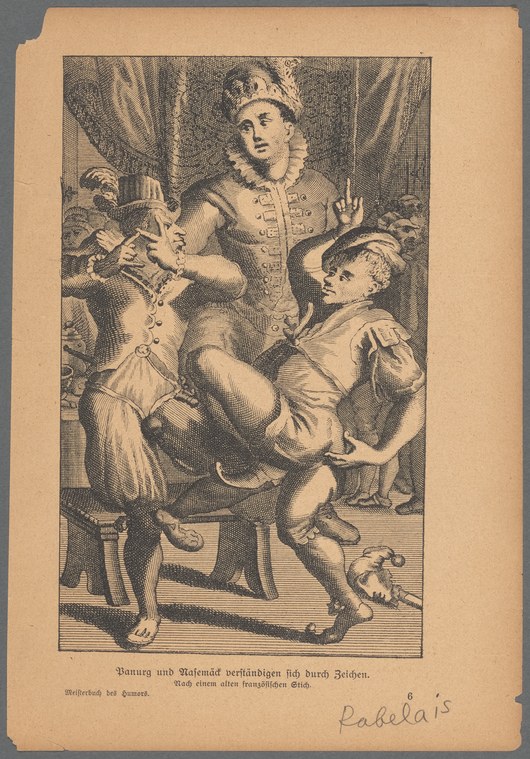
Panurg und Nasemäck verständigen sich durch Zeichen. Nach einem alten franzosischen Stich
Unknown artist
- Collection:
- Prints depicting dance
- Source:
- New York Public Library
- Rights:
- Public domain — free to use, share and adapt.
- Recorded as:
- Public Domain
For dance historians, this image documents a foundational moment in European performance culture: the recognition that the body can communicate complex meaning through codified gesture independent of words. It reveals that gestural eloquence was a teachable, transmissible skill valued in educated circles, laying groundwork for the emergence of choreography and theatrical movement as formal disciplines.
What you are looking at
A woman in elaborate court dress stands at center, wearing a jeweled bodice, puffed sleeves, and an ornate headdress; she gestures expressively with both hands raised, palms outward in a communicative pose. To her left stands a male figure in similar period dress, also gesturing with raised hands in mirror fashion. At lower right, a young putti or cherub in classical drapery looks up at the pair, also with hands raised. Heavy draped curtains form the background, and the composition is rendered in a fine engraving technique with dense cross-hatching to create depth and shadow. The moment captures what appears to be a tableau of gestural communication or silent discourse—the figures seem to be conducting a conversation through signs and hand movements rather than speech.
The dancing
Both adult figures maintain an upright, formal court carriage with their weight centered. Their arms are raised to approximately shoulder height with palms open and fingers spread, creating a vocabulary of gesture that reads as emphatic and communicative rather than choreographic. The pose is symmetrical and confrontational—the woman and man face each other across the composition, each mirroring the other's arm positions. The small putti at lower right echoes this gestural language at a smaller scale, grounding the composition and suggesting this is a teaching or demonstration moment.
The dance depicted
This is not a depiction of dance in the modern sense, but rather a sixteenth- or seventeenth-century emblematic representation of silent communication through gesture and sign language. The image illustrates the *langue des signes* or gestural rhetoric that was a valued accomplishment in courtly education and performance. The figures are demonstrating eloquence through bodily movement rather than speech—a practice rooted in classical rhetoric and Renaissance ideas about the expressive power of the body. While this precedes modern dance, it represents an important ancestor to theatrical gesture and a cultural moment when bodily expression was formalized and codified as an art.
How it was made
This is a copper engraving, identifiable from the fine parallel lines (hatching and cross-hatching) that build tone and shadow, and the crisp black-and-white definition characteristic of the medium. The technique allowed for precise delineation of fabric texture, jewelry, and facial expression, and the print's small scale and portable nature made it ideal for circulation among educated audiences as an exemplar of courtly manners and eloquence. The inscription in German at the bottom confirms its didactic purpose—it was a teaching image, reproduced and distributed to instruct viewers in proper gestural conduct.
About this work
This engraving depicts two courtly figures engaged in silent communication through formalized gesture, accompanied by a putti who witnesses or learns their discourse. It belongs to a tradition of Renaissance and early modern emblem books and instructional prints that codified bodily eloquence as a learned accomplishment. The image sits at the intersection of rhetoric, courtly conduct, and the history of gesture as a performable art form—an ancestor to both theatrical mime and the somatic practices of later dance, showing a moment when the expressive body was understood as a language equal to speech. The composition is symmetrical and ceremonious, suggesting this is not casual conversation but a formal demonstration or lesson.
How to look at it
Attend to the symmetry and formality of the pose: the woman and man are not in motion but held in a static tableau that emphasizes the deliberation of their gesture. Notice the spread fingers and open palms—this is rhetorical gesture, not functional movement. The putti below serves as a visual anchor and sign of the image's didactic purpose: this is a lesson in how to communicate through the body. The dense engraved background and the careful rendering of fabric and jewelry emphasize that this is a courtly, learned practice, not popular entertainment.
The artist
The artist is not recorded in the catalogue. The inscription credits a French original (*Nach einem alten franzosischen Stich*—after an old French engraving), suggesting this is a German reproduction of a sixteenth-century French source. The German text and printing conventions point to a German-language engraving workshop, likely sixteenth or early seventeenth century, but without a signature visible or documented, the maker remains unknown.
The period
This image emerges from the Renaissance revival of classical rhetoric and the courtly conduct literature that flourished in sixteenth-century Europe. Treatises on *gesta* (gesture) and nonverbal eloquence were authored by figures like Giovan Antonio Guarini and were central to the education of courtiers. Simultaneously, the period saw the codification of dance itself—basse danse, pavane, and other court dances were being notated and published (Arbeau's *Orchesographie* appeared in 1588). Gesture and dance were understood as sister arts, both expressive languages of the body governed by rule and decorum.
Where it lives
The work is held as part of the New York Public Library's collection of prints depicting dance. The catalogue notes identify it as derived from a French original but record no artist, date, or medium beyond the German-language inscription visible in the print.
Questions about this work
Is this a dance image?
Not in the modern sense. It depicts formalized gestural communication, a practice that predates choreographed dance as we know it but represents an important ancestor to theatrical movement and mime. Renaissance and early modern courts valued eloquence of gesture as a learned art equal to speech.
What are the figures doing with their hands?
They are demonstrating a codified language of gesture—signs, hand positions, and arm movements that conveyed meaning through deliberate bodily expression. This was taught as part of courtly education and rhetorical training, much as we might teach an actor today.
Why is there a small winged figure at the bottom?
The putti (putto) is a common emblem device in Renaissance prints, often representing learning, instruction, or divine presence. Here it suggests this is an instructional image meant to teach the viewer, and the cherub's raised hands echo the communicative gesture being demonstrated.
What language is the text?
German. The inscription indicates this is a German engraving made after an older French original. The print was intended for a German-speaking, educated audience learning courtly manners.
More dance artwork





