49 works in this view — arrow keys or swipe to move between them.
Dance in Art
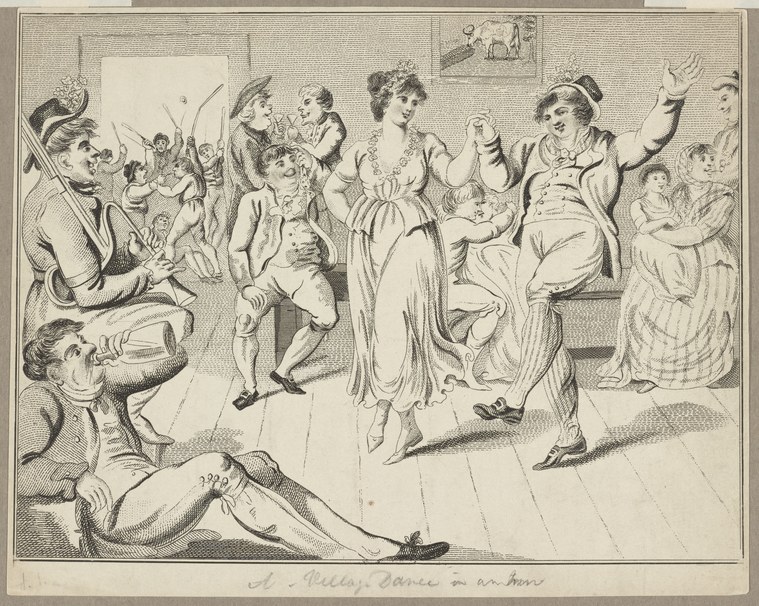
A village dance in an inn
Unknown artist
- Collection:
- Prints depicting dance
- Source:
- New York Public Library
- Rights:
- Public domain — free to use, share and adapt.
- Recorded as:
- Public Domain
The image is evidence of how 18th- and 19th-century artists understood popular dance as a subject worthy of detailed, sympathetic representation. The physical freedom and mingling of men and women in the scene—the raised arms, the exaggerated posture, the absence of rigid couple formation—contrasts sharply with contemporary courtly dance and tells us something true about how ordinary people actually moved. For historians of vernacular dance and social practice, this engraving is a primary source of equal value to written descriptions or dance notation.
What you are looking at
A crowded inn or tavern interior depicts a lively social dance in progress. The composition is busy and energetic, with figures distributed across the space in various states of merriment. A central group of women in high-waisted, classically draped gowns move together, some with arms raised or extended. Men in period dress—including military coats and hats—surround them. The setting includes architectural elements suggesting an indoor space: walls, a doorway or window frame at upper left, and what appears to be furniture or a bench. The engraving's fine hatching and line work creates depth and shadow, emphasizing the crowded, convivial atmosphere. Several figures gesture animatedly; some appear to be playing instruments (visible upper left); others clap or gesture in encouragement. The overall mood is one of spontaneous, uninhibited celebration.
The dancing
The dancers move in loose, individual patterns rather than formal couples or sets. Women's arms frequently rise above shoulder height, extended or gesturing freely. The weight distribution suggests sprightly, energetic movement rather than constrained courtly posture. Men and women intermix without the strict pairing convention of formal ballroom dance. Several figures adopt exaggerated postures—one man kneels or leans dramatically in the lower left—suggesting comic or uninhibited physicality. The drapery of the women's skirts is rendered to show movement and swirl, catching the energy of the dance.
The dance depicted
This appears to be a folk or peasant village dance rather than formal courtly choreography. The setting, dress, and uninhibited gesture all point toward rustic social dancing—the kind danced at inns and taverns during celebrations or holidays. The energetic, non-linear arrangement of bodies suggests contra or circle-based folk movement, or possibly free-form revelry to music rather than a learned dance form. The presence of musicians and the communal, mixed-gender participation typical of village festivity supports this reading. Without textual caption or other identifying marks, the specific regional or national tradition cannot be determined, but the visual language is consistent with European popular dance of the 18th or early 19th century.
How it was made
This is an engraving, executed in fine black line on white ground with extensive cross-hatching to create tone and shadow. The even, delicate line work and the precision of the composition suggest this was a commercial print, likely designed for reproduction and wide circulation. Engravings of this type were produced in quantity and sold as broadsheets, book illustrations, or collected sets; they were affordable to a broad audience. The technique allows for sharp detail in costume and setting, and the artist has exploited this to render the social specificity of the scene—the exact cut of coats, the texture of drapery, the furnishings of the room. The composition is tightly framed, suggesting this may be a page from a larger satirical or observational series.
About this work
This engraving documents a village dance in an inn, capturing the social and physical character of popular European dance practice in what appears to be the late 18th or early 19th century. The scene privileges the spontaneous, convivial, and bodily freedom of folk celebration as distinct from the formality of courtly or ballroom tradition. The work belongs in a gallery of dance imagery because it preserves, with specificity and wit, the visual culture of dance outside the aristocratic sphere—the dress, the gesture, the social roles, and the spatial logic of how ordinary people danced together. It is also a document of printmaking: the engraving technique allowed such scenes to circulate widely, making them accessible to readers across social classes and geographies.
How to look at it
Look first at the absence of formal structure. Unlike courtly quadrilles or minuets, the bodies do not arrange themselves in lines or couples; they cluster and gesture in response to music and mood. Notice the raised arms and open postures—these signal freedom of movement and emotional expressiveness. Observe the gender mixing and the participation of bystanders who clap and gesture: this is not a performance for observers but a communal activity in which the entire room participates. The artist has frozen a moment of high energy, with multiple bodies in different phases of gesture, which creates the impression of continuous, undirected motion rather than choreographed sequence.
The period
In the late 18th and early 19th centuries, the contrast between courtly ballroom dance and village folk celebration was a subject of keen artistic and social interest. Engravers and painters increasingly depicted rural festivity and carnival as subjects, reflecting both Enlightenment curiosity about popular life and Romantic elevation of the 'natural' over the artificially refined. Village dances were staged in satirical and moralizing prints, sometimes to mock rustic crudeness, but often—as here—with genuine attention to the physicality and social energy of communal celebration. The engraving medium made such scenes widely available to urban readers, creating a visual record of dance practice across social divides.
Where it lives
The work is held in the NYPL Prints depicting dance collection. It is catalogued only as 'A village dance in an inn' with no artist, date, or medium recorded; the date and medium have been inferred from visual inspection of the engraving itself.
Dance in this work
Questions about this work
Is this a real dance or a made-up comic scene?
It is both. The scene depicts a real social practice—village dancing in taverns and inns during celebrations—but the engraver has also shaped the image for effect, emphasizing the exuberance, the crowding, and the comic or grotesque gestures to amuse urban readers. The dance forms and music were real; the framing and perspective are artistic choices.
What can we learn about the actual dance from this image?
We can see that it was done to music, in mixed company, with freedom of arm movement and without rigid partner holds or linear formation. The costumes and setting tell us it was a popular, communal activity, not a learned or courtly practice. The exact steps and regional tradition are not visible in the engraving.
Who was this print made for?
Engravings like this were produced in quantity for the general urban market—readers of books, buyers of broadsheets and satirical prints. They were affordable and circulated widely, reaching audiences across Europe. The subject matter and tone suggest it was made partly to entertain and partly to document or comment on the life of ordinary people.
More dance artwork





