49 works in this view — arrow keys or swipe to move between them.
Dance in Art
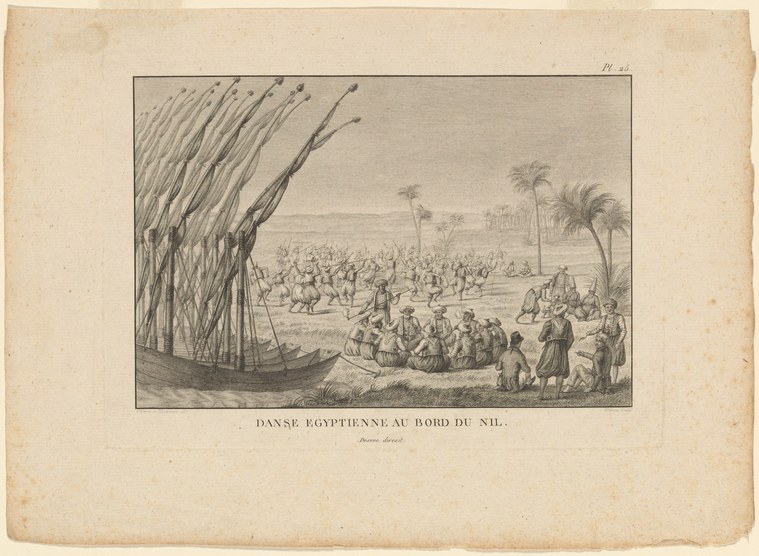
Danse Egyptienne au bord du Nil
Unknown artist
- Collection:
- Prints depicting dance
- Source:
- New York Public Library
- Rights:
- Public domain — free to use, share and adapt.
- Recorded as:
- Public Domain
This is rare documentary evidence of how European artists visualized non-Western dance in the pre-photographic era, and a window into the aesthetics of 18th-century travel literature and print culture. For historians of dance and empire, it illustrates both the European appetite for exotic movement and the visual conventions—landscape, distance, clustering—that colonized these bodies and practices in representation.
What you are looking at
A large sailing vessel with multiple masts and billowing sails dominates the left foreground of this engraving. Along the banks of the Nile, a substantial crowd of figures gathers in loose, animated groupings. The setting is recognizably Egyptian: palm trees rise in the middle distance, and the landscape is flat and open. The crowd exhibits varied postures—some figures stand, others bend or crouch, many appear to be in motion with arms raised or extended. The composition suggests a festive or ceremonial occasion, with the river itself as the stage and the moored vessel as a focal point that frames the scene. The engraving employs fine parallel lines and cross-hatching to create depth and shadow, with the sky rendered pale and atmospheric. The overall impression is one of energetic, uncontained movement across the shore.
The dancing
The figures are rendered at small scale across a wide landscape, making precise analysis of individual posture difficult, but the general vocabulary is clear: many dancers have raised arms, some in paired or group formations. Several figures appear to be in mid-leap or with weight shifted dramatically to one side. The poses suggest folk or popular movement rather than balletic formality—there is a quality of abandon and spontaneity. The crowd is distributed unevenly, with denser clusters near the vessel and looser groupings extending along the shore, suggesting waves of participation or call-and-response movement.
The dance depicted
The title identifies this as 'Egyptian Dance on the banks of the Nile.' The image almost certainly documents a real or imagined scene of popular or festive Egyptian dance as understood in 18th-century Europe. The presence of the Nile vessel, the palm trees, and the riverine setting confirm the geographical claim. The movement vocabulary—raised arms, apparent leaping, and loose group formation—is consistent with Egyptian folk or social dance, though the European engraver's eye and hand mediate the representation. This appears to be ethnographic or travel-literature imagery rather than a depiction of theatrical dance performed on European stages.
How it was made
This is an engraving, likely copper-plate, executed with fine burin lines and cross-hatching to create tonal depth and atmospheric perspective. The technique was standard for reproductive prints distributed with travel narratives and illustrated books in the 18th century, allowing wide circulation and multiple impressions. The meticulous handling of landscape and atmospheric effect suggests a skilled hand trained in formal European print-making tradition. The small, distant scale of the figures and the emphasis on landscape and colonial perspective mark this as product of the European print industry rather than Egyptian artistic practice.
About this work
This engraving presents a scene of Egyptian popular dance as witnessed and recorded by a European observer, most likely from a travel account or natural-history work of the 18th century. The work sits at the intersection of dance documentation, ethnographic representation, and European print culture—a moment when European artists and publishers were beginning to systematize visual knowledge of non-European customs and bodies. The engraving records both a dance practice (group celebration with raised arms and apparent leaping) and a colonial gaze: the dancers are rendered as inhabitants of a picturesque landscape rather than as practitioners of a structured tradition. The image is valuable not as an accurate choreographic record but as evidence of how Egyptian dance was imagined and circulated in European visual culture.
How to look at it
Attend to the composition: the artist has chosen to show the dance not as a formal or staged event, but as a spontaneous, widespread eruption of movement across the riverbank. The raised arms, the varied postures, and the way the figures are scattered and clustered create a sense of collective, uncontained energy. Notice also the framing device of the moored vessel on the left—it anchors the European viewer's perspective and suggests the commercial or colonial context in which this 'exotic' dance is being observed and recorded. The small scale of the dancers and the emphasis on the landscape are significant: the dance is embedded in geography and otherness rather than isolated as a formal subject.
The period
The 18th century saw an explosion of European travel narratives illustrated with engravings, driven by mercantile expansion, imperial exploration, and the Enlightenment appetite for systematic visual knowledge of the world. Dance, along with costume, architecture, and fauna, was a key subject in this documentary project. European artists and engravers working from sketches or written descriptions produced images of 'exotic' dances that served both as ethnographic record and as consumer spectacle. These images circulated in illustrated books, travel journals, and collected prints, shaping European understanding of non-Western cultures. Dance in this context was often rendered as a marker of cultural difference and primitivity—energetic, unrestrained, and embedded in landscape rather than in formal theatrical space.
Where it lives
The work is held in the New York Public Library's prints collection, catalogued as a dance-related print. It is likely an original impression or later printing from an 18th-century engraved plate, though the precise publication history and edition are not recorded.
Dance in this work
Questions about this work
Is this an accurate record of how Egyptian people danced?
This is a European engraving of Egyptian dance, not a documentation by Egyptian dancers or artists. It records the artist's interpretation and the conventions of 18th-century European print-making more reliably than it records Egyptian practice. The emphasis on landscape, the distant scale of the figures, and the style of rendering all reflect European aesthetic and commercial priorities.
What was this image used for?
Engravings like this were typically included in travel narratives, illustrated natural histories, or collected in print albums to satisfy European curiosity about distant lands and peoples. They served as both documentary and entertainment, circulating knowledge and exoticism together.
Why is the river and boat so prominent?
The Nile and the vessel establish the geographic and economic context: this is colonial or mercantile observation. The boat may represent European presence, or it anchors the scene in the geography that European readers would recognize as Egypt. The prominence of landscape over the dancers themselves is typical of 18th-century travel imagery.
More dance artwork





