49 works in this view — arrow keys or swipe to move between them.
Dance in Art
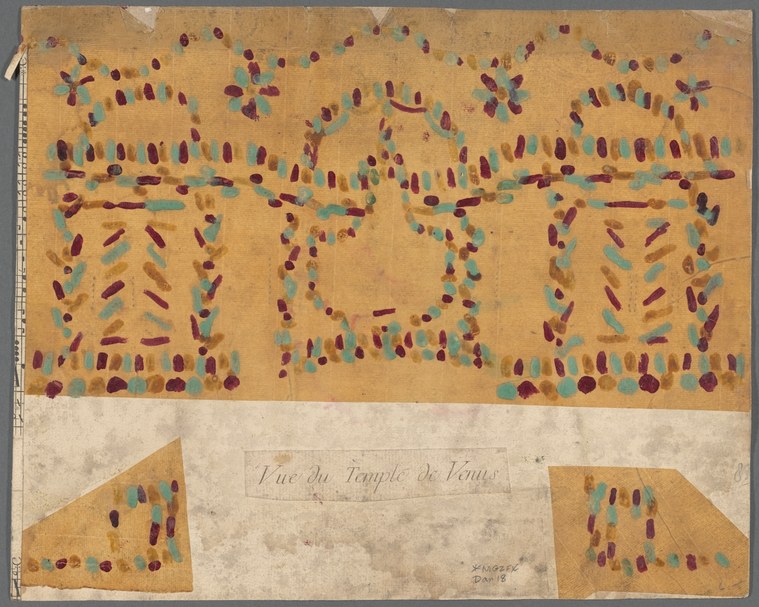
Vue du Temple de Venus
Unknown artist
- Collection:
- Prints depicting dance
- Source:
- New York Public Library
- Rights:
- Public domain — free to use, share and adapt.
- Recorded as:
- Public Domain
The work offers a rare glimpse at pre-notation attempts to record collective movement or spatial gathering, and raises questions about how dance and ceremony were visualized and preserved before the modern era. For historians, it documents a curiosity of neoclassical taste: the impulse to diagram, measure, and systematize even the ephemeral action of the body in space.
What you are looking at
This is a schematic architectural or dance notation diagram rather than a representational image. The composition shows a temple or building plan rendered in tan and cream, with a field of small red, purple, and teal marks arranged in precise geometric patterns across the upper two-thirds. The marks form concentric arcs, rectangular frames, and linear formations that suggest either the footprints of many figures or a notation system for recording movement. Below this main field are two triangular corner fragments showing similar mark patterns, and a cream-colored section at bottom center bearing the inscription "Vue du Temple de Venus" in period handwriting. The overall effect is of a technical diagram—possibly a floor plan showing dancer positions, or a documentary record of a ceremonial gathering—rather than a narrative scene. The marks are applied with apparent deliberation, suggesting a systematic attempt to record or represent spatial relationships rather than create a visually dramatic composition.
The dancing
The individual marks do not depict recognizable human figures with gesture or hold. Instead, the dense array of small ovals and dashes appears to represent multiple entities in abstract or symbolic form—possibly dancers reduced to notation, or worshippers at a sacred site rendered as unmarked presences. The arrangement shows formal organization: marks gather in radiating patterns and bounded areas, suggesting collective movement or processional grouping rather than the free spatial arrangement of individual performers. The lack of body-specific detail—no limbs, posture, or dynamic tension—indicates this is a record-keeping or planning document rather than a study of human movement.
The dance depicted
The title references a Temple of Venus and the use of "Vue" (view or representation) suggests this may document a ceremonial or ritual gathering, possibly with dance, but the notation system is too abstract to confirm a specific dance type or tradition. The systematic arrangement of marks might represent a processional formation, a sacred gathering, or a ballroom assembly seen from above—all possibilities compatible with the neoclassical period. Without clearer figural content or more specific visual markers of a known dance tradition (costume, instrument, architectural setting), the dance content cannot be reliably identified. The work appears to be more archival or architectural than performative.
How it was made
The object is a hand-colored paper document, likely an 18th-century drawing or print with watercolor or gouache applied. The tan ground and the precise but varied application of color suggest a working document rather than a finished decorative work—possibly a preliminary study, a technical record, or a copy of an original design. The technique of combining printed or drawn outlines with hand-applied color was common in architectural and technical documents of the period, and allowed rapid notation of spatial information across a large scale. The border-like framing and the formal inscription point toward a document prepared for preservation or reference rather than display.
About this work
This is an enigmatic schematic or notational diagram titled *Vue du Temple de Vénus* (View of the Temple of Venus), rendered as a dense pattern of colored marks on a tan ground. The marks may represent dancers, worshippers, or architectural elements arranged in geometric formations suggesting ceremony, procession, or gathering. Created as what appears to be an 18th-century hand-colored technical document, the work sits at the boundary between dance record, architectural plan, and ceremonial documentation—if it depicts dance at all. Its inclusion in a collection of prints about dance suggests its makers or later cataloguers recognized it as a record of movement or collective human action, even if the specific dance or ritual can no longer be securely identified.
How to look at it
Rather than scanning for narrative or emotion, the viewer should attend to the organizational logic of the marks: how they cluster, radiate, and form bounded areas. Look for any suggestions of hierarchy or sequence in the density and arrangement of the colored ovals. The two triangular fragments at bottom suggest this may be a corner detail or composite document. The careful preservation and inscription of the title indicate that this unusual image held meaning for its makers and later custodians, even if that meaning is now obscured.
The period
The neoclassical period saw a surge of interest in classical antiquity, including the religious practices and public gatherings of ancient Rome and Greece. The reference to a Temple of Venus reflects this antiquarian fascination. At the same time, the 18th century was developing new tools for recording and notating human action—from the geometric floor plans of ballroom dances to early attempts at movement notation. The style of handwriting and the watercolor technique suggest a document from the mid-to-late 18th century, a moment when both dance and classical scholarship were becoming subjects of systematic study.
Where it lives
The work is held in the New York Public Library's collection of prints depicting dance, catalogued as *Vue du Temple de Vénus* with no recorded artist, date, or medium. The presence of a spiral binding hole on the left edge suggests it was part of a bound album or folio. The style and technique point to an 18th-century European origin.
Questions about this work
Is this actually a dance?
It is unclear. The title and the collection in which it is held suggest the image was understood as a record of collective movement or a ceremonial gathering, but the schematic notation makes it impossible to confirm a specific dance or even confirm that dance is what is being depicted. It may be an architectural plan, a crowd diagram, or a movement notation of unknown purpose.
What do the colored marks represent?
The marks—small ovals in red, purple, and teal—are most likely meant to represent individual figures or positions, arranged in geometric formations. Whether they represent dancers, worshippers, audience members, or architectural elements is not determinable from the image alone. The systematic application suggests they were placed according to a plan or principle, not scattered randomly.
Why is there a temple of Venus?
The neoclassical period was deeply invested in evoking and reconstructing ancient Roman and Greek life. A Temple of Venus would have been a subject of scholarly and aesthetic interest, and the diagram may represent either an imagined reconstruction or a documentation of a modern ceremony staged as an homage to classical antiquity.
More dance artwork





