49 works in this view — arrow keys or swipe to move between them.
Dance in Art
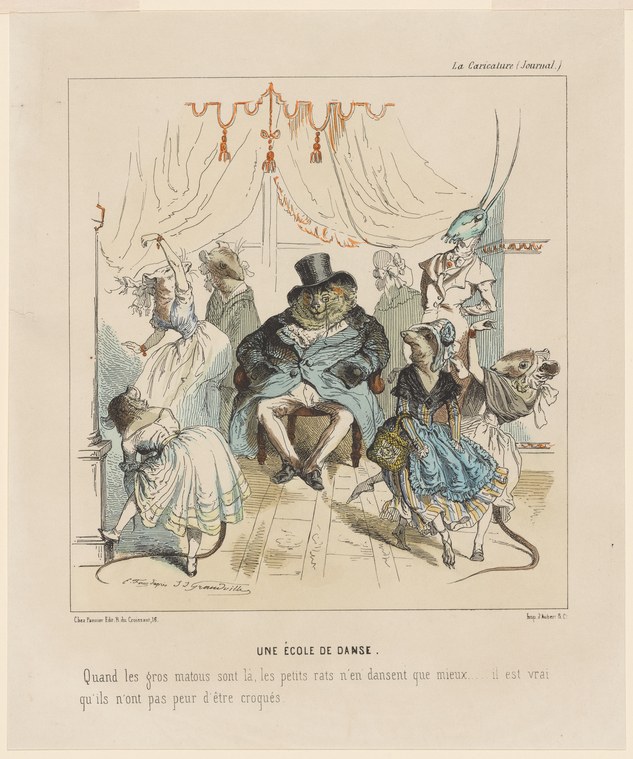
Une école de danse
Unknown artist
- Collection:
- Prints depicting dance
- Source:
- New York Public Library
- Rights:
- Public domain — free to use, share and adapt.
- Recorded as:
- Public Domain
This work documents the vernacular attitude toward formal dance instruction in 19th-century France, showing that dance was understood as both a marker of social aspiration and a target for ridicule. It reveals how dance featured in the visual humor of the period and what anxieties about class, control, and bodily propriety were associated with learning to dance.
What you are looking at
A caricatured dance lesson unfolds under an ornate tent or pavilion with draped fabric and decorative swags. At center sits a rotund, well-dressed male instructor in a top hat and blue coat, gesturing with his hands as he conducts the class. Around him, seven or eight figures in various states of awkwardness attempt to dance: women in light dresses with exaggerated postures, men in formal dress, and what appear to be rats or mice anthropomorphized as dancers. The figures are scattered across the composition in ungainly poses—some with arms raised at odd angles, others bent at extreme angles, one figure appearing to balance precariously. The setting is theatrical and absurd, rendered in colored engraving with fine cross-hatching and line work. The overall mood is one of ridicule and slapstick comedy rather than admiration for the dance itself.
The dancing
The bodies throughout display exaggerated, contorted postures far removed from ballroom technique. Most figures lack the upright carriage or controlled frame of formal dance instruction. Arms are thrown up wildly or held in awkward angles. One dancer appears to be doing a backward bend or fall. Another stands on one leg in an unstable pose. The central instructor gestures with both arms raised, apparently trying to correct or direct the chaos around him. The physical disarray suggests intentional mockery of dance itself rather than documentation of actual practice.
The dance depicted
This appears to be a satirical commentary on a dance lesson, likely mocking the pretensions of dance instruction or the incompetence of students. The title 'Une école de danse' (A Dance School) is reinforced by the French caption, which translates roughly to: "When the big cats are away, the little rats dare not dance for fear of being crunched." This suggests a moral or social commentary using dance as metaphor. The specific dance form cannot be identified with confidence, as the figures are deliberately portrayed as maladroit rather than executing recognizable steps or holds. The scene may reference ballroom or salon dancing based on the formal dress and indoor setting, but the exaggeration makes identification impossible.
How it was made
This is a hand-colored engraving, likely from the 19th century, executed in fine lines with careful cross-hatching for shading and depth. The technique allows for precise detail in costume and facial caricature while maintaining the satirical tone through distorted proportions. The colored hand-tinting (visible in the blue coat, pale dresses, and flesh tones) was applied after printing and indicates a popular print intended for a broad middle-class audience. The style and subject matter are consistent with French satirical periodicals of the 1840s–1860s.
About this work
This is a caricatural engraving mocking a ballroom dance lesson, presenting the scene as chaos and absurdity rather than refined instruction. The artist uses exaggeration, contortion, and the intrusion of anthropomorphized animals to ridicule both pretentious dance instruction and the social aspirations it represents. The work belongs in a dance archive not as documentation of actual dance practice, but as evidence of how dance was perceived in popular culture—as a subject for satire, social commentary, and comedy.
How to look at it
Attend first to the central figure of the instructor and the chaos radiating outward from him. Notice how the artist has distorted every body into an awkward, unstable posture—none of the dancers have the upright carriage or balanced frame of actual ballroom dance. Look at the faces for expressions of strain or foolishness. The ornate pavilion frames the absurdity: the elegant setting contrasts sharply with the incompetent or monstrous bodies within it. The inclusion of animal-like figures (particularly visible on the right) suggests that this is not realistic instruction but a fantasy or moral lesson.
The artist
The print is unsigned in the visible portion, and the catalogue record does not attribute it. The style, technique, and composition are consistent with French satirical prints of the mid-19th century, when periodicals like *La Caricature* and *Le Charivari* employed artists to comment on social life through distorted, exaggerated imagery. Without further research, the artist cannot be named with confidence.
The period
In the early-to-mid 19th century, ballroom dancing was undergoing formalization and codification, with dance instruction becoming a commercialized practice for the aspirational middle classes. Simultaneously, satirical prints flourished as a form of social commentary, often targeting the vanities and pretensions of the bourgeoisie. Dance instruction—as a marker of gentility, self-improvement, and social climbing—was a natural subject for satire. This print exemplifies the genre of moral caricature in which social practices are depicted as ridiculous or dangerous.
Where it lives
The work is held in the New York Public Library's collection of prints depicting dance. The source record offers minimal detail; the print is catalogued only by title and subject, with no artist attribution, date, or medium recorded in the accessible metadata.
Dance in this work
Questions about this work
Is this a real dance class or a fictional scene?
This is a satirical fantasy. The contorted bodies, apparent animal-dancers, and overall absurdity make clear that the artist intended mockery rather than documentation. The caption reinforces the moral fable aspect. It may be inspired by actual dance instruction, but it exaggerates ruthlessly for comic and social effect.
What dance form is being taught here?
The formal dress, indoor setting, and orchestral pavilion suggest ballroom dancing or salon dance, likely a waltz, quadrille, or cotillion. However, the artist's exaggeration makes it impossible to identify any specific steps or holds. The point of the print is to ridicule the practice of formal dance instruction itself, not to document a particular style.
Who made this print and when?
The artist is not named in the surviving catalogue information. The style, technique, and subject matter are consistent with French satirical prints from the 1840s–1860s, but without further research or documentation, the precise date and attribution remain uncertain.
What is the French caption saying?
The caption translates roughly as: "When the big cats are away, the little rats dare not dance for fear of being crunched." It is a moral observation—possibly about authority and obedience, or about social hierarchy and transgression—using dance as the vehicle for the joke.
More dance artwork





