49 works in this view — arrow keys or swipe to move between them.
Dance in Art
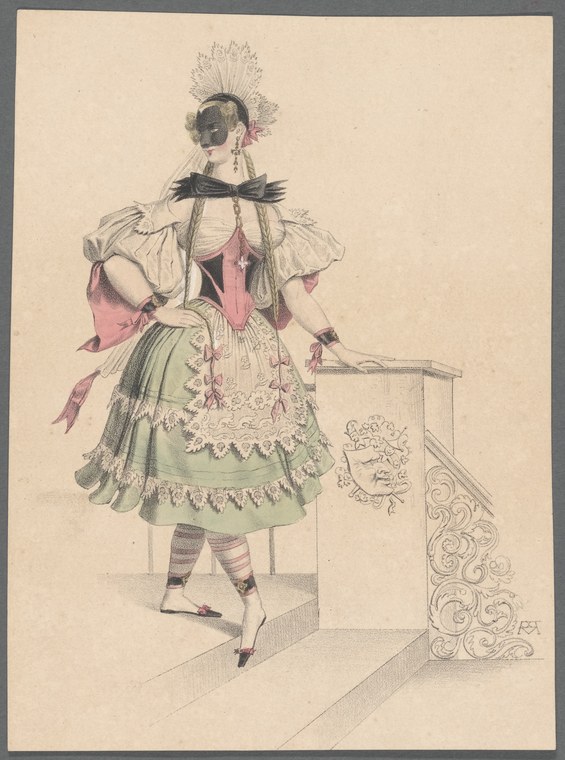
Masked female dancer
Unknown artist
- Collection:
- Prints depicting dance
- Source:
- New York Public Library
- Rights:
- Public domain — free to use, share and adapt.
- Recorded as:
- Public Domain
For theatre historians and costume scholars, this print is a direct visual record of late 19th-century stage costume and character design; it documents not just what was worn, but how costume was used to signal character type and theatrical genre. For dance historians, it illustrates the boundary between dance and theatrical entertainment in the period: while held in a dance collection, the figure demonstrates a theatrical pose and costume presentation that sits adjacent to rather than within formal dance practice.
What you are looking at
A single female figure stands in three-quarter view against a plain background, positioned as if on a stage or in a theatrical space suggested by the sketched architectural element (a decorative pillar or doorframe) to her right. She wears an elaborate costume of the 1880s–1890s: a fitted bodice in deep pink with short puffed sleeves, a white lace apron or skirt overlay, and a voluminous skirt in pale green with decorative lace trim at the hem. Her head is covered with an ornate headdress—a tall, feathered or fringed crown in pale tones—and she wears a black choker or ribbon at her neck. Striped stockings (pink and black or brown stripes) and dark shoes complete the outfit. The figure holds one arm extended to the side, palm upward in a graceful gesture, while the other hangs naturally. Her posture is upright and composed, with weight balanced on both feet. The entire composition is rendered in a delicate hand-coloured lithograph or similar print technique, with fine pen work in black and subtle watercolour washes in pink, green, and neutral tones. The style and execution suggest a theatrical costume study or character design from the late 19th century.
The dancing
The single dancer is shown in an upright, formal stance characteristic of theatrical display rather than active movement. Her extended arm—raised to shoulder height with an open palm—suggests a moment of presentation or greeting rather than a dynamic step. The weight appears evenly distributed, the frame open and frontal, the body composed and still. There is no suggestion of the close holds, partnering, or rapid footwork that would indicate ballroom, folk, or street dance. Instead, the pose and costume reading suggest a character presentation, possibly from musical theatre or pantomime.
The dance depicted
This appears to be a theatrical character or costume study rather than a documentation of a specific dance style or technique. The elaborate fancy-dress costume—the combination of ornate headdress, apron, striped stockings, and the theatrical setting—suggests a pantomime character, music hall performer, or character from operetta or comic theatre of the 1880s–1890s. The masked or heavily made-up face and the presentation pose are consistent with theatrical entertainment of the period rather than any formal dance idiom. The figure is likely costumed as a recognisable character type (possibly Harlequinade or commedia dell'arte inspired, given the mask-like treatment of the face), but without inscription or title the specific character and narrative context cannot be determined from the image alone.
How it was made
This is a hand-coloured lithograph or possibly a colour-printed lithograph with fine pen detail, characteristic of theatrical costume and character studies of the 1880s–1890s. The technique allowed for precise linework (visible in the architectural background and the delicate rendering of the lace) combined with subtle colour washes that define form and fabric without heaviness. This medium was ideal for theatrical publishing: relatively quick to produce, suitable for circulation as sheet prints or in periodicals, and capable of capturing both the graphic and the refined decorative qualities of stage costume. The small initials or mark visible in the lower right corner suggest a professional publishing house or printer's mark rather than a fine-art signature.
About this work
This is a theatrical character or costume study from the late 19th century, rendered as a hand-coloured print. It documents the appearance of a performer in stage dress—likely a character from pantomime, music hall, or operetta—captured in a formal, frontal pose that emphasises the costume rather than movement or dance technique. The figure's upright stance, extended arm, and ornate theatrical dress suggest a moment of character presentation or introduction on stage. While the work is held in a collection of dance-related prints, it functions primarily as a costume record rather than a documentation of dance practice. The work offers insight into the visual culture of late 19th-century theatre, the relationship between costume design and character identity, and the role of printed images in theatrical promotion and documentation.
How to look at it
Attend to the stillness and formality of the pose: this is not a moment of dance or action, but a presentation. Notice how the costume is designed to be read and admired as a complete visual object—the eye is drawn from the ornate headdress downward through the contrasting fabrics (the fitted bodice, the white apron, the full skirt) to the striped stockings. The extended arm and open palm are a theatrical gesture of presentation or introduction, not a dance movement. The sketched architectural element grounds the figure in a theatrical space, emphasising that this is a stage costume and character, not a naturalistic figure.
The period
This print dates from the height of the music hall and pantomime era in Britain (1880s–1890s), when theatrical costume studies and character prints were widely produced and circulated as promotional materials, souvenirs, and fashion references. The period saw the rise of the illustrated theatrical press and the commercial reproduction of costume designs. The elaborate costume and headdress reflect the ornamental aesthetic of late Victorian theatre, when spectacle and visual richness were central to popular entertainment. The formal, composed pose is typical of costume documentation of the era—theatrical performers posed in character for the camera or print, emphasising visual presentation over movement.
Where it lives
The work is held in the New York Public Library's Prints collection under the subject heading 'Prints depicting dance,' though it functions more precisely as a theatrical costume study. It appears to be part of a broader 19th-century archive of theatrical and entertainment prints.
Questions about this work
Is this a dancer or a theatrical character?
This is a theatrical character in costume, likely from pantomime or music hall entertainment. While the work is catalogued within dance collections, the figure is shown in a formal costume presentation pose rather than executing a dance or demonstrating dance technique. The ornate headdress, mask-like face treatment, and elaborate dress are consistent with theatrical character types of the 1880s–1890s.
What kind of print is this?
This is a hand-coloured lithograph or colour-printed lithograph, a technique well-suited to theatrical publishing in the 19th century. The fine pen detail combined with subtle watercolour washes allowed for both graphic clarity and decorative refinement, making such prints ideal for documenting and promoting stage costumes.
Can you identify the specific character or performance?
No. Without an inscription or title, the specific character and theatrical context cannot be determined. The mask-like face treatment and ornate costume suggest a pantomime or commedia dell'arte–inspired character, but further documentation would be needed to identify the precise role or performance.
More dance artwork





