49 works in this view — arrow keys or swipe to move between them.
Dance in Art
Opera extravagance
Unknown artist
- Collection:
- Prints depicting dance
- Source:
- New York Public Library
- Rights:
- Public domain — free to use, share and adapt.
- Recorded as:
- Public Domain
This print is a primary document of 19th-century theater culture and the role of opera and theatrical dance within elite social life. It shows how the design of the theater, the dress of the audience, and the framing of the stage all conspired to create a ritualized experience of aesthetic consumption. For dance historians, it illuminates the social context in which theatrical performance—including ballet and opera dance—took place, revealing the theater as a space where class, gender, and taste were performed as visibly as the art on stage.
What you are looking at
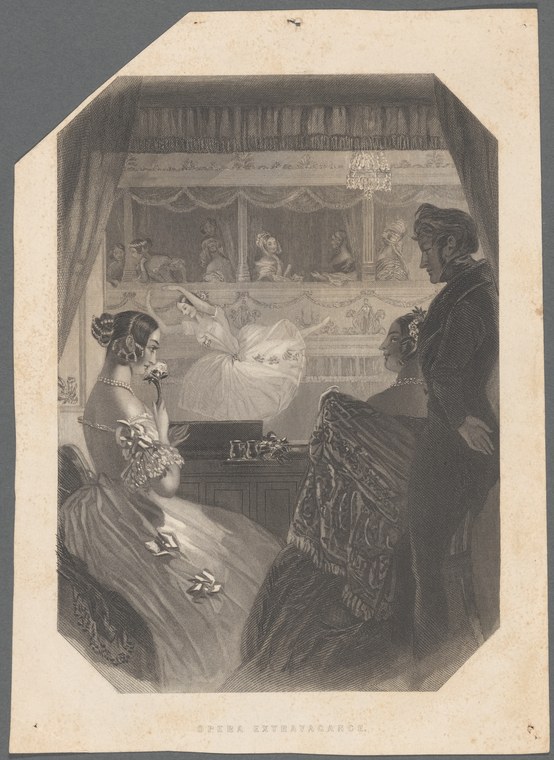
An engraved theatrical scene showing the interior of an opera house or grand theater, viewed from the audience's perspective. In the foreground, two fashionably dressed women sit in a box or loge, their backs to us—one holding an open parasol or fan—watching the performance unfolding on the distant stage. The stage itself, framed by heavy draped curtains and ornamental architecture, depicts a crowded scene of performers in formal dress. The contrast between the intimate, close foreground and the miniaturized stage creates a sense of theatrical depth; the composition emphasizes the ritualized viewing experience rather than the action on stage. The women's elegant costumes, with their characteristic silhouettes and layered fabrics, along with their posed attention, anchor the social spectacle as much as the theatrical one.
The dancing
The two women in the foreground are seated in profile or three-quarter view, their bodies angled toward the stage with the composed posture of theater-goers of the period. Their arms are relaxed or gently occupied—one woman holds her parasol or fan as a prop of attention. The figures on the distant stage are too small to discern individual movement, but they appear to be arranged in formal groupings consistent with theatrical blocking of the era. No direct dance movement or technical technique is visible in the principal figures.
The dance depicted
This is not primarily a depiction of dance technique or movement, but rather a scene of operatic or theatrical entertainment as social ritual. The title 'Opera extravagance' suggests the subject is the spectacle and excess of opera itself—the orchestrated display of performers, costumes, and stagecraft—rather than any specific choreography. The distant stage figures may include dancers, but they are rendered too small and schematic to identify any particular dance form or style. The image documents the theater as a space of social performance, where being seen watching is as important as what is being watched.
How it was made
This is an engraving or steel engraving, a medium well suited to rendering the fine architectural detail, dramatic contrasts of light and shadow, and elaborate costumes of a theater interior. The technique allows sharp definition of the decorative elements—the curtains, moldings, and the characters' dress—while the distance of the stage is conveyed through diminishment and softer focus. Engravings of this type were produced for serial publication or as standalone prints, making theatrical scenes accessible to the middle-class public who could not always attend live performances. The medium and subject matter suggest a mid-to-late 19th-century date and an audience of educated urbanites interested in cultural life.
About this work
This engraved print captures a moment of refined theatrical spectatorship, showing the opera house as a space of social display and aesthetic consumption. Rather than depicting dancers or choreography, it illustrates the culture of opera-going itself—the formal dress, the composed attention, the architectural splendor—as a form of performance. The work belongs in a gallery about dance because it documents how theatrical performance, including dance, was framed, consumed, and socially situated in the period, and because it shows the theater interior as the stage for both artistic and social display. The image is valuable not for what it teaches about dance technique but for what it reveals about dance as a social institution.
How to look at it
Attend first to the composition and the way it stages a spectator's point of view: we are positioned in the audience, watching watchers watch. Notice the meticulous rendering of the women's dress and the theater's architectural ornament, which ground the image in a specific historical moment and social world. Look at how the stage is miniaturized and distant, rendered almost dreamlike by its scale and the soft focus—this distance is not a technical limitation but a deliberate choice that emphasizes the audience's mediated relationship to the performance. The parasol or fan held by the foreground figure is a small detail, but it anchors attention: it is a prop of refined leisure, a tool for managing visibility and desire in the social space of the theater.
The period
The style and subject of this engraving place it in the mid-to-late 19th century, when opera and theatrical spectacle had reached a peak of cultural prestige and commercial expansion in Europe. This was the era of grand opera, elaborate stage machinery, and the full professionalization of ballet as an art form. Theaters were architectural monuments, designed to showcase both the performers and the audience; theater-going was a crucial social ritual for the urban bourgeoisie. Engravings and lithographs of theatrical scenes were widely produced and distributed, feeding a public appetite for images of cultural life and fashionable society. The print medium democratized access to imagery of theatrical grandeur, allowing those who might not attend in person to participate imaginatively in the spectacle.
Where it lives
The work is held in the NYPL's collection of prints depicting dance. It is catalogued under the title 'Opera extravagance' but with minimal attribution or dating information, typical of 19th-century popular prints whose makers and precise dates are often lost.
Questions about this work
Is this an image of dancers performing?
Not primarily. The stage figures are too distant and small to be read as dancers. The print is instead a view of the theater as a social and architectural space, with performers barely legible at a distance. It documents opera-going as a social ritual rather than theatrical performance as a technical or artistic matter.
What does 'extravagance' in the title refer to?
Likely the excess and spectacle of opera itself—the elaborate costumes, set design, orchestration, and staging that made grand opera a hallmark of 19th-century culture. It may also comment on the extravagance of theater-going as a form of display for the urban elite.
When and where was this made?
The style, fashion, and theater architecture suggest a mid-to-late 19th-century European print, probably French, German, or British. The precise date and printer are unknown, but the work was clearly produced for commercial distribution, likely as part of a series of theatrical or cultural scenes.
More dance artwork





