49 works in this view — arrow keys or swipe to move between them.
Dance in Art
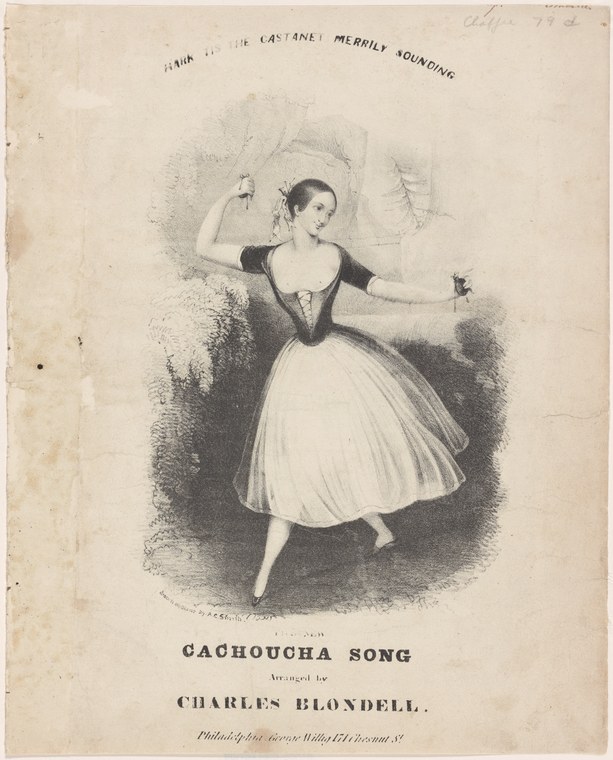
Hark, tis the castanet merrily sounding.: The new cachoucha [sic] song arranged by Charles Blondell
Unknown artist
- Collection:
- Prints depicting dance
- Source:
- New York Public Library
- Rights:
- Public domain — free to use, share and adapt.
- Recorded as:
- Public Domain
The print documents a transatlantic theatrical phenomenon that influenced both concert dance and social dancing in the 1830s–1850s. It shows how dance imagery was commodified and circulated to advertise musical arrangements and build star performers' visibility. For historians of 19th-century dance and its role in entertainment culture, this represents an invaluable record of costume, pose, and the kind of performers and moments that audiences wanted to see and own as prints.
What you are looking at
A young woman in a full white skirt and dark bodice is captured mid-dance against a softly rendered background. She stands in three-quarter view, her body twisted in a dynamic contrapposto, one arm raised and bent at the elbow while the other extends downward. Her face is turned toward the viewer with a composed, focused expression. The composition emphasizes her movement and elegance through careful use of light and shadow—her skirt is brightly rendered to catch the eye, while the background dissolves into soft charcoal tones that do not compete with the figure. A delicate prop or ornament appears in her raised hand. This is a theatrical portrait of a professional dancer, not a narrative scene, designed to showcase the grace and technical facility of the performer at a specific moment in the choreography.
The dancing
The dancer stands in a single elegant pose with weight shifted onto one leg, the supporting leg extended and appearing to carry full weight. Her upper body is rotated and lifted, with her raised arm bent at approximately 90 degrees and her lowered arm extending into the frame. The pose is balletic and controlled—this is not a snapshot of everyday movement but a carefully composed attitude. Her bodice is fitted and dark; her skirt is full and extends nearly to her ankles, consistent with mid-19th-century theatrical dress. No other figures are present; this is a study of a single dancer's form and deportment.
The dance depicted
The title identifies this as the Cachoucha, a Spanish-influenced theatrical dance that became fashionable in European ballrooms and on the concert stage in the early 19th century. The Cachoucha was typically danced by a single woman and was known for its rapid footwork, rhythmic use of castanets (referenced in the title's first line: "Hark, tis the castanet merrily sounding"), and animated character. The pose shown here—elevated, controlled, with arms in a balletic frame—suggests this is a moment of display or preparation rather than the vigorous footwork that defined the dance. The Cachoucha appears on theatrical playbills and in sheet music covers of the 1830s–1850s, and this print likely accompanies a popular instrumental arrangement by Charles Blondell, suggesting this was a widespread entertainment.
How it was made
This is a lithograph, evident from the tonal gradations, the characteristic lithographic crayon marks, and the treatment of light and shadow. The technique allowed for rapid reproduction and circulation—sheet music covers and theatrical publicity prints like this reached wide audiences at modest cost. The artist has employed careful tonal modeling to suggest volume and movement, using darker charcoal tones in the background to throw the figure forward. Lithography was the dominant medium for theatrical imagery, dance instruction, and music publishing in the 19th century, making works like this accessible to urban audiences and aspiring dancers.
About this work
This is a theatrical publicity print advertising a popular arrangement of the Cachoucha, a Spanish dance craze that swept European stages and ballrooms in the early 19th century. The lithograph depicts a professional dancer in performance dress, posed to showcase the elegance and technical control the dance required. Created by an unnamed lithographer after an arrangement by Charles Blondell, and published in Philadelphia, it is both a record of a specific musical-theatrical production and evidence of how dance imagery circulated through the commercial print market. The Cachoucha was danced by individual performers—often women—and was celebrated for its energy, rhythmic complexity, and theatrical presence; this image captures the posed elegance that complemented the kinetic excitement of the actual performance.
How to look at it
Note the moment the artist chose to freeze: not a moment of rapid footwork or percussive energy (when castanets would be most audible), but a posed, lifted attitude that emphasizes the dancer's form and control. This reflects the aesthetic priorities of the period—the beauty of the line, the composure of the face, the elegance of stillness—rather than action alone. The artist has also used the conventions of theatrical portraiture: three-quarter view, dramatic lighting that isolates the figure, neutral background, and a costume that is immediately identifiable. These choices tell us that theatrical dance was being presented to a public that valued visual beauty and refinement as much as kinetic excitement.
The artist
The artist is not identified in the catalogue record. Charles Blondell is credited as the arranger of the music, suggesting he was a composer or musician, not the visual artist. The lithograph was published in Philadelphia by Fiot, Vogt & Co., indicating it was produced and sold through a commercial music and print publishing house. Without further research, the creator of the image cannot be confirmed.
The period
The Cachoucha emerged as a fashionable dance in the 1820s–1830s, a period when Spanish and Latin American influences were entering European high culture. It coincided with the height of Romantic ballet and the rise of the virtuosic ballerina as a celebrity figure. Unlike the structured court dances of the 18th century, the Cachoucha was a performance piece—concert entertainment rather than participatory social dance—and it thrived in the age of the printed theatrical image. Sheet music covers and playbills featuring dancers became a standard commercial product, allowing audiences to take home images of favorite performers and popular works. This print is typical of how dance was marketed, consumed, and remembered in urban cultural life before photography.
Where it lives
This is a sheet music cover or theatrical publicity print from the New York Public Library's collection of prints depicting dance. It was published in Philadelphia, likely in the 1840s–1850s based on the style and the presence of a publisher's mark. The NYPL holds such prints as evidence of dance's place in 19th-century commercial culture and urban entertainment.
Dance in this work
Questions about this work
What is the Cachoucha?
The Cachoucha is a theatrical solo dance for women that became fashionable in Europe in the 1820s–1830s. It was Spanish-influenced and known for rapid footwork, rhythmic use of castanets, and dramatic presence. Unlike social dances of the period, it was performed on concert stages and at theatrical entertainments by professional dancers, making it a key part of early 19th-century entertainment culture.
Why is this print significant?
It shows how dance was advertised and sold to the public through sheet music covers and theatrical publicity. The image of the performer became a commodity in itself, allowing audiences to remember and promote their favorite dances and dancers. This print is evidence of how visual culture and dance were intertwined in the commercial world of 19th-century entertainment.
Who was Charles Blondell?
The catalogue record identifies him only as the arranger of the musical arrangement. He was likely a composer or musician working in Philadelphia in the mid-19th century, but further biographical details are not available from this source.
More dance artwork





