49 works in this view — arrow keys or swipe to move between them.
Dance in Art
Elssler, Fanny, Therese Elssler
Unknown artist
- Collection:
- Prints depicting dance
- Source:
- New York Public Library
- Rights:
- Public domain — free to use, share and adapt.
- Recorded as:
- Public Domain
Dance historians use such prints to understand how Romantic ballet was consumed and promoted — to see what the public saw and valued in its greatest performers. The image also documents the extraordinary fame and marketability of the Elssler sisters, whose tours and rivalry with Marie Taglioni shaped ballet's international expansion in this era. For art historians, it exemplifies the 19th-century genre of theatrical celebrity prints that functioned as an ancestor to modern celebrity photography and fan culture.
What you are looking at
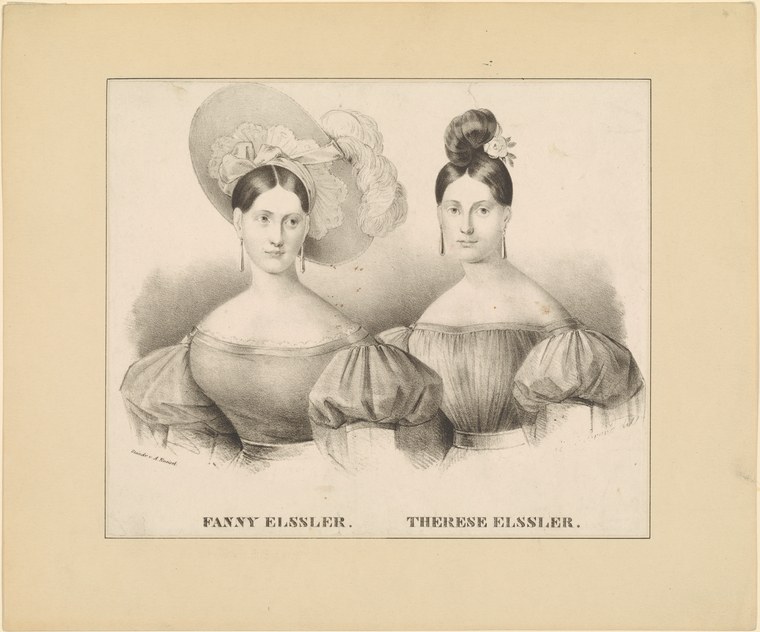
A lithograph or engraving portraying two young women in early 19th-century dress, identified by inscription as Fanny Elssler (left) and Therese Elssler (right). Both wear the fashionable off-shoulder gowns of the 1830s–1840s, with puffed sleeves and fitted bodices. Fanny wears an elaborate wide-brimmed bonnet adorned with ostrich plumes and ribbon; Therese's hair is styled up with a simple flower ornament. The composition is a formal double portrait in the convention of celebrity prints: the figures are shown from the waist up against a plain background, rendered in fine detail through careful shading. The women gaze directly outward with composed expressions, presenting themselves as objects of public admiration. The engraver's signature appears in the lower left corner, though it is not clearly legible in this reproduction.
The dancing
Both women are seated or positioned as if seated, presenting a static, frontal arrangement rather than a dynamic pose. Their shoulders are relaxed and squared toward the viewer; their arms rest naturally at their sides or in lap. There is no indication of dance movement, extension, or the physical tension that would characterize a dancer mid-performance. The posture is that of sitters for a formal portrait, not performers in action.
The dance depicted
This is not a depiction of dance in action. Fanny Elssler (1810–1884) was the most celebrated European ballerina of the 1830s–1840s, renowned for her role in *La Sylphide* and her tours across Europe and the Americas. Therese Elssler (1808–1891) was her sister and also a professional dancer. This print documents them as celebrities and public figures rather than capturing them dancing. It belongs to the large 19th-century market for theatrical celebrity prints — lithographs and engravings of famous performers produced for public consumption, sale, and display in homes and collecting albums. The image records their faces, fashion, and social status, not their art.
How it was made
This is a lithograph or engraving, executed in black ink with fine cross-hatching and stippling to create tonal modeling. The technique allows precise rendering of fabric texture, facial feature, and hair detail. The inscription in serif capitals below the figures is integral to the print, naming the subjects for a public audience. The work is unsigned by the artist (or the signature is illegible in reproduction). As a mass-produced print on paper, it was affordable and intended for wide circulation — the primary medium by which theatre-going public and those far from performance venues could possess images of famous dancers.
About this work
This is a 19th-century celebrity print of two famous ballet dancers presented as fashionable public figures rather than performers. Fanny and Therese Elssler were among the most celebrated ballerinas of the Romantic era, and this engraving belongs to the extensive market for theatrical portraiture that flourished in the 1830s–1840s. The work is significant not as a document of dance technique or performance, but as evidence of how dancers were commodified, consumed, and imagined by the public during this period — their faces and fashion far more relevant than their artistry to the mass market. It sits at the intersection of celebrity culture, fashion history, and the popular graphic arts of the 19th century.
How to look at it
Observe the hair and costume in detail: the enormous bonnet and plumed ostrich feathers signal wealth and fashionable status. Note the off-shoulder neckline and puffed sleeve — hallmarks of Romantic-era fashion, contemporary with the era of *La Sylphide*. The two figures are differentiated by age and styling: Fanny (left) is presented more elaborately adorned, befitting her senior fame. The composition — frontal, symmetrical, static — is deliberately non-theatrical. There is no arabesque, no raised leg, no turnout. The print asks you to admire the women as objects of fashion and celebrity, not to imagine them dancing.
The artist
The artist is not recorded in the catalogue, and the signature in the lower left is not clearly legible in this reproduction. The work is one of numerous prints of Fanny Elssler issued by different publishers and engravers across Europe and North America during the height of her fame. Such prints were produced by commercial printing houses and distributed widely; individual engravers and lithographers are often now unattributed.
The period
In the 1830s–1840s, Romantic ballet was at its aesthetic and commercial apex. Marie Taglioni's *La Sylphide* (1832) and the cult of the ethereal, supernatural ballerina dominated European stages. Fanny Elssler rose to prominence partly as a rival to Taglioni, known for more earthy, sensual, and nationalistic (particularly Spanish and Italian) choreography. Both sisters toured internationally — Fanny's American tour of 1840–1842 was a sensation. The mass production of celebrity prints paralleled the growth of a consumer culture and leisure class for whom owning images of famous performers was a form of fashionable collecting. Lithography, perfected in the early 19th century, made such prints cheaper and more accessible than engravings alone.
Where it lives
This print is held in the New York Public Library's collection of prints depicting dance. It is a mass-produced work with no known provenance beyond its acquisition by the Library; such prints were inexpensive and widely distributed, and individual copies rarely retain detailed ownership histories.
Questions about this work
Why is this print in a dance gallery if it doesn't show dance?
Because dance history includes how dancers were marketed, consumed, and imagined by the public. Fanny Elssler was a legendary ballerina, and this image of her was circulated to millions in her lifetime. Understanding how celebrities were packaged and sold — what the public wanted to see in them — is as important as studying the choreography itself.
Who was Fanny Elssler?
Fanny Elssler (1810–1884) was an Austrian dancer who rivaled Marie Taglioni as the greatest ballerina of the Romantic era. She excelled in Spanish and Italian character dances and toured Europe and the Americas to enormous acclaim. Her 1840–1842 tour of the United States was a cultural event. She retired in the 1850s and was long regarded as the embodiment of Romantic ballet's dramatic and sensual power.
What is lithography, and why was it used for this print?
Lithography is a printing technique based on the principle that oil and water do not mix. An image is drawn on a limestone block, which is then chemically treated so that ink adheres only to the drawn lines. The result can be printed hundreds or thousands of times. Lithography was cheaper and faster than hand engraving, allowing publishers to produce celebrity prints in large quantities for mass sale — a hugely profitable business in the 1830s–1840s.
What can you learn about Romantic ballet from this image?
The fashionable dress, the emphasis on the face and beauty, and the celebrity cult around these women all reflect how Romantic ballet was marketed to a wealthy, leisure-class audience. The absence of any balletic pose or costume suggests that for the general public, the dancer's celebrity as a fashionable woman mattered more than her technique.
More dance artwork





