49 works in this view — arrow keys or swipe to move between them.
Dance in Art
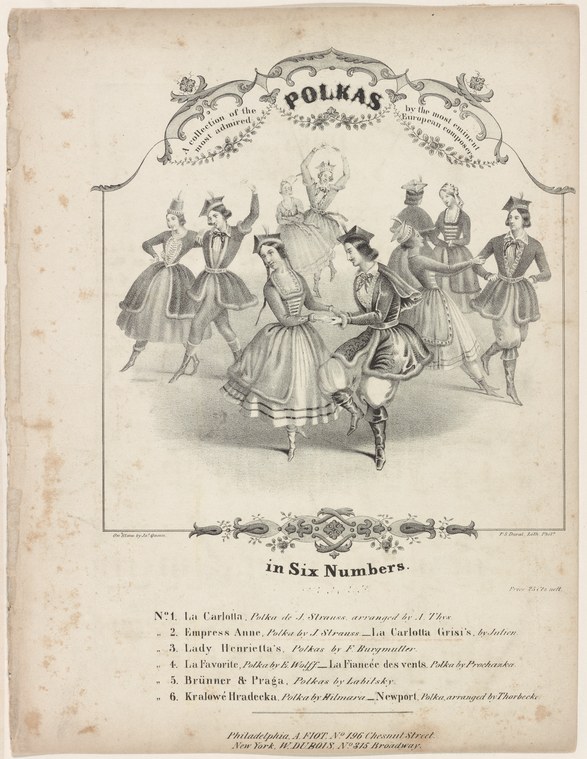
A collection of the most admired polkas by the most eminent European composers in six Numbers: No. 2. Empress Anne, polka by J. Strauss. - La Carlotta Grisi's, by Julien
Unknown artist
- Collection:
- Prints depicting dance
- Source:
- New York Public Library
- Rights:
- Public domain — free to use, share and adapt.
- Recorded as:
- Public Domain
The polka was one of the first dances to move rapidly from folk origin to international urban fashion, and this image is direct evidence of how it looked in American parlors when it was at peak popularity. For historians of dance and of 19th-century social practice, it documents both the technique (the characteristic hop and turn) and the cultural meaning of the dance—its association with European sophistication, its role as a display of genteel femininity and masculine deportment, and its function in courtship and social cohesion.
What you are looking at
This is a title page for a published collection of polkas arranged for piano or small ensemble, showing six fashionably dressed dancers in mid-performance against a plain background. The figures wear mid-19th-century ball gowns and formal attire: the women in full skirts with fitted bodices, the men in tailcoats and military-style jackets. The composition is a lively group scene with dancers arranged in a loose circle or conversational cluster, their bodies angled toward each other in the social intimacy of the ballroom. The central pair appear to be actively dancing—the woman's skirt is caught mid-swirl—while the surrounding figures gesture animatedly, some with arms raised or extended in the expansive movements characteristic of the period. The engraving uses fine cross-hatching to suggest fabric texture and shadow, creating volume in the skirts and definition in the faces. A decorative banner reading "POLKAS" anchors the composition at top, with publisher information at the bottom identifying this as a New York and Philadelphia publication, likely from the 1840s–1850s.
The dancing
The dancers are shown in the open, upright posture of social ballroom dancing: spines extended, arms either in hold with partners or raised expressively. The central woman's body twists in a dynamic turn, her full skirt flaring outward—a signature moment of the polka. The surrounding figures show the social aspect of the dance: some engage with partners in the characteristic close frame of the period, while others gesture conversationally or prepare to join. All maintain the formal uprightness and restraint expected of genteel dancing, without the extremes of later theatrical styles. The engraver has captured the moment of energetic motion within socially sanctioned bounds.
The dance depicted
This is a polka collection, a social ballroom dance that reached peak popularity in Europe and America during the 1840s–1850s. The polka originated in Bohemia in the 1830s and quickly became a dominant feature of middle- and upper-class balls, where it replaced or competed with older forms like the quadrille and waltz. Unlike the waltz's three-beat rotation, the polka is danced in a lively 2/4 time with a characteristic hop-step pattern that gives it a bouncing, sprightly character—visible here in the way the central figure's body catches mid-turn. The collection credits arrangements to named European composers including J. Strauss (likely Johann Strauss I, the "Waltz King"), emphasizing the work's legitimacy and Continental prestige for an American audience. The presence of a "Carlotta Grisi" polka (likely after the celebrated Italian ballerina) suggests that even theatrical celebrities lent their names to fashionable dances of the moment.
How it was made
This is a steel or copper engraving, a technique that allowed for mass reproduction and wide distribution through print shops in major cities. The fine detail and precise cross-hatching are hallmarks of engraved title pages for published sheet music; this was the standard format for disseminating dance music to the drawing rooms and parlors of the literate middle class. The technique's capacity for fine tonal gradation allowed the engraver to render fabric texture and facial expression with considerable delicacy. Such title pages served simultaneously as frontispiece, advertisement, and documentation of fashionable dance practice—they were visual arguments for both the legitimacy of the music and the social standing of those who would perform it.
About this work
This is a commercial title page for a published collection of polka arrangements, one of many such collections produced in America during the height of the polka craze of the 1840s–1850s. It functions as both a musical artifact and a document of ballroom fashion and social dancing practice. The engraving captures not just the dance itself but the moment of its performance in a genteel setting—the social intimacy, the fashionable dress, the mixed-gender sociability that made the polka such a powerful phenomenon. For dance historians, it provides precise visual evidence of how the polka was actually danced and dressed in the Anglophone ballroom, information that complements the musical scores themselves.
How to look at it
Attend to the central woman's body: the engraver has frozen her in a moment of turn, with the skirt flaring and the body twisting—this is not a static pose but a moment of action, the characteristic hop-step pivot that defines the polka. Notice also the social composition: the dancers are arranged as if you have stepped into a ballroom and caught sight of a group mid-performance. The formal dress and the contained, upright posture mark this as genteel social dancing, not theatrical spectacle. Compare this image with images of waltzing from the same period: here the movement is more contained and bouncy, less flowing and rotational.
The artist
The artist is not recorded. The engraving is unsigned or the signature is not legible in available reproductions. It was produced for commercial music publishing, a trade that employed hundreds of journeyman engravers in major American cities during the mid-19th century. Such title pages were often the work of specialist firms that handled book and sheet-music illustration; the quality of the engraving and the clarity of the composition suggest competent professional work, though not the signature style of a known master.
The period
The polka arrived in Paris around 1840 and swept through European capitals and then America in the mid-1840s. By 1844–1850, it had become the dominant social dance among the urban bourgeoisie, spawning polka crazes, polka fashion (shorter skirts to permit the vigorous hopping), and a flood of published polka music. This collection represents the commercial music industry's rapid response to the craze: publishers issued hundreds of titled polkas, often named after famous dancers, singers, or social celebrities to market them. The presence of J. Strauss's name signals the intersection of folk music, Viennese tradition, and commercial cosmopolitanism. By the 1850s, the polka was beginning to fade from fashion, but not before it had reshaped ideas about what women's bodies could do in public—the energetic hop and swirl of the polka required a different posture and movement vocabulary than the gliding waltz.
Where it lives
This engraving is held in the New York Public Library's collection of prints depicting dance. It is one of hundreds of mid-19th-century dance title pages, most of which are uncatalogued or minimally catalogued, held in institutional collections across North America. Such prints are primary sources for the history of popular dance practice and were produced for commercial circulation rather than as fine art.
Dance in this work
Questions about this work
What is a polka?
The polka is a lively ballroom dance in 2/4 time, originating in Bohemia in the 1830s and reaching peak popularity in Europe and America during the 1840s–1850s. It is danced by couples in a closed hold, with a characteristic bouncy, hopping step and rapid rotations. Unlike the waltz, which is smooth and flowing, the polka is energetic and percussive, with the dancers' bodies moving up and down as well as around.
Who were Carlotta Grisi and J. Strauss?
Carlotta Grisi was an Italian prima ballerina of the Romantic era, famous for her roles in *Giselle* and other works; her name was used to market a polka to give it theatrical prestige. J. Strauss likely refers to Johann Strauss I (1804–1849), the "Waltz King," a Viennese composer famous for orchestral dance music. The crediting of named composers to individual polkas was a marketing strategy to lend legitimacy and Continental sophistication to American publications.
What does this print tell us about 19th-century ballroom dance?
It shows that social dancing was a mixed-gender, carefully choreographed activity performed in formal dress within genteel social settings. The upright posture, the formal attire, and the controlled energy reflect period norms about respectability, social class, and the display of femininity and masculinity. The print also documents the rapid commercialization of dance: music publishers, engravers, and retailers all profited from the polka craze by issuing collections, title pages, and instructional materials.
More dance artwork





