49 works in this view — arrow keys or swipe to move between them.
Dance in Art
Selected plates from Les maîtres de l'affiche
Unknown artist
- Collection:
- Prints depicting dance
- Source:
- New York Public Library
- Rights:
- Public domain — free to use, share and adapt.
- Recorded as:
- Public Domain
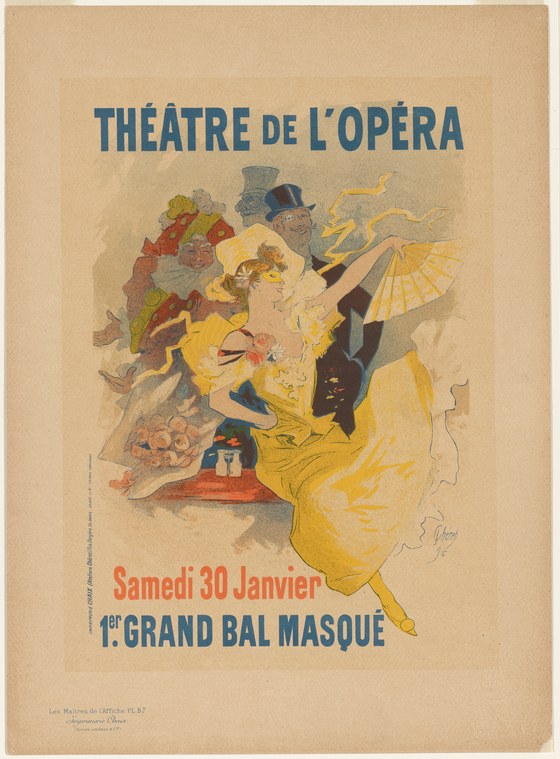
This work documents the masquerade ball as a social institution at the Paris Opéra and reveals what Belle Époque society valued about the experience: transgression through masking, the display of fashion and femininity, and social mixing under the umbrella of theatrical glamour. It also shows how the visual language of poster art was used to sell dance events to an urban, fashionable audience, making it invaluable for understanding both the social history of ballroom culture and the history of graphic design as public communication.
What you are looking at
A chromolithographic poster announces a masquerade ball at the Théâtre de l'Opéra on Saturday, 30 January. The composition is dominated by a young woman in elaborate yellow ball gown and mask, positioned in the foreground with her body turned three-quarters toward the viewer. She holds a large yellow fan and gestures expressively with her free hand raised. Behind her stands a man in formal black tailcoat and top hat, similarly masked. The background suggests the opulence of the opera house, with hints of a chandelier and architectural detail rendered in softer tones. The palette emphasizes the striking yellow of the woman's dress against warmer earth tones and muted blues, creating visual depth and theatrical glamour. The figures occupy only the upper half of the composition, leaving substantial space below that emphasizes the poster's functional design for public display.
The dancing
The woman's posture is one of animated social display rather than formal dance technique: her torso is gently curved, weight appears to rest on one leg while the other is relaxed, and her raised arm gestures with the palm open in a gesture of invitation or revelation. The man stands more rigidly upright, his body angled to frame rather than engage with the woman. Neither figure is in a closed or open dance hold; instead they are positioned as social companions at a gathering, their relationship conveyed through proximity and gaze rather than physical contact. The woman's expression and gesture suggest vivacity and social confidence rather than the formal carriage required for ballroom dance technique.
The dance depicted
This is not a depiction of specific dance technique but rather of the social context in which dance occurred—the masquerade ball. The 'bal masqué' was a prominent social form in late 19th-century Paris, particularly associated with the opera house, where masked guests gathered for dancing, flirtation, and social transgression. The poster advertises the event rather than illustrating a particular dance style. The presence of masks, formal evening dress, and the theatrical setting all point to the context of social ballroom dance (waltz, quadrille, or similar partnered forms), but no specific choreography is legible from the figures' positioning.
How it was made
This is a chromolithographic poster, a mass-production technique that allowed for vibrant color and subtle tonal gradations while remaining economical for public display. The process involved multiple stone matrices, each applying a different color in sequence. The composition shows the graphic sophistication of Belle Époque poster design: bold legible type at top and bottom, a central figural composition that draws the eye, and careful use of color to create hierarchy and visual interest. The technique and its circulation as a public poster mean this work was designed to reach a broad audience of Parisian theatergoers and fashionable society, advertising a specific social event.
About this work
This is a chromolithographic poster advertising the Grand Masquerade Ball at the Paris Opéra, likely from the 1890s or early 1900s, the golden age of such events at the opera house. The work captures the atmosphere and visual spectacle of the 'bal masqué' rather than choreographic detail: the masking, formal evening wear, and theatrical setting that defined the occasion. It represents the intersection of dance, fashion, and society in the Belle Époque, a moment when the opera house functioned as the center of Parisian social life and when the masquerade ball was a fixture of the social calendar.
The poster's significance lies not in documenting how people danced but in revealing how a society understood and marketed the experience of dancing—as social performance, erotic possibility, transgression through masking, and luxury consumption. The image belongs in a gallery of dance because it documents the context and social meaning of ballroom dance in a specific time and place, showing us what mattered about the event to those who marketed it.
How to look at it
Attend first to the woman's expression and gesture: the slight smile, the raised arm, the turned head suggest not the formal comportment of ballroom dance technique but rather social confidence and erotic appeal—what the poster is actually selling to potential attendees. Notice how the masking and formal dress work together: the mask permits anonymity and transgression, while the elaborate gown and accessories signal luxury and status. The composition places the woman in the visual foreground and the man in the background, reflecting the cultural fact that the masquerade ball was marketed to men as an opportunity to encounter desirable women in a space of theatrical fantasy. The soft focus and color gradations create atmosphere and elegance rather than documentary clarity.
The artist
The work is a plate from *Les maîtres de l'affiche* (*The Masters of the Poster*), a periodical publication (1896–1900) that collected and celebrated poster design as an art form. The series featured works by leading poster artists of the Belle Époque, including Toulouse-Lautrec, Mucha, and Chéret. The specific artist of this plate is not recorded in the catalogue, but the style suggests it is by or in the manner of one of the leading poster studios of 1890s Paris. The attribution and date remain to be established.
The period
The masquerade ball at the Opéra was a signature social institution of late 19th-century Paris, reaching its peak popularity in the 1890s and early 1900s. These events were occasions for social performance, where masks allowed a temporary suspension of ordinary social constraint. Ballroom dance—particularly the waltz and quadrille—was the central activity, though the masquerade also emphasized social mixing, flirtation, and theatrical display. The popularity of such events in visual culture, from poster art to painting to photography, reflects their importance to Parisian identity and the culture of leisured society. Simultaneously, poster art itself was experiencing a renaissance: after the innovations of Chéret in the 1870s and 1880s, poster design was recognized as a legitimate art form, and the publication of *Les maîtres de l'affiche* from 1896 onward canonized it as such. This poster sits at the intersection of those two enthusiasms.
Where it lives
This work is a chromolithographic poster plate from *Les maîtres de l'affiche*, a periodical publication assembled from 1896 to 1900 that reproduced original poster designs as art objects for collectors. It is held in the New York Public Library's collection of prints depicting dance. The plate format and color technique indicate this is a mass-produced work designed for public circulation and collection.
Dance in this work
Questions about this work
Is this depicting an actual dance, or just a party?
The poster advertises a masquerade ball, which was primarily a social event centered on ballroom dancing—waltzes, quadrilles, and other partnered social dances of the period. However, the poster does not illustrate specific dance technique or choreography. Instead, it captures the theatrical and social context in which dancing occurred, emphasizing the masking, formal dress, and erotic possibility of the occasion. For a dancer studying ballroom history, the poster is valuable for understanding the cultural milieu and social presentation surrounding the dance, rather than for technical detail.
What is 'Les maîtres de l'affiche'?
*Les maîtres de l'affiche* (The Masters of the Poster) was a French periodical publication that ran from 1896 to 1900, collecting and reproducing outstanding poster designs as colored lithographic plates. It functioned as both a celebration of poster art as a legitimate art form and as a collector's publication for the fashionable public. The periodical helped establish poster design—previously considered mere commercial ephemera—as worthy of serious artistic attention and aesthetic appreciation.
When was this poster made?
The catalogue record does not provide a specific date. However, the work appears in *Les maîtres de l'affiche*, which was published between 1896 and 1900. The style and typography are consistent with 1890s Belle Époque design. A precise date would require consulting the original periodical or additional archival sources.
Who was the artist?
The specific artist is not recorded in the catalogue. The work is catalogued as a plate from *Les maîtres de l'affiche*, but the original poster designer's name is not provided. Identification would require research into the periodical's original issues or additional documentation from the holding collection.
More dance artwork





