49 works in this view — arrow keys or swipe to move between them.
Dance in Art
Eskimos
Unknown artist
- Collection:
- Prints depicting dance
- Source:
- New York Public Library
- Rights:
- Public domain — free to use, share and adapt.
- Recorded as:
- Public Domain
This drawing is one of the few surviving visual records of Arctic indigenous dance practice from the nineteenth century, executed by someone who either observed the practice directly or had access to reliable ethnographic sources. For historians of indigenous Arctic culture and dance, the work provides tangible evidence of how movement, dress, and celebration were integrated in these communities—and how they were interpreted by contemporary European and American eyes.
What you are looking at
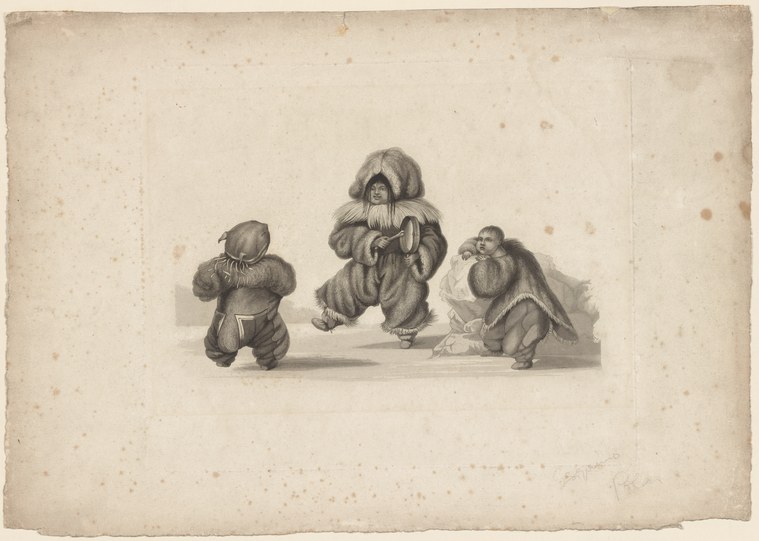
Three figures in heavy, voluminous fur garments are depicted in a moment of animated social interaction, likely dancing or celebrating. The central figure stands taller, arms raised in an expressive gesture of movement or exuberance, while the two flanking figures are in lower, more crouched postures. All wear what appear to be traditional Arctic or subarctic garments—thickly layered furs and parkas rendered in soft graphite tones. The setting is minimal and undefined, a pale ground that emphasizes the figures without context or landscape. The drawing technique creates strong shadows and depth in the heavy clothing, giving the garments substantial presence. The composition suggests a moment of communal joy or festive movement rather than formal dance instruction.
The dancing
The three figures are not in any ballroom or theatrical hold. The central dancer's raised arms and elevated posture suggest upward momentum or celebratory gesture; the lateral stance and posture of the flanking figures suggest they are responding to or participating in the same moment. All three bear weight low—knees bent or body compressed—which creates a sense of springy movement or grounded footwork. The artist has paid close attention to how heavy furs move and compress with the body's action, and the poses suggest contact and shared rhythm rather than individual display.
The dance depicted
This appears to document a social or celebratory dance form from Inuit or other Arctic peoples. The title 'Eskimos' reflects nineteenth-century nomenclature. The heavy fur dress, the grounded postures, the sense of communal participation, and the expressive but non-balletic gestures all point toward indigenous Arctic dance tradition—likely a form of celebration, social gathering, or ceremonial movement. Without more precise documentation, the specific dance cannot be named, but the image suggests movement practices tied to Arctic clothing and physical culture. The artist may have observed or documented these practices from life or from ethnographic sources circulating in the nineteenth century.
How it was made
This is a graphite drawing on paper, executed with considerable skill in rendering fabric texture and human form. The soft modeling of the heavy garments shows understanding of weight and fold, achieved through careful tonal gradation. The paper has aged to a cream tone with visible foxing. The technique suggests a work made for circulation as a study, preparatory sketch, or finished drawing intended for print reproduction or academic/ethnographic documentation rather than a unique object for exhibition. The scale and presentation indicate this may belong to a series of costume or ethnographic studies.
About this work
This drawing documents a moment of social or celebratory dance among Arctic peoples, rendered with ethnographic interest in dress and movement. The work captures three figures in heavy fur garments in animated, grounded postures that suggest communal rather than formalized movement practice. It belongs to the nineteenth-century tradition of ethnographic drawing—a period when European and American artists and naturalists were documenting the physical practices, dress, and rituals of non-European peoples. The work sits at the intersection of ethnographic documentation and dance imagery, offering evidence of how Arctic movement practices were observed and represented by outside artists.
How to look at it
Attend to the postures of the three figures: none stands upright or formally posed. All three are compressed downward, suggesting a movement vocabulary based on flexion and springy, grounded action rather than extension or lift. The raised arms of the central figure and the responsive postures of the others suggest synchronized or call-and-response movement. Look at how the artist has rendered the fur garments—they move and compress with the bodies beneath them, suggesting the artist understood how clothing affects the visibility and execution of movement. The moment frozen is one of apparent joy or exuberance, not a formal position.
The period
The nineteenth century saw intense European and American ethnographic interest in indigenous peoples worldwide, driven by colonial expansion, natural history museums, and the emerging disciplines of anthropology and ethnography. Arctic peoples were subjects of particular fascination due to perceived 'remoteness' and distinctive material culture. Drawings and prints of indigenous dress, ritual, and daily life circulated widely in scientific publications, museums, and popular prints. At the same time, Arctic exploration narratives and accounts were bestsellers, creating demand for visual documentation. This work likely falls within that context—a drawing made to circulate among educated audiences interested in Arctic ethnography, natural history, or travel.
Where it lives
The work is held in the New York Public Library's collection of prints depicting dance. It is catalogued as a historical print or drawing with minimal attribution or dating information, reflecting the often incomplete provenance of nineteenth-century ethnographic materials.
Questions about this work
What dance is this?
The specific dance form is not identified in the catalogue record or visible from iconography or costume alone. The image suggests a social or celebratory movement practice of Inuit or other Arctic peoples, documented in the nineteenth century. Without additional context about the source of the drawing or the artist's observations, a precise identification is not possible.
Who made this drawing?
The artist is not recorded. The work may be attributed to an explorer, naturalist, military officer, or professional artist who visited Arctic regions or worked from ethnographic sources. The style and technique are consistent with nineteenth-century naturalistic drawing practice.
Why is the title 'Eskimos'?
'Eskimo' was the standard English term in the nineteenth century for Inuit and related Arctic peoples, though it is now considered outdated and is not used by the communities themselves. The title reflects the historical period and ethnographic context in which the drawing was made and circulated.
How does the heavy clothing affect what we can see of the dance?
The fur garments obscure detail of footwork and lower-body movement, but they also show clearly how the body underneath is moving—through compression, shift of weight, and flexion. The artist has paid attention to how clothing moves with the body, suggesting they understood the movement was continuous and energetic despite the visual concealment of the limbs.
More dance artwork





