49 works in this view — arrow keys or swipe to move between them.
Dance in Art
Marie Taglioni
Unknown artist
- Collection:
- Prints depicting dance
- Source:
- New York Public Library
- Rights:
- Public domain — free to use, share and adapt.
- Recorded as:
- Public Domain
Taglioni transformed what was possible in ballet technique and aesthetic, pioneering the Romantic style and the use of the pointe shoe as a foundational element of movement vocabulary. This portrait—one of many mass-produced prints in circulation—shows how her image as a public personality was as carefully constructed and marketed as her stage presence, making her perhaps the first modern celebrity dancer.
What you are looking at
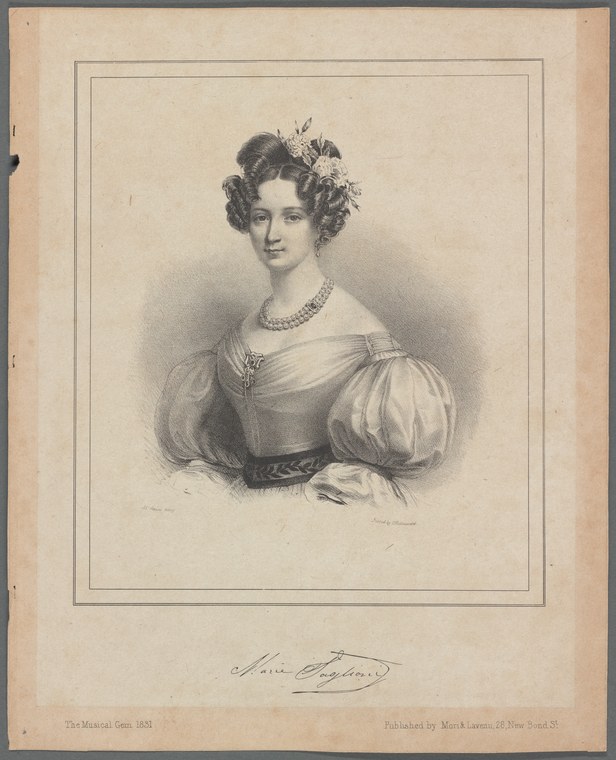
A half-length portrait of a young woman in the refined style of 1830s society engraving. She is shown from the waist up, turned slightly to the viewer's right, with her head inclined gracefully in three-quarter view. Her dark hair is swept back from her face and crowned with a circlet or wreath of delicate flowering sprigs—a motif associated with Romantic-era portraiture. She wears a low-necked, off-shoulder white gown with characteristic puffed sleeves gathered at the arm. A pearl necklace encircles her throat. The background is plain and neutral, rendered with subtle shading to create depth and focus attention on the figure. The whole composition is framed by a simple rectangular border. The work is executed as a lithograph or engraving in black and white, with fine tonal gradations creating a luminous, ethereal quality to the fabric and skin.
The dancing
The woman's posture is one of composed elegance: her shoulders are relaxed and squared, her neck elongated, her gaze directed downward and away in the contemplative manner favored by Romantic portraiture. Her arms are not visible below the lower edge of the frame, making assessment of balletic alignment impossible. The positioning suggests a model posed for a formal society portrait rather than a figure caught in movement. There is no indication of dance frame, hold, or active weight-bearing in the visible portion.
The dance depicted
This is a portrait of Marie Taglioni, the most celebrated ballet dancer of the Romantic era, but the image itself does not depict her dancing. It is a formal portrait in the society engraving tradition, showing her as a public figure of prominence rather than performing. Taglioni revolutionized theatrical-ballet through her technique and the development of Romantic ballet vocabulary, but this work documents her as a fashionable personality of 1830s Europe rather than capturing her art.
How it was made
This is a lithograph or engraving, executed in black ink on paper, showing the refined technique characteristic of 1830s commercial portraiture. The work demonstrates the precision of line and subtle tonal modeling that made such prints the dominant medium for circulating images of celebrities and society figures in the Romantic period. The fineness of the execution and the presence of a publisher's mark indicate this was a commercial production for a broad educated audience—such prints were collected, framed, and traded widely among the middle and upper classes.
About this work
Marie Taglioni (1804–1884) was the most influential ballet dancer of the nineteenth century, the muse of Romantic ballet and the embodiment of the ethereal, weightless dancing style that defined the era. This engraved portrait, published by N. Maurin in Paris, captures her as a fashionable public figure of the 1830s—not in performance, but as a celebrity whose image had market value independent of her dancing. The work belongs in a dance gallery not because it shows dance, but because it documents the cultural status of the Romantic ballet dancer and the way that dancers themselves, not only their art, became commodities of visual circulation and celebrity.
How to look at it
Attend to the styling choices: the Romantic-era hair treatment with its wreath of flowers, the fashionable low-necked white gown, the pearl jewelry. These elements position Taglioni not as a stage performer but as a society woman of refinement, suggesting how dancers of her stature occupied an ambiguous position between theatrical entertainer and aristocratic social equal. The downcast, contemplative gaze is a convention of Romantic female portraiture, suggesting interiority and sensibility rather than the confidence of public performance.
The artist
The artist is not recorded in the catalogue. The publisher, N. Maurin (likely Nicolaas Maurin, a French lithographer and publisher active in Paris in the 1830s), was a significant figure in the production of theatrical and society portraiture. Such portraits were often made from live sittings or existing paintings and were reproduced by skilled commercial workshops rather than being considered works of fine art by individual masters.
The period
The 1830s saw the full flowering of Romantic ballet and the emergence of the first modern celebrity culture around dancers. Marie Taglioni's performance of *La Sylphide* in 1832 revolutionized ballet and established the ethereal, supernatural feminine ideal that shaped aesthetic values across the visual arts. At the same time, lithography and commercial engraving had made portraiture of public figures widely accessible and profitable. Prints of celebrated performers—singers, actors, dancers—were collected as evidence of one's cultural sophistication and awareness of contemporary taste.
Where it lives
This work is held as part of the New York Public Library's collection of prints depicting dance. The notation "Printed by N. Maurin, 35 Rue Ricali, N. St." indicates it is a commercial print from a Paris publisher, one of an edition made for public sale.
Questions about this work
Is this a picture of Marie Taglioni actually dancing?
No. This is a formal society portrait, not a depiction of dance. It shows Taglioni as a fashionable public figure of the 1830s—how she presented herself in social space, not how she performed on stage. Such prints were business products: images of celebrities for those who could not see them perform.
Who was Marie Taglioni?
Taglioni (1804–1884) was a Swedish-Italian dancer and the most celebrated performer of Romantic ballet. She created the role of the Sylph in *La Sylphide* (1832), which defined the era's aesthetic of weightlessness and supernatural femininity. She was the first dancer to be treated as an international superstar with the global celebrity apparatus that entailed.
Why would someone collect a portrait print like this?
In the 1830s, printed portraits of celebrated performers were fashion items—evidence of cultural awareness and taste. Theater-goers and art collectors would buy prints of favorite singers, actors, and dancers, frame them, and display them in homes and studios. They also served as mementos and evidence of one's attendance at significant cultural moments.
More dance artwork





