49 works in this view — arrow keys or swipe to move between them.
Dance in Art
John D'Auban, ballet master
Unknown artist
- Collection:
- Prints depicting dance
- Source:
- New York Public Library
- Rights:
- Public domain — free to use, share and adapt.
- Recorded as:
- Public Domain
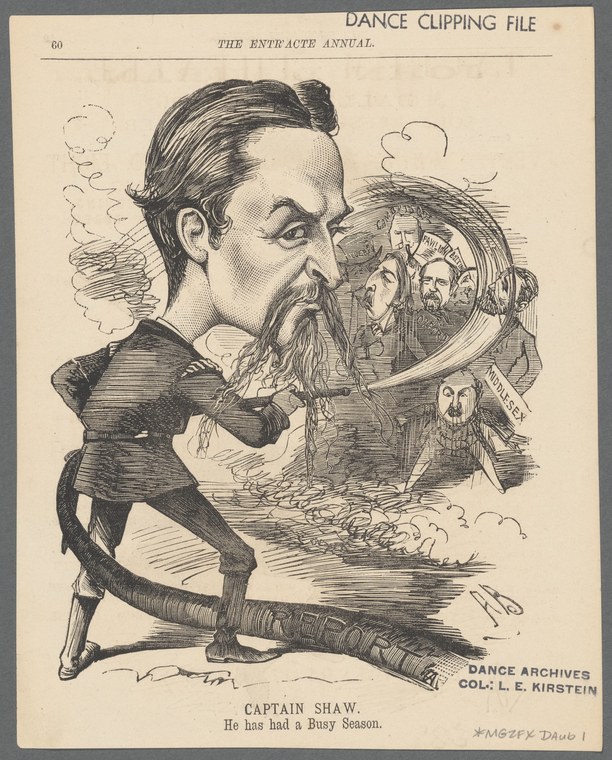
The work demonstrates how theatrical and music-hall figures of the late 19th century were documented and mocked through caricature, and suggests that Captain Shaw held sufficient cultural prominence to merit such treatment. Its presence in the Lincoln Kirstein Dance Archive indicates the broad scope of that collection beyond formal dance documentation to include theatrical performance culture more widely.
What you are looking at
A caricature portrait of a bearded man in Victorian dress dominates the left side of the composition. His distinctive facial features—prominent nose, full beard, and intense expression—are rendered in bold pen strokes that emphasize his physiognomy. He wears a dark jacket with a white collar. Emerging from or contained within his beard is a nautical scene: several smaller male figures in period dress appear to stand within a circular frame that resembles a ship's porthole or globe, as though his beard itself is a vessel containing them. The inscription below reads "CAPTAIN SHAW. He has had a Busy Season." The print is labeled "DANCE CLIPPING FILE" at the top and "DANCE ARCHIVES COL: L. E. KIRSTEIN" and "*M267X Dance I" in the margins, indicating its cataloging history. The technique is pen and ink engraving or etching, typical of Victorian satirical journalism.
The dancing
The secondary figures visible within the circular frame are rendered as small standing figures in contemporary dress, appearing static and posed rather than in motion. They are not shown dancing or in any recognizable dance frame or hold. Their positioning suggests they are the subject of commentary rather than performers. The primary figure's static, confrontational pose and the careful attention to facial features rather than bodily movement indicate this is portraiture-based satire rather than dance documentation.
The dance depicted
This print does not depict dance. The inscription and composition suggest it is a satirical portrait of a theatrical or public figure named Captain Shaw, with the embedded figures within the circular frame likely referencing his achievements or activities during "a busy season." While filed in a dance archive, the work is a caricature employing naval and comedic visual metaphors rather than a representation of dance performance or instruction.
How it was made
This is a wood engraving or steel engraving, executed in fine pen linework characteristic of 19th-century satirical prints. The technique allowed for mass circulation through commercial printing, and the sharp, detailed rendering of physiognomy and costume suggests this was produced for newspaper or magazine reproduction—likely from the theatrical or music hall world given its cataloging. The archival marks indicate it was collected as part of a research archive on dance and performance.
About this work
This is a Victorian-era caricature portrait of Captain Shaw, a figure apparently notable enough to warrant satirical treatment in the press. The print employs a nautical conceit, containing smaller figures within a circular frame that emerges from the subject's beard—a visual pun on his "busy season" of activities. Though cataloged within a dance archive, the work is primarily a character study in the tradition of Victorian satirical journalism rather than a documentation of dance.
How to look at it
The viewer should attend to the visual pun that structures the entire composition: the contained figures within the circular frame that emerges from Shaw's beard. This reflects Victorian satirical convention, which often embedded commentary or absurdist visual jokes within portraiture. The intensity of the facial rendering contrasts with the smaller, less detailed figures, emphasizing that this is a portrait study rather than a scene of action or performance.
The artist
The artist is not recorded. The print carries the marks of professional satirical or theatrical journalism of the Victorian era, executed in the style of mid-to-late 19th-century comic periodicals such as *Vanity Fair* or similar publications that specialized in caricatures of public figures.
The period
This work dates to the era when theatrical caricature was a major form of commentary on public performers and entertainment figures. The late Victorian music hall and theater world generated enormous amounts of such satirical imagery, which was widely circulated through print media. The reference to a "busy season" suggests Shaw was active in live performance or theatrical management during a notable period.
Where it lives
This print is held in the Lincoln Kirstein Dance Archive at the New York Public Library, part of a "Dance Clipping File" that collected printed materials related to theatrical and dance performance. The archival marks suggest it was accessioned as part of a broad-based collection of performance documentation rather than as a work centrally focused on dance.
Questions about this work
Is this actually about dance?
Not directly. While cataloged in a dance archive, the print is a satirical portrait of a theatrical figure named Captain Shaw. It was likely collected because Shaw was involved in entertainment or performance, but the work itself is caricature rather than dance documentation.
Who was Captain Shaw?
The inscription notes he had a "busy season," suggesting he was an active performer or theater manager in the late Victorian era, prominent enough to warrant satirical treatment. Further identification would require additional archival research beyond what the print itself provides.
What does the circular frame with figures inside his beard mean?
This is a Victorian satirical visual conceit—a pun suggesting his activities or achievements are contained within or emerge from his public persona. The nautical imagery may reference his name or a specific theatrical production or theme associated with him.
More dance artwork





