49 works in this view — arrow keys or swipe to move between them.
Dance in Art
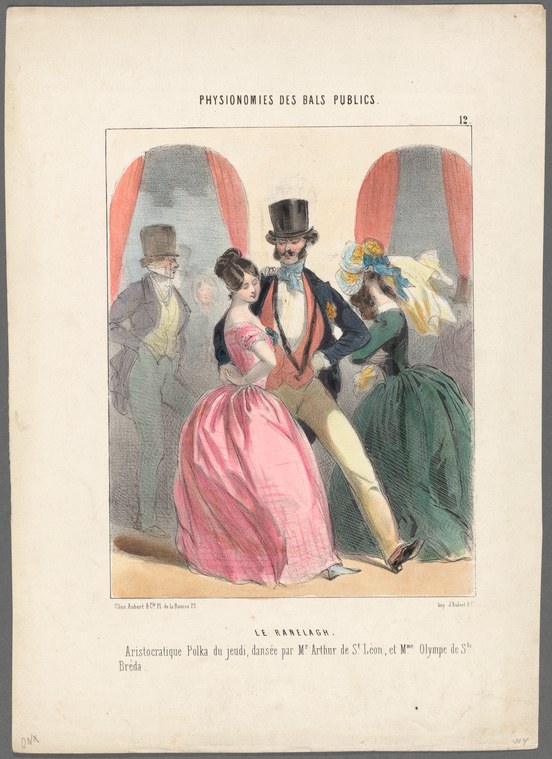
Le Ranelagh: aristocratique polka du jeudi, dansée par Mr. Arthur de St. Léon, et Mme. Olympe de Ste. Bréda
Unknown artist
- Collection:
- Prints depicting dance
- Source:
- New York Public Library
- Rights:
- Public domain — free to use, share and adapt.
- Recorded as:
- Public Domain
This is evidence of the polka's adoption into elite Parisian society and the role of named performers—especially the celebrated ballet master Arthur de Saint-Léon—in legitimizing and shaping how new social dances were performed. The image shows the polka not as abstract pattern but as embodied movement: the specific frame, the rotation, the weight, the skirts. For historians of ballroom dance, it is documentation of technique and fashion at a moment when the polka was still novel enough to be noteworthy.
What you are looking at
This hand-colored lithograph depicts a moment from a Thursday aristocratic polka at Ranelagh, an 18th-century pleasure garden in Chelsea. Five figures occupy a theatrical interior defined by a deep perspective with draped red curtains framing the scene. At the center, a man in black tailcoat and top hat leads a woman in a billowing pink ball gown; she is caught mid-turn, her skirts swept up in a full arc. To the left, a second couple in darker dress watches or waits to dance. At the right, a third woman in green leans back in an animated pose, her fan raised. The setting is intimate and social rather than staged; the lighting is soft and diffuse, characteristic of interior gas-lit venues of the period. The composition emphasizes the swirl and energy of the dance through the women's voluminous skirts and the implied movement of the central couple.
The dancing
The lead dancers hold in a closed ballroom frame typical of mid-19th-century polka: the man's right hand guides the woman's waist, his left hand extended to hers at shoulder height. The woman's weight is momentarily suspended as she turns, her body angled into the rotation. The secondary figures adopt poses of social participation—watching, conversing, preparing to dance—rather than executing steps. The composition and body angles suggest the characteristic bouncy, energetic quality of polka, with the central woman's lifted skirts and the man's forward posture suggesting rapid rhythmic movement.
The dance depicted
This is a polka, specifically a named polka performed at Ranelagh by the notable dancers Arthur de Saint-Léon and Olympe de Ste. Bréda. The title specifies it as an "aristocratic polka of Thursday"—referring to the fashionable Thursday assemblies at Ranelagh. The polka was a relatively new phenomenon when this image was created (the dance originated in Bohemia around 1830 and spread rapidly through Europe in the 1840s-1850s); this image documents how it was performed in elite Parisian society with a closed ballroom hold, rotating movement, and the characteristic springy action of the dance. The involvement of named professional dancers suggests this may commemorate a specific performance or may be a theatrical adaptation of the social dance.
How it was made
This is a hand-colored lithograph, a mass-production technique that allowed for rapid dissemination of dance imagery to a broad audience. The soft crayon work visible in the shading of the figures and the translucent quality of the clothing are characteristic of lithography's capabilities. The application of watercolor or gouache by hand afterward adds the pink and green of the women's gowns and the subtle flesh tones. This technique—cheaper and faster than engraving—made such images affordable to the middle and upper-middle classes who attended Ranelagh and wished to own mementos of fashionable dances and dancers.
About this work
This lithograph is a social document of elite dance fashion in mid-19th-century Paris, recording both the polka as a performance and as a society dance. It names two professional dancers—Saint-Léon and Ste. Bréda—whose involvement suggests this was either a performance that was then adapted into fashionable ballroom practice, or an artistic record of how the dance was performed in aristocratic circles. The image sits at the intersection of theatrical dance imagery and ballroom documentation, showing how new dances moved from stage to salon. The polka itself represents a moment of rapid cultural change, when a Central European folk dance became the dominant social dance of the European aristocracy and bourgeoisie within a single generation.
How to look at it
The viewer should attend to the moment of rotation in the central couple's dance: the woman is caught in mid-turn, her skirts lifted and spread, which allows the artist to show both the volume of her gown and the energetic, bouncing quality of the polka step. The contrast between the animated central dancers and the more static social figures at the margins shows how polka was performed—as entertainment for onlookers as much as participation by the dancers. The setting, the dress, and the presence of named performers all point to this being a representation of elite, fashionable dance-making: this is not folk polka but polka as it had been adopted, refined, and performed for aristocratic and bourgeois audiences.
The artist
The artist is not recorded in the catalogue. The work is attributed to a lithographic publishing house in Paris (the imprint reads "Imp. Aubert & Cie à Charnier"), suggesting it was produced as a commercial print for the fashionable market. Such prints were typically produced by studios rather than individual named artists, and the hand-coloring may have been done by specialized colorists rather than the original lithographer. This was standard practice for popular dance and fashion prints of the period.
The period
The polka emerged from Bohemia around 1830 and reached Paris by 1840, where it rapidly became the dominant social and theatrical dance. By the 1850s—the likely date of this image—polka mania was at its height; the dance appeared on stage at the Paris Opéra, in ballrooms, in street dances, and in popular imagery. Arthur de Saint-Léon was a major figure in this dissemination: a renowned ballet master, choreographer, and dancer (1821–1870), he performed polkas and other social dances in theatrical contexts, lending them artistic legitimacy. The appearance of a named performance at a specific location (Ranelagh) suggests this print may commemorate an actual event or a notable performance that was then memorialized for collectors. The 1840s–1850s were the era when lithography transformed the circulation of dance imagery, making it cheap and plentiful enough to be a form of mass entertainment and social aspiration.
Where it lives
This print is held in the New York Public Library's collection of prints depicting dance. It belongs to a broad class of 19th-century commercial dance imagery produced for and consumed by the educated urban classes, commemorating specific performances, dancers, and fashionable dances.
Dance in this work
Questions about this work
Who were Saint-Léon and Ste. Bréda?
Arthur de Saint-Léon (1821–1870) was a celebrated French ballet master, choreographer, and dancer who was instrumental in popularizing the polka and other social dances in theatrical contexts in Paris. He later became maître de ballet at the Opéra. Olympe de Ste. Bréda was a dancer of the period, less documented in histories than Saint-Léon but evidently notable enough to be named on this print. Their joint performance of the polka suggests they were collaborators in bringing the dance to elite audiences.
What is Ranelagh?
Ranelagh was an 18th-century pleasure garden and assembly venue in Chelsea, London, famous for its grand rotunda and fashionable social events. By the 19th century, it had declined but remained a venue for assemblies and dances. The print's reference to "Ranelagh" and "Thursday" suggests a regular weekly assembly where fashionable dances were performed and society gathered.
Why was the polka such a big deal?
The polka was revolutionary as a social dance because it was the first dance to combine rapid rotation, a closed hold, and energetic springy movement—quite different from the stately quadrilles and cotillions that had dominated ballrooms. It also originated outside the aristocracy (in Bohemia), yet spread upward into elite circles, democratizing dance in the process. By the 1850s, polka mania had swept Europe, and dances competed to perform it on stage and in salons.
Is this a record of an actual performance or an imagined scene?
Likely both. The print names specific dancers and a specific venue (Ranelagh, Thursday), which suggests it commemorates an actual performance or a series of performances. However, as a commercial lithograph, it was also designed to be sold to consumers who wanted to own images of fashionable dances and dancers, so the scene may be idealized or composite rather than documentary. The theatrical framing and the presence of spectators suggest it may show the polka as performed for an audience rather than in a private ballroom.
More dance artwork





