49 works in this view — arrow keys or swipe to move between them.
Dance in Art
Miss Emma D'Auban, Drury Lane Theatre, 3rd season
Unknown artist
- Collection:
- Prints depicting dance
- Source:
- New York Public Library
- Rights:
- Public domain — free to use, share and adapt.
- Recorded as:
- Public Domain
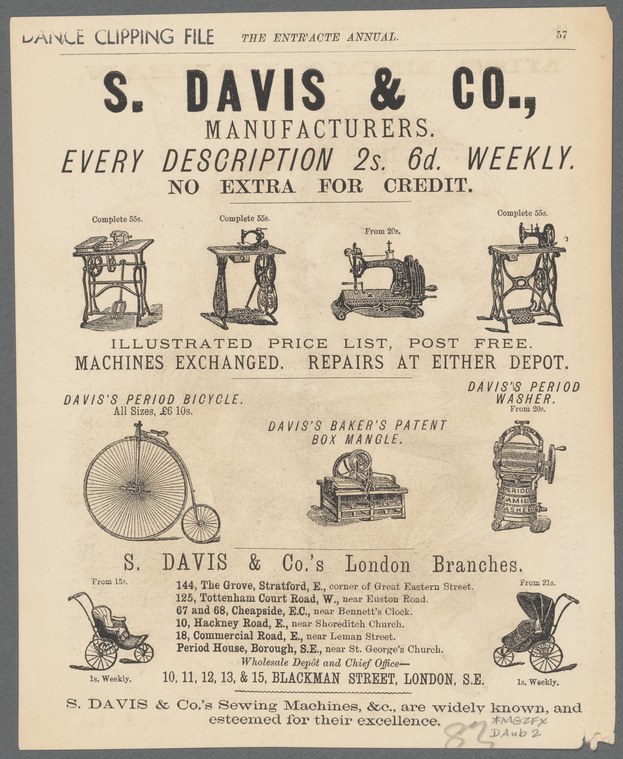
This advertisement is valuable as evidence of how commercial products were marketed to theatre workers and the theatre-going public in the late 19th century, and demonstrates the relationship between theatrical publications and consumer culture. It also documents the specific domestic technologies available to middle-class households of the period.
What you are looking at
This is a commercial advertisement for S. Davis & Co., manufacturers of sewing machines and related domestic equipment, published in The Entr'acte Annual—a theatre industry periodical. The page displays six different sewing machine models in technical line drawings arranged in two rows, each labeled with price and specifications. Below these are illustrations of three additional products: a period bicycle, a baker's patent box mangle, and a period washer. The lower half of the page lists the company's London branch locations with addresses. The layout is typical of late 19th-century trade advertising: dense with product images and text, designed for utility and information rather than aesthetic appeal. The typography is heavy and utilitarian, emphasizing "EVERY DESCRIPTION 2s. 6d. WEEKLY. NO EXTRA FOR CREDIT" as the primary sales pitch.
The dancing
There are no human figures in this image. The page contains only mechanical equipment rendered in technical line drawings showing the external profiles and key mechanical features of industrial machinery.
The dance depicted
This image contains no dance content. It is a commercial advertisement for domestic and industrial machinery.
How it was made
This is a wood engraving or letterpress line block reproduction, evidenced by the crisp black lines, uniform weight, and the characteristic appearance of relief printing. The technique allowed for high-volume reproduction in periodicals, making it economical for trade advertising in weekly and annual publications. The halftone-free line work is typical of commercial printing in the 1880s–1890s, before photomechanical processes became standard.
About this work
This is a trade advertisement from The Entr'acte Annual, a British theatre and entertainment industry publication. S. Davis & Co. used the pages of this theatrical annual to reach theatre workers and middle-class readers with disposable income. The company's placement in a theatre annual (rather than a domestic magazine) suggests they were marketing to a specific socioeconomic cohort: theatre staff, performers, and the theatre-going public with the means to purchase sewing machines on installment ("2s. 6d. WEEKLY. NO EXTRA FOR CREDIT"). The inclusion of the company's multiple London addresses indicates they were a substantial retail operation with significant market presence.
How to look at it
Examine the technical precision of the machinery drawings and the careful labeling of prices and specifications—this reflects the commercial purpose of the advertisement. Note the prominent placement of payment terms ("NO EXTRA FOR CREDIT") at the top, suggesting the primary audience was buyers who could not pay in full. The company's listing of multiple London branch locations at the bottom reflects their retail strategy and market reach.
The artist
The image is unsigned and attributed to the printing house or publisher rather than an individual artist. Commercial wood engravers of this period were typically anonymous craftspeople working for printing establishments. The quality and style suggest professional commercial work from an established London printer.
The period
The Entr'acte Annual was published during the height of the Victorian music-hall and theatre boom in Britain (1870s–1890s). This was a period of rapid industrialization and the proliferation of domestic machinery marketed to middle and upper-middle-class households. The availability of installment payment ("NO EXTRA FOR CREDIT") reflects the emergence of consumer credit culture in the late 19th century. Sewing machines in particular had become aspirational domestic goods by this period, transforming both domestic labour and the garment trades. The pages of the Entr'acte Annual mixed theatrical editorial with such commercial content, making the annual a valuable advertising platform.
Where it lives
This page is part of The Entr'acte Annual, a British theatre industry publication held in the Prints collection at the New York Public Library. It functions within the annual as commercial advertising material aimed at readers of theatre and entertainment content.
Questions about this work
Why is this advertisement in The Entr'acte Annual, a theatre publication?
Entertainment industry annuals and periodicals attracted affluent readers—theatre staff, performers, and regular theatre-goers—who were the target market for consumer goods like sewing machines. Advertising in such publications allowed manufacturers to reach a specific socioeconomic cohort while supporting the publication financially.
What does 'NO EXTRA FOR CREDIT' mean?
This phrase advertises installment payment plans without additional charge—the customer could pay 2 shillings 6 pence per week without interest or markup. This was a significant marketing innovation in the late 19th century and made expensive machinery accessible to middle-class households that could not afford full payment upfront.
Why are there so many different sewing machine models shown?
The range of prices and specifications ("Complete 3s." through "From 5s.") allowed the company to serve different market segments and budgets. Customers could choose a model suited to their needs and financial capacity.
More dance artwork





