49 works in this view — arrow keys or swipe to move between them.
Dance in Art
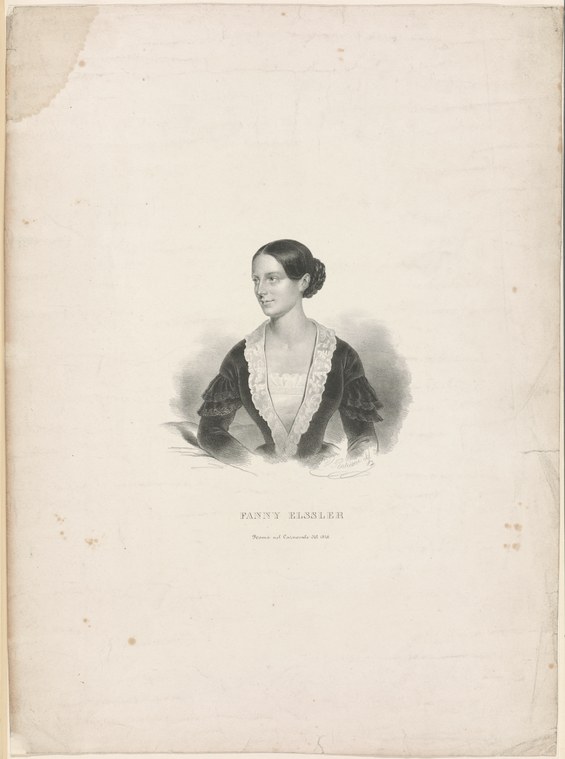
Fanny Elssler, Roma nel carnevale 1846
Unknown artist
- Collection:
- Prints depicting dance
- Source:
- New York Public Library
- Rights:
- Public domain — free to use, share and adapt.
- Recorded as:
- Public Domain
Fanny Elssler was a foundational figure in Romantic ballet and one of the nineteenth century's most globally celebrated dancers. This engraving is a primary document of her celebrity and of how dancers were marketed and memorialised in the print culture of the era—it tells us who mattered, who was worth engraving, and how fame circulated.
What you are looking at
This is a portrait engraving of a woman shown from the shoulders up, turned slightly to the viewer's right and gazing into the middle distance. She wears a dark, low-necked dress or bodice with short, puffed sleeves, revealing a pale décolletage and a white chemise or undergarment beneath. Her dark hair is pulled back smoothly and gathered at the nape in a neat chignon. The figure is rendered in fine grayscale with careful attention to light and shadow, creating volume and dimension. The background is plain cream paper, and below the portrait is printed text identifying the subject. The work shows the formal conventions of mid-nineteenth-century portraiture—the neutral setting, the idealized but recognizable likeness, and the restrained, dignified pose that conveys both accessibility and distinction.
The dancing
The sitter's posture is upright and composed, her shoulders relaxed. Her head is held erect, tilted very slightly away from the viewer, suggesting both poise and a moment of thoughtful repose. The neck is long and graceful, and the bare shoulders and upper chest are arranged to convey elegance without ostentation. There is no active gesture or movement; the figure is static and presentational, as befits a formal portrait.
The dance depicted
This work documents Fanny Elssler, one of the most celebrated dancers of the Romantic era. The inscription references her as a star of the 1846 Rome Carnival season. The portrait itself does not depict her dancing—it is a commemorative likeness made for circulation during or shortly after a celebrated engagement. Elssler was known for her virtuosic technique in ballet and for her signature roles in works demanding both technical brilliance and emotional expressiveness. The date 'Roma nel carnevale 1846' suggests this print was created to capitalise on her fame in Italy during that season.
How it was made
This is a steel or copper engraving, a reproductive print medium that allowed wide dissemination of the image. The fine parallel lines and careful cross-hatching create tone and volume; the technique demands precision and patience, and such prints were relatively costly, suggesting an audience of educated, affluent collectors and admirers of the dancer. The quality of execution indicates a skilled engraver, likely working from a painting or drawing. Engravings of this type were standard promotional objects in the theatre world, circulating among fans, patrons, and archives.
About this work
This is a commemorative portrait engraving of Fanny Elssler, the Austrian dancer who was one of the defining figures of Romantic ballet in the mid-nineteenth century. Made or issued in connection with her celebrated engagement at the Rome Carnival in 1846, it represents her not in performance but as a public figure worthy of preservation and collection. The print documents both the dancer's fame and the cultural machinery that sustained it—the engraved portrait was a standard technology for circulating the likenesses of celebrated performers to audiences across Europe. Elssler's career spanned classical and Romantic styles, and she danced across Europe and the Americas, making her one of the first truly international dance celebrities.
How to look at it
Look at the way the engraver has rendered the dancer's face: there is both idealism and specificity, a likeness made dignified and memorable. The bare shoulders and elegant dress signal her status as a performer of the highest rank, not a working-class entertainer. The restraint of the pose—no theatrical gesture, no costume prop—emphasises her as a person of cultivation and distinction rather than merely as a stage body. This was how the nineteenth-century public wanted to imagine its greatest dancers: as women of talent and character, not merely as objects of spectacle.
The artist
The engraver is not recorded. Reproductive engravings of this calibre were often made by studio engravers working from portrait paintings or drawings, sometimes unsigned or signed only with initials. The inscription 'Roma nel carnevale 1846' suggests the print was issued in Italy, possibly by an Italian publisher, which may account for the loss of attribution.
The period
The 1840s were the height of the Romantic ballet era in Europe. Elssler was one of the two dominant ballerinas of the period, celebrated for her dramatic intensity and technical command. Romantic ballet emphasised ethereal, otherworldly female beauty and emotional narrative; dancers were increasingly treated as international celebrities, and engravings, lithographs, and photographs of them became highly collectible. The mid-century saw a boom in print culture around dance and theatre, with engravings serving as the primary technology for circulating images of performers before photography became widespread.
Where it lives
The work is held in the New York Public Library's prints collection, which documents theatre, dance, and cultural history through pictorial media. It is catalogued as a work depicting dance, part of a larger archive of performance iconography.
Questions about this work
Who was Fanny Elssler?
Fanny Elssler (1810–1884) was an Austrian ballerina and one of the two supreme figures of Romantic ballet, along with Marie Taglioni. She was celebrated across Europe and the Americas for her technical brilliance, dramatic intensity, and charisma. She danced in the major European capitals and had a legendary tour of the United States (1840–1842). Her career spanned both classical and Romantic styles, and she was known for roles demanding both virtuosity and emotional depth.
Why was an engraving made of her?
Engravings and lithographs of celebrated performers were standard products of nineteenth-century theatre culture. They served as mementos for fans, as promotional material for theatres and managers, and as collectible items for patrons. Making an engraving of a dancer was a mark of her international fame and importance. This print was likely issued during or shortly after her 1846 Rome Carnival engagement to capitalise on her celebrity in Italy.
What was the Rome Carnival season of 1846?
The Rome Carnival was an annual festival season of balls, theatrical performances, and entertainments that drew celebrated performers from across Europe. Engagement at major Carnival seasons was a mark of prestige. Elssler's presence in Rome in early 1846 would have been a major cultural event, and the date 'Roma nel carnevale 1846' indicates this engraving commemorates that engagement.
More dance artwork





