49 works in this view — arrow keys or swipe to move between them.
Dance in Art
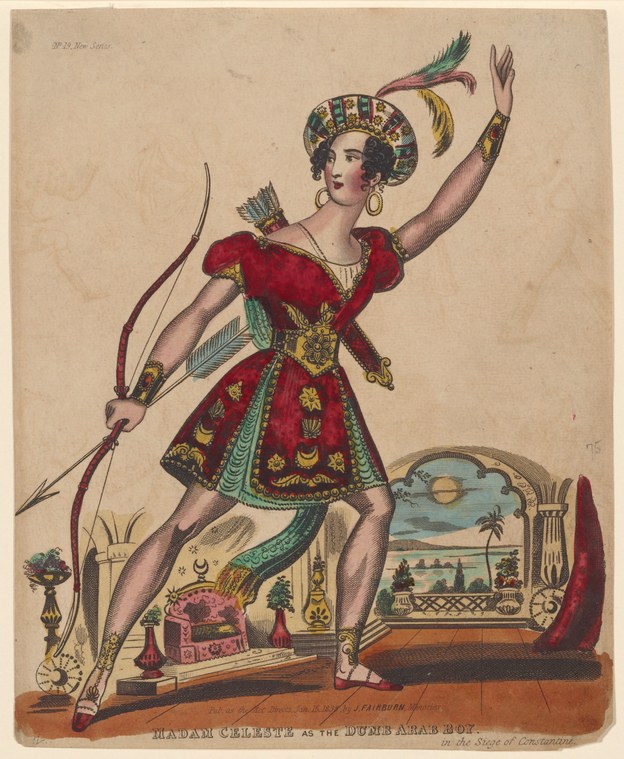
Madam Celeste as the dumb Arab boy in The siege of Constantine
Unknown artist
- Collection:
- Prints depicting dance
- Source:
- New York Public Library
- Rights:
- Public domain — free to use, share and adapt.
- Recorded as:
- Public Domain
Madame Celeste was one of the most celebrated performers of the 19th-century stage, famous for her physical expressiveness and her domination of roles requiring both dance and dramatic pantomime. This print is documentary evidence of how the body was deployed in popular theatrical entertainment, what audiences paid to see, and what was considered worth preserving and circulating in print. For historians of dance, it illustrates the close relationship between concert dance, theatrical pantomime, and popular spectacle in a period when these categories were not yet firmly separated.
What you are looking at
A woman in a richly decorated red dress with gold embroidery and green trim strikes a dramatic theatrical pose against a warm-toned background. She wears an ornate headdress with radiating feathers and gold detailing, and large hoop earrings. Her left arm is raised high with palm outward in an expressive gesture, while her right arm holds a curved bow at her side. Her pose is highly energized and asymmetrical, with her weight shifted. The background contains small vignettes: at lower left, a still-life arrangement of theatrical properties including a shield, musical instruments, and vessels; at right, a framed landscape with a palm tree and water, suggesting an exotic or Arabian setting. The whole composition is rendered in hand-colored engraving or etching, with crisp outlines and selective color application characteristic of 18th-century popular theatrical prints.
The dancing
A single female figure dominates the frame in a contrapposto stance with marked torsion. The raised left arm is fully extended upward with fingers spread and palm facing outward—a pose of display or supplication rather than dance partnering. The right arm holds a bow at mid-body. Her torso twists away from her hips, creating dynamic diagonal energy. The pose is theatrical and presentational rather than balletic or classical: it reads as a moment of dramatic narrative rather than structured choreography. No footwork is clearly visible, but her stance suggests weight on the back leg with the front leg extended or lightened.
The dance depicted
This does not appear to depict dance in the strict sense, but rather a theatrical tableau from dramatic performance. The work is identified in the inscription as Madame Celeste performing as the 'dumb Arab boy' in *The Siege of Constantine*, a melodrama. The pose is one of pantomime and characterization rather than dance steps. However, the theatrical context and the physical expressiveness of the figure place it within the broader world of theatrical performance where dance and pantomime were closely intertwined in 19th-century popular entertainment. The costume and pose suggest spectacle and exotic character performance rather than a specific dance genre.
How it was made
This is a hand-colored engraving or etching, a print medium that was the standard vehicle for circulating images of popular theatrical performances in the 19th century. The technique allowed rapid reproduction and wide distribution to audiences who would pay a few pence for a memento of a celebrated performance. The crisp outlines, selective hand-coloring in red, green, and gold leaf or metallic paint, and the addition of a printed inscription at the base are all typical of theatrical character prints—a major genre of popular visual culture. The inclusion of small property-vignettes around the main figure echoes emblematic engraving conventions while advertising the theatrical spectacle.
About this work
This is a hand-colored engraving documenting a celebrated theatrical performance by Madame Celeste, a major star of 19th-century dramatic and pantomime stages. The print shows her in character costume and pose from *The Siege of Constantine*, one of the exotic melodramas that dominated popular entertainment. While the image captures a moment of theatrical spectacle rather than formal dance, it belongs in a gallery of dance in art because it documents the physical expressiveness, costume, and performative culture that surrounded dance in the theater of its era, and because the boundary between pantomime, dance, and dramatic performance was fluid and permeable in 19th-century popular theater. Theatrical character prints like this one are primary sources for how bodies, movement, costume, and spectacle were understood and celebrated in performance culture.
How to look at it
Attend to the pose: it is frozen in the moment of performance, not in repose. The raised arm and turned torso suggest vocalization or command even though she is silent ('dumb' in the character description means mute or non-speaking). The exotic costume—the headdress, the embroidered dress, the bow—is the visual index of character and setting; note how much of the print's visual weight goes to ornament and color. The small background vignettes show the theatrical apparatus: the properties needed to construct the illusion of *The Siege of Constantine*. This was spectacle as a commodity, and the print was both advertisement and souvenir.
The artist
The artist is not recorded. This appears to be a commercial theatrical print, likely produced by a London or provincial print publisher as a commodity for theatrical audiences. Such prints were typically executed by journeyman engravers working from drawings by artists who attended performances, and were sold in print shops, at theaters, and by street vendors. Attribution was often not given or valued; what mattered was that the print captured a recognizable likeness and the costume details that would draw buyers.
The period
This print dates to the era of Romantic melodrama and pantomime, when the theater was the primary venue for spectacle and physical display for popular audiences. The early-to-mid 19th century saw the rise of the star system, in which celebrated performers became the focus of performance and audience desire. Madame Celeste was one of the few women to command both dramatic and physical roles with equal acclaim, at a time when women performers were often confined to decorative or purely comic parts. Exotic melodramas set in the Middle East, Ottoman Empire, and colonial periphery were major commercial draws, offering audiences visual spectacle, costume display, and narratives of adventure and conquest. The theatrical print was the mass medium of theatrical publicity before photography, and competed with playbills, newspapers, and word-of-mouth.
Where it lives
This print comes from the New York Public Library's collection of theatrical prints and portraits. It is a commercial artifact of 19th-century entertainment culture, produced and circulated as a cheap popular print for sale to theater-goers.
Questions about this work
Was Madame Celeste a dancer?
Celeste was known as a dancer, pantomimist, and dramatic actress—categories that were not yet firmly separated in 19th-century theater. She excelled in roles that required physical expressiveness, acrobatic ability, and the ability to convey narrative and emotion through the body without speech. She was famous for her ability to move between comic and serious roles and for her command of spectacular physical effects.
What was *The Siege of Constantine*?
It was one of many exotic melodramas that were popular in the 19th century, featuring adventure, spectacle, and narratives of conquest and rescue. These plays were often loosely based on historical events or literary sources and were vehicles for celebrated performers and visual effects. Celeste's role as a 'dumb Arab boy' suggests a mute, possibly enslaved or exotic character—a common trope in such melodramas.
Why is this print valuable as a historical document?
It is direct evidence of what was performed, how bodies were dressed and deployed in theatrical spectacle, and what audiences valued enough to purchase and preserve. Theatrical prints are primary sources for performance history before photography, and they show us the relationship between dance, pantomime, costume, and dramatic narrative in popular entertainment.
More dance artwork





