49 works in this view — arrow keys or swipe to move between them.
Dance in Art
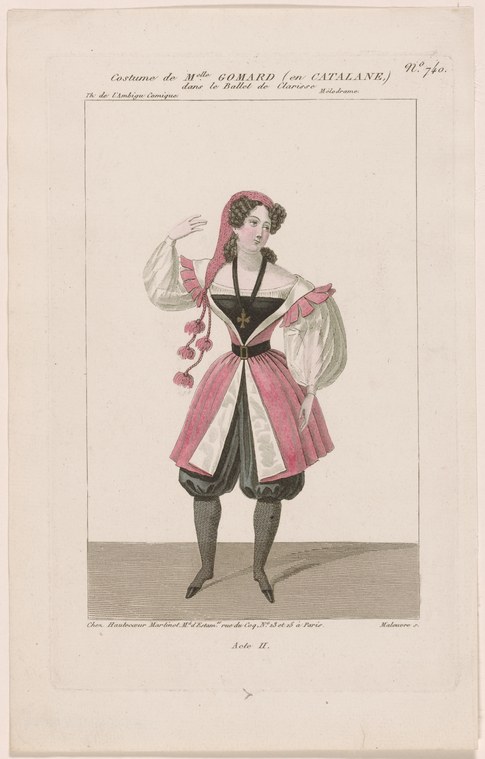
Costume de Melle. Gomard (en Catalane), dans le ballet de Clarisse Acte II.: Th. de l'Ambigu Comique. Mélodrame
Unknown artist
- Collection:
- Prints depicting dance
- Source:
- New York Public Library
- Rights:
- Public domain — free to use, share and adapt.
- Recorded as:
- Public Domain
This work illuminates the role of costume spectacle and female performers in early 19th-century French melodrama, a theatrical form that was central to the cultural life of the period yet has often been eclipsed in art-historical attention by ballet. The print also documents the specific performance practices and visual conventions through which melodrama conveyed character and narrative—regional dress as a marker of ethnic or social identity, and the formal 'attitude' pose as a standard mode of theatrical presentation, distinct from narrative or social dance.
What you are looking at
A single female dancer stands in theatrical costume against a plain light background, captured in a moment of performance. She wears a striking ensemble combining theatrical artifice with regional dress: a fitted black corseted bodice with a low neckline, over which she wears a pink silk skirt and a sheer white chemise with voluminous sleeves gathered at the wrist. Her legs are encased in dark stockings, and her feet wear soft shoes appropriate to theatrical dance rather than pointe. Her dark hair is bound up in an elaborate coiffure adorned with ribbon or feathering. She holds her left arm raised with the hand extended gracefully upward, while her right arm is lowered with the hand near her skirt; her body is turned slightly, her weight distributed in a stance that suggests either a held position or the instant before movement. Her expression is refined and alert, her gaze directed away from the viewer.
The dancing
A single dancer stands in a posed, presentational attitude rather than a captured moment of kinetic dance. Her weight appears evenly distributed, her stance balletic but not using turned-out positions. The raised left arm with extended fingers and the lowered right hand suggest classical theatrical carriage—the arms frame the body in a three-quarter turn. Her torso is upright and contained within the corseted bodice; there is no dynamic weight shift or indication of rapid movement. The overall frame is one of statuary poise, consistent with the formal theatrical presentation conventions of early 19th-century melodrama.
The dance depicted
The work depicts Mlle. Gomard in Catalan costume, performing in the 1820 melodrama 'Clarisse' at the Théâtre de l'Ambigu-Comique in Paris. The Catalan regional dress—identifiable by the pink skirt, white chemise, and fitted bodice—was popular in early 19th-century French theatre as exotic or regional spectacle within melodramatic productions. The pose and presentation suggest a 'pose plastique' or a formal theatrical attitude rather than a social or narrative dance step; this is costume documentation within theatrical performance rather than the depiction of an active dance form. The work belongs to the tradition of theatrical fashion prints commemorating celebrated performances and notable performers of the day.
How it was made
This is a hand-coloured engraving, executed with fine line work typical of early 19th-century French theatrical prints. The technique allowed for precise rendering of costume detail—the gathered sleeves, the striping and folds of the skirt, the corseting of the bodice—with subtle tonal variation achieved through light watercolour washes applied over the engraved line. The medium suggests commercial distribution to a theatre-going public; such prints were sold as souvenirs and costume references, documenting celebrated performances and allowing absent audiences to visualize the spectacle. The relatively modest scale and the absence of elaborate architectural framing mark it as a costume print rather than a grand theatrical narrative engraving.
About this work
This hand-coloured engraving documents the costume and presentation of Mlle. Gomard performing in 'Clarisse', a melodrama staged at the Théâtre de l'Ambigu-Comique in Paris around 1820. The work belongs to the tradition of French theatrical fashion prints of the early 19th century—commercial prints sold to commemorate celebrated performers and their most notable costumes. Though labeled as depicting 'Act II', the image shows not a narrative moment or active dance sequence but a posed, presentational costume portrait: Gomard in Catalan regional dress, standing in a refined theatrical attitude with carefully composed arm and body positions. The Catalan costume itself—pink skirt, white chemise with full sleeves, fitted black bodice—signals the exoticism and regional spectacle that melodrama audiences found compelling; the precise rendering of fabric and trim in the engraving reflects the commercial importance of costume in this entertainment form.
How to look at it
Attend to the formal pose and the composed stillness of the figure: this is not a frozen moment of dance movement but a presentational attitude, designed to showcase the costume and the performer's refinement. Notice how the raised arm and turned torso create a balletic frame despite the regional costume; the refinement of carriage was understood as a marker of the performer's skill and status. Observe the precise rendering of textile detail—the gathers and folds of the sleeves, the striping and weight of the skirt—which was a primary purpose of such prints: to document the visual splendor of the theatrical spectacle for audiences who could not attend or who wished to study the costume. The background is deliberately plain and undefined, allowing the figure and dress to stand as the sole subject.
The artist
The print is not signed, and the artist is unrecorded. The style and execution are consistent with the commercial printing shops of Paris that produced theatrical fashion prints in the 1820s, likely under the direction of a publisher or printseller rather than as a signed artistic work. Such prints were often produced rapidly and in series, with hand-colouring applied by workshop assistants, and were frequently uncredited. The inscription at the bottom indicates the theatre and performance context but not the engraver or publisher.
The period
The early 1820s saw the consolidation of French melodrama as the dominant commercial theatrical form, attracting the widest audiences and the most elaborate spectacle. The Théâtre de l'Ambigu-Comique, where 'Clarisse' was performed, was one of the leading melodrama houses. The costume print emerged as a significant commercial art form during this period, distributed to fashion-conscious theatregoers and collectors of theatrical ephemera. Simultaneously, Romantic ballet was beginning to establish itself in Paris; the theatrical vocabulary of the pose, the emphasis on female beauty and refined carriage, and the costume as a primary signifier of character or exoticism were shared conventions across both forms. By the 1820s, the sketch-and-print had become the standard way for theatres to document and promote their performers and productions.
Where it lives
The work comes from the New York Public Library's collection of prints depicting dance ('Prints depicting dance'). It is a commercial theatrical fashion print, one of a substantial category of ephemeral documentation produced by Paris print publishers to commemorate notable performances and performers of the early 19th century.
Questions about this work
Who was Mlle. Gomard and why would she be printed?
Gomard was a performer at the Théâtre de l'Ambigu-Comique, one of Paris's major melodrama houses. Celebrity performers of the period were documented in costume prints sold to the theatre-going public; these prints were a form of fan merchandise and also a way for theatres to advertise upcoming productions and notable roles. Gomard's appearance in 'Clarisse' was significant enough to warrant a printed costume portrait.
What does 'Catalan costume' mean in a Paris melodrama?
In early 19th-century French theatre, regional or 'exotic' costumes signaled character type and social position. Catalan dress marked a character as foreign, rural, or of low social status—lending local colour and spectacle to the narrative. Melodrama relied on such visual distinctions to quickly communicate character to the audience; the costume itself carried meaning.
Is this a depiction of a specific dance form?
No. While Gomard is clearly trained in theatrical movement and presents a refined, balletic carriage, this print documents a costume and a posed attitude rather than an active dance or a specific choreographed step. It is a theatrical fashion print, not a record of choreography or social dance practice.
What is the theatrical setting and why does it matter?
The Théâtre de l'Ambigu-Comique was a major Paris venue devoted to melodrama—a form that dominated popular theatre in the 1820s. Melodrama emphasized spectacle, costume, music, and emotional extremes rather than literary sophistication, and attracted the widest audiences of any theatrical form. Understanding this context helps explain why such performances were documented in prints and why costume detail was paramount.
More dance artwork





