49 works in this view — arrow keys or swipe to move between them.
Dance in Art
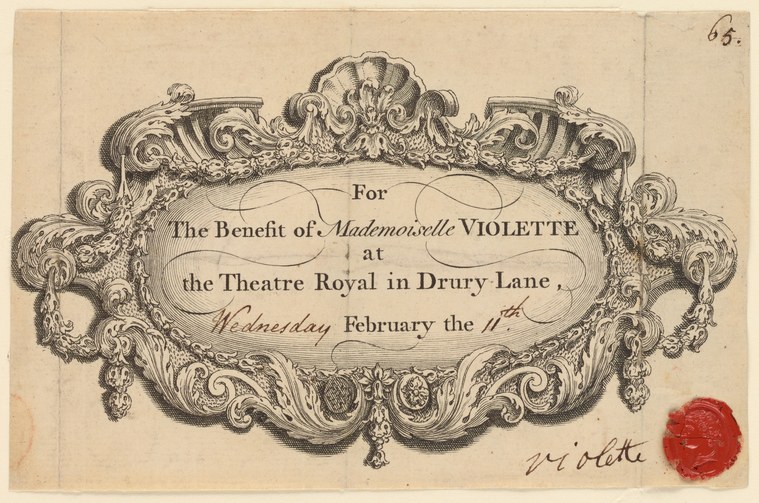
For the benefit of Mademoiselle Violette at the Theatre Royal in Drury Lane, Wednesday February the 11th
Unknown artist
- Collection:
- Prints depicting dance
- Source:
- New York Public Library
- Rights:
- Public domain — free to use, share and adapt.
- Recorded as:
- Public Domain
This object illustrates the material culture surrounding professional theatrical dance in 18th-century London: how performances were announced, authenticated, and marketed to potential audiences. The naming of Mademoiselle Violette as the beneficiary attests to the celebrity status of individual dancers and the benefit system that provided their income. For historians of dance, theatre, and print culture, such ephemera are primary evidence of who performed, where, and how theatrical dance was valued.
What you are looking at
This is an engraved ticket or playbill ornament for a benefit performance featuring Mademoiselle Violette at the Theatre Royal in Drury Lane, London, dated Wednesday, February 11th (year not specified). The design is a symmetrical, elaborately decorated cartouche in the rococo style, with scrolling foliate ornaments, acanthus leaves, and shell motifs framing a central oval reserve. Within the oval, hand-written italic script announces the event. The engraving itself contains no depiction of dancers or a dance scene; it is a purely decorative architectural frame of the kind used for theatrical announcements in the 18th century. A red wax seal impression appears in the lower right corner, suggesting this was an official document or invitation. The overall composition is typical of high-quality theatrical ephemera from the Georgian period.
The dancing
No figures or dancers appear in this image. The work is an ornamental design without human representations.
The dance depicted
While the document announces a benefit for a named performer (Mademoiselle Violette) at a major London theatre, the engraving itself provides no visual evidence of what dance style or form was performed. The Theatre Royal in Drury Lane was the premier venue for theatrical dance in 18th-century London, but the ticket design offers no costume, pose, or choreographic clue to identify the genre. Without additional documentation, the specific dance cannot be determined from this image alone.
How it was made
This is a copperplate engraving, executed in fine line work with careful handling of parallel lines and stippling to create tonal variation and decorative texture. The rococo ornament appears to be professionally cut, suggesting it was produced by a skilled London engraver for repeated use—the blank oval reserve allows for insertion of different text or information by hand-written inscription for each performance. The technique and style are consistent with mid-18th-century theatrical printing practices, implying circulation as a printed ephemeron distributed to theatre patrons and the public.
About this work
This is an ornamental engraved frame for a theatrical ticket or announcement, created for a benefit performance at London's Drury Lane Theatre. The cartouche design, executed in fashionable rococo style with symmetrical botanical ornament, demonstrates the visual prestige attached to theatrical events in the Georgian period. Although it advertises a named dancer, Mademoiselle Violette, the engraving itself is a document of theatre culture and commercial practice rather than a record of choreography or performance style. It belongs in a dance history collection as evidence of how dance was publicised, commodified, and framed within 18th-century theatrical institutions.
How to look at it
Study the ornamental frame itself: the symmetry, the confident handling of scrollwork, the clarity of the engraved line. Rococo ornament was labour-intensive and expensive to reproduce; the quality of this cutting suggests it was an investment in the theatre's prestige and in the importance placed on the announcement of this performance. The blank oval reserve—hand-filled with information—shows how printed and manuscript production were integrated. The wax seal authenticates the document as an official or formal item. The typography and language conventions (the French 'Mademoiselle', the formal phrasing) mark this as a product of Georgian theatrical culture aimed at fashionable audiences.
The period
This engraving dates to the era when theatrical dance in London was undergoing rapid professionalization and commercialisation. The mid-18th century saw the rise of named ballet masters and dancers as celebrity figures; benefit performances—in which the proceeds went to a named performer rather than the theatre—were a crucial source of income for dancers and a mechanism for attracting audiences. The rococo ornamental style reflects contemporary taste in design and printing. Drury Lane, under successive management, was the primary stage for ballet and dance entertainment in London, competing with other venues for fashionable audiences. The hand-written annotation of performance details into pre-engraved frames was standard practice, allowing theatres to produce tickets and announcements efficiently and repeatedly.
Where it lives
This object is held in the New York Public Library's collection of prints depicting dance, catalogued as a print from an unknown date and with artist unrecorded. It is an example of theatrical ephemera—material produced for immediate use and consumption in the theatre, and historically of the kind that rarely survives.
Questions about this work
Was Mademoiselle Violette a famous dancer?
The engraving provides her name but no other information. However, that she was granted a benefit performance—a mark of status in the 18th-century theatre—suggests she was an established or celebrated performer. Benefit nights were financial and cultural honours, indicating the dancer had sufficient celebrity to draw a paying audience. Further research in theatre records, playbills, and newspapers would be needed to establish her career details.
What is a benefit performance?
A benefit performance was a theatrical event in which the profits went to a named performer (in this case a dancer) rather than to the theatre management. Benefits were used from the 17th century onwards as a form of payment and prestige for established performers. Benefit nights were often occasions for special performances, celebrity appearances by guest artists, or expanded programmes designed to draw large audiences. For dancers, who had no permanent salary or pension, benefits were a crucial source of income.
Why is the text in this document handwritten on an engraved frame?
Theatre companies produced engraved frames and ornaments as reusable printing blocks or plates, allowing them to economise on engraving costs. The date, performer's name, and programme details were filled in by hand for each individual performance, or printed separately and pasted in. This was an efficient hybrid of print and manuscript production suited to the rapid turnover of theatrical announcements.
What does the red wax seal mean?
The wax impression (likely a theatre seal or the seal of a named official) authenticates the ticket or announcement as genuine and official. Wax sealing was a standard method of authentication, ownership marking, and authorisation in the 18th century. Its presence suggests this was either a formal ticket for entry or an official announcement meant for distribution.
More dance artwork





