49 works in this view — arrow keys or swipe to move between them.
Dance in Art
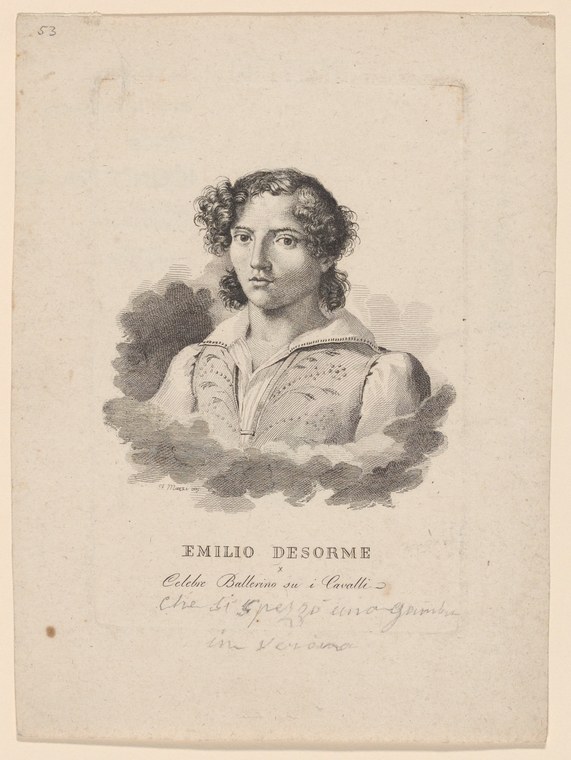
Emilio Desorme: celebre ballerino su i cavalli
Unknown artist
- Collection:
- Prints depicting dance
- Source:
- New York Public Library
- Rights:
- Public domain — free to use, share and adapt.
- Recorded as:
- Public Domain
Equestrian dance is a largely forgotten skill and spectacle form; this portrait is evidence of its professional practice and celebrity. The image preserves the identity and public face of a performer in a tradition that left few other traces in dance history.
What you are looking at
A half-length portrait bust of a young man with shoulder-length curled hair, shown against a clouded background that fades from darker tones at the shoulders to lighter tones at top. He wears a sleeveless tunic or doublet with detailed embroidery or patterning visible on the chest and arms, and a draped collar or mantle. His gaze is direct and composed. The inscription below identifies him as "Emilio Desorme" and describes him as a "celebre ballerino su i cavalli" (celebrated horseback dancer), with additional handwritten text below that is partially legible. The print employs fine cross-hatching and stippled shading to model the face and suggest the textured fabric of the costume.
The dancing
A single figure shown as a portrait head and shoulders only, not in active pose. The body is frontal and upright, the expression neutral and dignified. No limbs or full-body movement are visible, and no dance position or hold can be assessed from this format. The focus is on the face and upper body as a record of the person rather than a demonstration of choreography.
The dance depicted
The inscription explicitly identifies this as a portrait of Emilio Desorme, a celebrated dancer known for performing on horseback—a specialty act that was part of circus, fair, and theatrical entertainment from at least the 18th century onward. The portrait does not depict the dance itself, but rather the dancer as a public figure or celebrity. Equestrian dance was a feat of acrobatic and rhythmic skill performed on a moving horse, combining dance, balance, and horsemanship; without seeing Desorme in action, we cannot assess his specific technique from this image alone.
How it was made
This is an engraving, likely stipple engraving or a combination of line and stipple work, a technique that produced fine tonal gradations suitable for portraiture. The delicate cross-hatching and dotted shading create a soft modeling of the face and suggest texture in the fabric and hair. Engravings of this kind were widely produced and distributed, often as prints for public sale or as illustrations for theatrical bills and celebrity records; this suggests Desorme was a known performer whose image had commercial value in the 18th or early 19th century.
About this work
This is a commemorative portrait print of a performing artist known for an acrobatic and rhythmic act on horseback—a form of theatrical entertainment that combined dance, balance, and equestrian skill. The engraving records not the performance itself but the person of the dancer, presented in dignified bust format typical of celebrity portraiture. It belongs in a dance history collection both as evidence of a specialized and now-vanished performance tradition and as a document of the public profile and cultural status of a theatrical performer in the early modern era.
How to look at it
This is a celebrity portrait, not a dance action picture. Attend to the costume—the fine embroidered tunic suggests specialized theatrical dress designed for visibility and movement. The direct, composed gaze and dignified frame present the performer as a public figure of status, not as a character in narrative or motion. The engraving format allowed wide distribution and reproduction, making this the kind of image that would have promoted a touring performer's name and face across Europe.
The artist
The artist is not recorded in the catalogue. The style and technique suggest a professional engraver working in the 18th or early 19th century, likely in Italy or France given the Italian inscription and the Continental fashion of the dress.
The period
Equestrian performance flourished in 18th- and early 19th-century Europe as a circus and fair attraction, and occasionally as a theatrical specialty. The Regency and Romantic eras saw the height of such entertainment as public spectacle, and celebrity performers were widely portrayed and advertised. This print belongs to that culture of theatrical celebrity documentation.
Where it lives
The work is held in the New York Public Library's Prints collection on dance. It is catalogued as an engraving from an unknown date and hand, suggesting it entered the collection as part of a broader archive of performance portraiture and theatrical documentation.
Questions about this work
What was equestrian dance or 'ballerino su cavalli'?
It was an acrobatic performance art that combined dance, rhythmic movement, and balance executed on a moving horse. Performers like Desorme were circus and theatrical attractions in 18th- and 19th-century Europe, and the skill required coordination between dancer and horse, making it a specialized and impressive feat.
Why is this a portrait and not a picture of him dancing?
This engraving served as a celebrity portrait and promotional record, circulating his name and face to the public. It functioned like a theater playbill or modern publicity photograph—identifying the performer rather than documenting the performance itself.
What does the inscription say?
It reads 'Emilio Desorme, celebre ballerino su i cavalli' (Emilio Desorme, celebrated horseback dancer). The handwritten text below is partially legible but appears to be a later annotation or inscription by hand.
More dance artwork





