49 works in this view — arrow keys or swipe to move between them.
Dance in Art
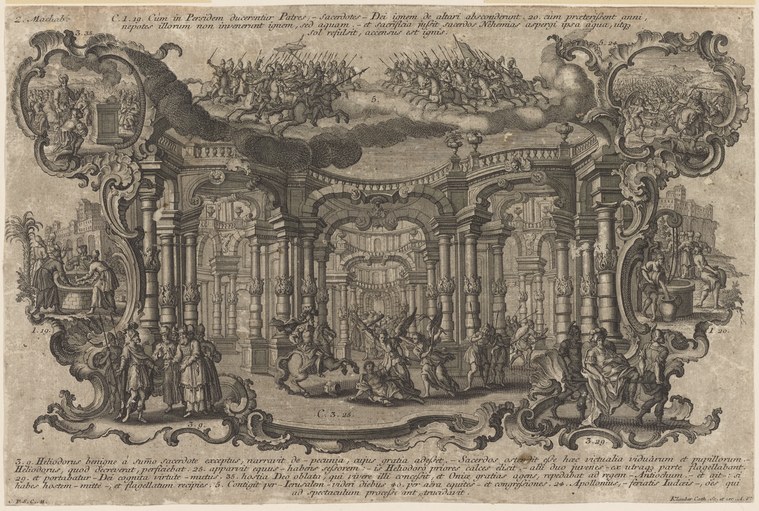
2. Machab., C. 1.19, Cum in Persidem ducerentur Patres
Unknown artist
- Collection:
- Prints depicting dance
- Source:
- New York Public Library
- Rights:
- Public domain — free to use, share and adapt.
- Recorded as:
- Public Domain
This print illuminates the Renaissance understanding of courtly movement and ceremony as a mode of visual communication parallel to dance. It reveals how formal procession, costume, and spatial arrangement conveyed meaning in early modern court culture, and how engraving as a medium made such ceremonial spectacles available to a much wider audience than could witness them in person.
What you are looking at
A richly decorated Renaissance interior serves as the stage for a formal court procession or ceremonial gathering. Tall columns with Corinthian capitals and ornate entablature frame a receding architectural space rendered in perspectival depth. The floor is patterned, and the walls are articulated with pilasters and decorative panels. In the foreground, robed and richly dressed figures process or stand in formal arrangement. Beyond them, visible through the colonnade and in the background, a large crowd of armed soldiers or courtiers can be seen, some on foot and others mounted on horseback, arranged in ordered ranks that recede into the distance. The scene is bounded by elaborate cartouches in the corners and margins, typical of Renaissance didactic prints, with text in Latin inscribed above and below the main image. The print's fine hatching and detailed linework convey both the architectural splendor and the social hierarchy encoded in costume and position.
The dancing
The figures in the foreground stand in formal, upright postures with minimal gestural expression—their bodies arranged to display rank and regalia rather than to convey narrative movement. Some stand at rest, while others appear to be in procession, moving slowly and deliberately through the space. The mounted figures in the background are positioned in parallel ranks, their horses aligned to suggest orderly military formation rather than dynamic action. Arms hang at sides or are raised in gesture of greeting or oration. The overall effect is one of ceremonial stillness rather than active dance.
The dance depicted
This does not depict dance in the sense of rhythmic bodily movement. The image illustrates a religious or political narrative—likely the passage of the Maccabees into Persia, as indicated by the Latin title and inscription. The formal procession, military assembly, and architectural grandeur suggest a historical or biblical event rendered as a court pageant or ceremonial occasion. What might at first appear to be choreographed movement is instead the formal, hierarchical arrangement of bodies characteristic of state ceremonies and diplomatic receptions, which Renaissance audiences would have recognized as distinct from social or courtly dancing.
How it was made
This is an engraving, executed with fine lines and careful cross-hatching to create tonal modulation and spatial depth. The technique allowed for fine detail in both architecture and costume, and the composition's symmetry and perspective demonstrate the Renaissance mastery of geometric principles applied to printmaking. The ornamental borders and integrated Latin text indicate this as a didactic print, likely from a series illustrating biblical or historical narratives. Engravings of this type circulated widely in Renaissance Europe, making them accessible to educated viewers beyond the court.
About this work
This is a Renaissance engraving depicting a ceremonial or biblical narrative—the entry of the Maccabees into Persia—rendered as a formal procession through a classicizing architectural setting. The print combines historical or religious subject matter with Renaissance ideals of perspective, proportion, and architectural order. It belongs in a gallery of dance imagery because it captures the visual language of Renaissance court ceremony and formal movement, even though it does not depict dancing in the modern sense. The work shows how the period's visual culture represented state power, hierarchy, and ritual through the ordered arrangement of costumed bodies.
How to look at it
Attend to the careful gradation of space created by the receding colonnade, which guides the eye from the foreground figures through the procession and into the military assembly beyond. Notice how costume and position encode social hierarchy—the most elaborately dressed figures occupy the foreground and center. The symmetry of the composition and the ordered ranks of soldiers and courtiers convey stability and power. The ornamental cartouches frame this scene as a significant historical or allegorical moment worthy of study and reflection.
The artist
The artist is not recorded. The print's style, proportions, and technique suggest a Central European or Italian workshop of the mid-to-late sixteenth century. The integration of classical architecture, biblical narrative, and Renaissance perspective was common among didactic printmakers of the period who produced both single prints and series for educated audiences.
The period
In the Renaissance, court ceremony and formal procession were understood as arts akin to dance and music—all part of the spectacle of princely power. The period saw increasing interest in classical antiquity and in the representation of historical and biblical events with contemporary dress and settings. Engravings like this served both as records of actual ceremonies and as ideal models for how princes and their courts should conduct themselves. The print's Latin inscriptions suggest it was aimed at a learned audience who could read both text and image.
Where it lives
The work is held in the New York Public Library's collection of prints depicting dance. It was catalogued under the title referencing 2 Maccabees 1:19, indicating its source in biblical narrative.
Questions about this work
Is this actually a dance image?
Not in the modern sense of rhythmic movement to music. However, Renaissance ceremony—including formal procession and the hierarchical arrangement of costumed bodies—was understood as a kind of spectacle closely related to dance. The image shows how courts used movement and costume to communicate power and order. It belongs in a dance gallery because it documents the visual language of courtly performance, even if not dancing itself.
What does the Latin text say?
The title references 2 Maccabees 1:19, a biblical passage about the Maccabees' entry into Persia. The text below the image, in smaller Latin script, contains an inscription providing further context for the narrative depicted. The specific content of the longer inscription cannot be fully read from this reproduction, but such texts typically explained the historical or allegorical significance of the scene.
Why are there soldiers and horses in the background?
The military assembly likely represents the power and authority of the ruler receiving the Maccabees or the forces accompanying them. The presence of mounted soldiers in ordered ranks underscores the political and military significance of the event. In Renaissance prints, such details conveyed both historical accuracy (as understood in the period) and a sense of grandeur and importance.
More dance artwork





