49 works in this view — arrow keys or swipe to move between them.
Dance in Art
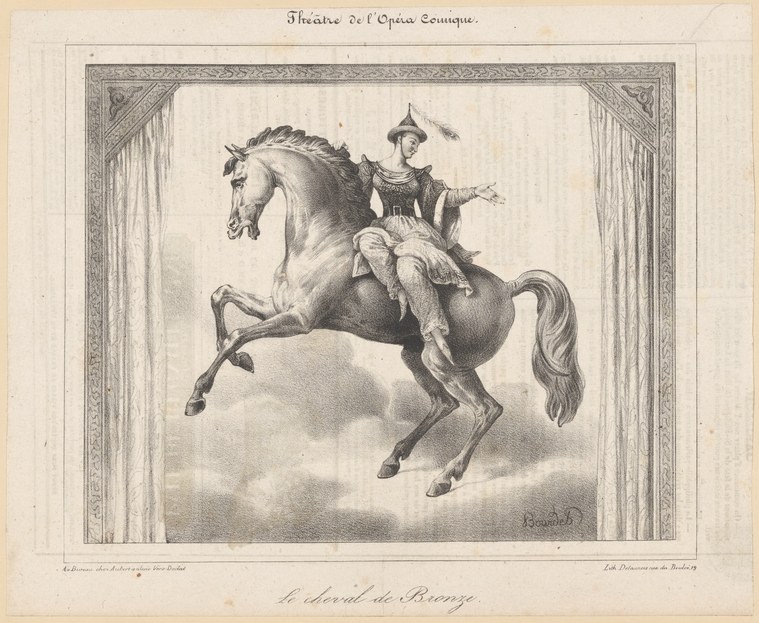
Théâtre de l'Opéra Comique. Le cheval de bronze
Unknown artist
- Collection:
- Prints depicting dance
- Source:
- New York Public Library
- Rights:
- Public domain — free to use, share and adapt.
- Recorded as:
- Public Domain
This work reveals that 'dance' in the theatrical context of the nineteenth century was not limited to human performers. The capriole represents an extreme case of bodily control and elevation that shares technical and aesthetic vocabulary with ballet; the engraving documents how spectacle, training, and bodily virtuosity could be applied to animals as well. It also testifies to the continued prestige of classical horsemanship and its place within theatrical culture, even as Romantic ballet was rising.
What you are looking at
A woman in elaborate period dress sits sidesaddle atop a rearing horse, her body balanced against the animal's violent motion. She wears a dark riding habit with ornate details and a plumed hat, her posture upright and composed despite the horse's dramatic rear. The horse, rendered with anatomical precision, lifts its front legs high off the ground in a capriole—the classical dressage movement—while its muscular hindquarters remain planted. The scene is set against a soft, clouded background within a decorative rectangular frame with hatched borders, rendered in the style of an engraving. The composition emphasizes the horse's athletic prowess and the rider's elegant control, frozen in the moment of maximum elevation.
The dancing
The female rider sits in formal sidesaddle position, her weight centered and her upper body vertical, communicating classical equestrian discipline. Her arms are positioned with one hand extended and the other controlling the bridle, maintaining the formal frame of haute école horsemanship. The horse's body is extended in full capriole—all four legs lifted clear of the ground simultaneously—demonstrating the highest degree of training. There is a single dancer-rider, and her relationship to the horse is one of mastery through refined technique rather than force.
The dance depicted
This is not a depiction of theatrical dance but of haute école horsemanship—classical dressage, specifically the capriole movement taught in riding schools descended from Renaissance and Baroque court tradition. The horse and rider together constitute a performed spectacle that shares the aesthetic and technical discipline of theatrical dance: composed movement, control of elevation, and display of training. The capriole was a signature movement of the Spanish Riding School tradition and similar academies, performed in court festivals and riding demonstrations. The print documents this equestrian 'dance' as a form of bodily virtuosity comparable to ballet.
How it was made
This is an engraving, identifiable from the fine hatching used to model form and shadow, the sharp linear definition of forms, and the characteristic tonal range of the intaglio print. The decorative border and compositional framing suggest this is a print intended for circulation, possibly as part of a series on theatrical or spectacular performances (the title references the Théâtre de l'Opéra Comique). The technique allowed for precise anatomical rendering of the horse and detailed costume, making this suitable for an educated audience familiar with both equestrian and theatrical conventions.
About this work
This engraving depicts a moment from 'Le Cheval de Bronze' (The Bronze Horse), a spectacle performed at the Opéra Comique. It captures a woman rider in formal habit mounted on a horse executing the capriole, one of the most demanding movements in classical dressage. The image belongs in a dance collection because haute école horsemanship was presented as theatrical performance and spectacle, and the capriole represents the same principles of trained elevation, control, and virtuosity that define theatrical dance. The horse and rider together perform a composed bodily feat within a theatrical frame, making this a document of how the concept of dance extended beyond human bodies in the nineteenth-century imagination.
How to look at it
Observe the precision with which the horse's anatomy is rendered—the tension in its lifted legs, the engagement of its hindquarters, the arched neck. Note the rider's absolute vertical composure; there is no sense of struggle or precariousness, only disciplined control. The engraver has chosen the moment of maximum elevation, when all four hooves leave the ground, a choice that emphasizes the movement's difficulty and spectacularity. The soft background and formal framing elevate this to the status of a fine art performance rather than a mere equestrian feat.
The period
This print dates to a period when the Opéra Comique in Paris was famous for incorporating equestrian spectacles and mechanical marvels into its productions. The Romantic era saw a fascination with both classical erudition and spectacular display; classical dressage, with its Renaissance and Baroque heritage, appealed to both sensibilities. Haute école horsemanship represented refinement, control, and the perfectibility of nature through training—values central to Romantic theatrical culture. The framing of this equestrian act within the theatrical canon reflects a broader understanding of performance that encompassed not only ballet and drama but all virtuosic displays of trained bodily movement.
Where it lives
This engraving comes from a holdings collection of prints depicting dance, likely assembled as a visual archive of theatrical and performative practices. It is one of several works documenting the Opéra Comique and its productions, suggesting it served as both a theatrical keepsake and a record of spectacles that mixed human dancers with equestrian and mechanical performance.
Questions about this work
Is this actually a dance?
Not in the human sense, but yes in the sense of theatrical performance. Haute école horsemanship—the capriole in particular—was presented as a spectacle at the Opéra Comique and shares the principles of composed, trained bodily movement that define dance. The horse and rider together perform a choreographed feat of control and elevation. In the nineteenth century, the boundaries of theatrical 'dance' were broader than they are now.
What is a capriole?
A capriole is a classical dressage movement in which the horse rears and then leaps forward, lifting all four hooves off the ground simultaneously before landing. It is the highest and most demanding movement in classical horsemanship, taught in schools like the Spanish Riding School in Vienna. The movement requires years of training and represents the pinnacle of equestrian control.
What was the Opéra Comique?
The Opéra Comique in Paris was a major theatrical institution known for comic opera and spectacular entertainments. Unlike the grand Opéra, it was willing to experiment with mixed media and effects, including equestrian numbers, mechanical spectacles, and elaborate choreography. It was a site of theatrical innovation and popular entertainment throughout the nineteenth century.
Who was the rider?
The engraving does not identify the rider by name. Equestrian performers were celebrity attractions in nineteenth-century theater, but this print does not preserve the rider's identity. She is presented as the embodiment of refined technique rather than as an individual performer.
More dance artwork





