49 works in this view — arrow keys or swipe to move between them.
Dance in Art
The new polka, or dance of peace
Unknown artist
- Collection:
- Prints depicting dance
- Source:
- New York Public Library
- Rights:
- Public domain — free to use, share and adapt.
- Recorded as:
- Public Domain
This print reveals that dance criticism has always been entangled with social anxiety. The polka's popularity provoked fierce resistance from establishment figures who saw in it a threat to hierarchy, dignity, and order—anxieties crystallized in the grotesque bodies depicted here. For dance historians and dancers, the work demonstrates how caricature and satire can be as revealing as instructional texts: the intensity of the mockery tells us how genuinely destabilizing the polka's democratic informality was to 19th-century elites.
What you are looking at
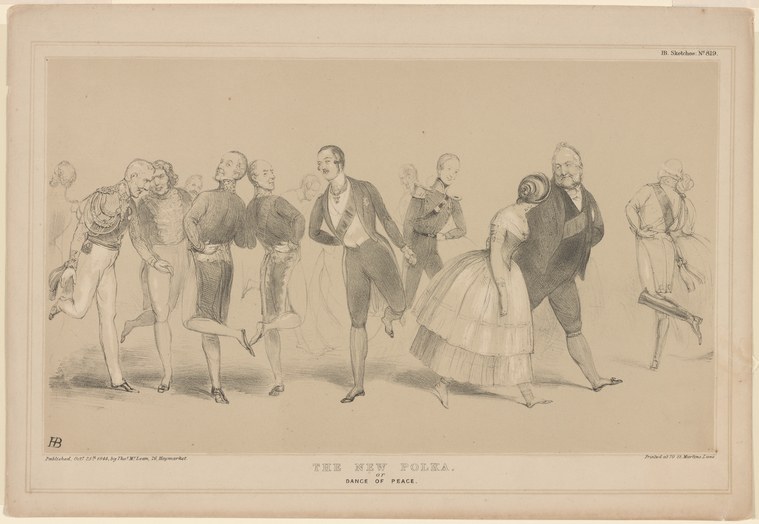
A lively line of nine figures progresses across a cream-colored ground in this satirical print. From left to right, the dancers move in a loose procession: a military officer in dress uniform with plumed hat, several men in civilian coats with exaggerated postures and contorted limbs, a woman in an elaborate white dress with ruffled skirts caught mid-movement, and additional figures tapering toward the right edge. The figures range from grotesquely bent and twisted to relatively upright, creating a visual crescendo of absurdity. The print employs light ink lines and minimal shading, characteristic of mid-19th-century satirical journalism. The title below reads "THE NEW POLKA, / DANCE OF PEACE" in capital letters, anchoring the social commentary.
The dancing
The bodies display exaggerated, contorted poses that mock ballroom etiquette rather than demonstrate it. Most figures lean or twist unnaturally, with one on the far left appearing nearly doubled over. The woman in the center wears a voluminous white skirt and moves with arms extended, her body relatively straight by comparison to the distorted men surrounding her. The officers and gentlemen adopt stiff, angular postures with raised elbows and twisted spines. No closed ballroom hold appears; instead, the figures suggest individual flailing or passive shuffling rather than partnership.
The dance depicted
This is a satirical commentary on the polka craze, likely from the 1840s-1850s when the polka swept European and American social dance floors with unprecedented fervor. The print lampoons both the dance itself and those who performed it, suggesting that the polka reduced dignified gentlemen—including a uniformed military officer—to undignified contortions. The exaggerated, awkward poses mock the claim that the polka was a rational or elegant "dance of peace," implying instead that it was absurd, chaotic, or socially destabilizing. The title's ironic framing—peace through a dance associated with disorder—is central to the satire.
How it was made
This is a line engraving or lithograph, executed in the light, rapid sketch style typical of 19th-century periodical illustration. The minimal shading and reliance on outline suggest it was designed for rapid reproduction in newspapers or satirical journals. The technique allowed for quick distribution of topical commentary to a wide urban audience. The print's provenance as part of the New York Public Library's "Prints depicting dance" collection indicates it circulated as ephemeral social commentary rather than fine art, typical of the popular press's response to contemporary dance phenomena.
About this work
This satirical print captures the moral anxiety surrounding the polka during its explosive popularity in the mid-19th century. While the polka was marketed as a democratic, energetic, and even peaceful social dance, conservative critics condemned it as a threat to propriety and order. The print's exaggerated rendering of contorted bodies—particularly the military officer reduced to undignified gesticulation—mocks both the dance itself and the supposedly respectable people who performed it. The work belongs in a dance gallery because it documents not how the polka was actually danced, but how it was *perceived* and *feared* by critics who saw in its popularity a sign of social disorder.
How to look at it
Observe the progression from left to right: the poses become increasingly exaggerated and absurd, creating a visual argument about the degrading effect of the dance itself. The uniformed officer on the left grounds the satire in respectability, which makes his contortion more pointed. Notice that the woman's pose, while energetic, remains more composed than the men's around her—a frequent trope in satirical prints, which often depicted women as naturally suited to fashion while men became ridiculous imitators. The print's power lies not in anatomical accuracy but in visual excess; the exaggeration *is* the message.
The period
The polka originated in Bohemia in the 1830s and became a dominant social dance across Europe and North America by the mid-1840s. Unlike the formal, prescribed figures of the quadrille or the waltz's austere three-count, the polka was energetic, improvised, and embraced by working and middle classes alike. This democratization of dance alarmed conservative critics and satirists, who produced numerous prints mocking the dance and its dancers. The polka was also coded as potentially revolutionary or at minimum transgressive—a Bohemian import at a time of political upheaval. Simultaneously, the waltz itself had faced similar moral panic twenty years earlier, suggesting that each generation's popular dance provokes establishment resistance.
Where it lives
The print is held in the New York Public Library's collection of prints depicting dance, catalogued as part of their holdings on historical dance imagery. It was printed and circulated as journalistic satire, likely in a weekly illustrated newspaper or satirical magazine of the 1840s-1850s period.
Dance in this work
Questions about this work
Is this showing how people actually danced the polka?
No. This is satire, not instruction. The grotesque poses mock both the dance and its performers; they exaggerate and distort rather than document. To see actual polka technique, you would need period dance manuals or different types of images. This print tells us how critics *perceived* the polka—as undignified and socially disruptive.
Why is the military officer dancing with everyone else?
The officer's presence is deliberate satire: he represents authority, dignity, and respectability—all of which the polka supposedly destroys. By showing a uniformed officer contorted and ridiculous, the print argues that the polka reduces even the most respectable men to absurdity. The ranking and hierarchy that the uniform represents becomes irrelevant on the polka floor.
What does the title 'Dance of Peace' mean?
It is deeply ironic. Proponents of the polka marketed it as a democratic, peaceful, and unifying social form. Critics, however, saw in it chaos and disorder. By pairing "peace" with images of contortion and discord, the print suggests that the polka's promise of peaceful social mingling is a lie.
More dance artwork





