49 works in this view — arrow keys or swipe to move between them.
Dance in Art
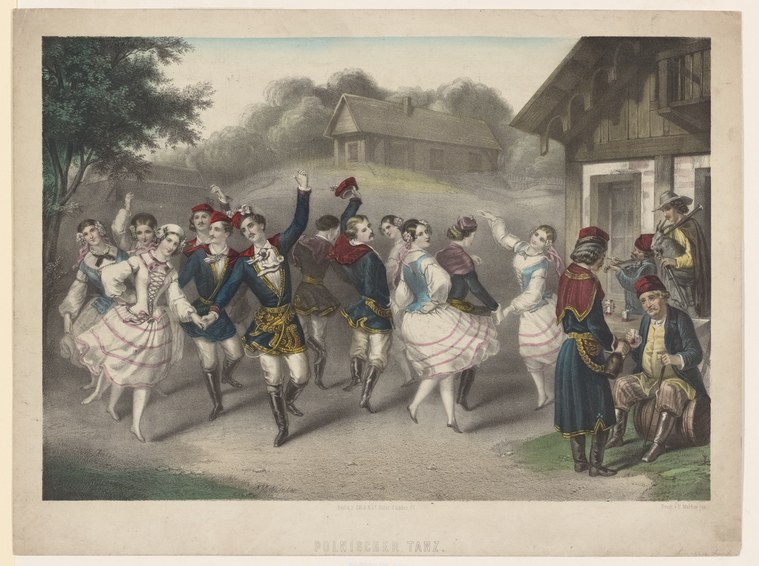
Polnischer Tanz
Unknown artist
- Collection:
- Prints depicting dance
- Source:
- New York Public Library
- Rights:
- Public domain — free to use, share and adapt.
- Recorded as:
- Public Domain
This image is one of the primary visual records of the polka craze that transformed 19th-century social dance and music. It shows not the dance in isolation but as a lived social practice embedded in specific contexts of class, nationality, and public celebration, making it invaluable for understanding how European society engaged with non-European cultural forms.
What you are looking at
A lively outdoor gathering in what appears to be a village setting, with a church or chapel visible in the misty background. The scene captures a moment of social dance, with multiple couples arranged in a loose circle or line formation. At the center, several men in military-style dress uniforms with ornate jackets and caps dance alongside women in pale pink or white dresses with full skirts. The figures are caught mid-movement, with raised arms and animated postures suggesting vigorous, energetic stepping. To the right, spectators—including seated figures and observers—watch from near a building. The entire composition has a hand-colored or tinted appearance, with soft greens and browns in the landscape, pale flesh tones, and jewel-toned accents in the uniforms. The mood is festive and convivial, capturing a moment of public celebration or entertainment.
The dancing
The dancers maintain an upright, sprightly posture with many displaying raised or extended arms in gestures of celebration. The hold between partners appears loose or absent; figures seem to be dancing individually or in a side-by-side formation rather than in close partner holds. The women's skirts are in mid-swirl, suggesting rotational movement and rapid footwork. The men's legs are visible and appear to be executing quick, precise steps. The overall impression is of vigorous, grounded movement with considerable vertical energy and elevation in the upper body, quite different from the smooth gliding of ballroom forms.
The dance depicted
The title *Polnischer Tanz* (Polish Dance) identifies this as a depiction of a Polish folk or social dance, most likely the polonaise or polka, dances that experienced enormous popularity across European social contexts in the 19th century. The mixed dress—military uniforms alongside civilian women in fashionable period gowns—suggests this is a scene of social dancing at a public or semi-public event rather than peasant folk practice. The energetic arm movements, upright carriage, and apparent rapid footwork are consistent with the polka, which became a craze across Europe from the 1840s onward. The loose coupling and individual arm gestures distinguish this clearly from the restrained partnered forms of ballroom dancing that developed in parallel.
How it was made
This is a hand-colored lithograph or engraving, identifiable by the fine line work, the characteristic creasing and aging of the paper, and the applied color wash typical of 19th-century reproductive prints. The technique allowed for wide circulation and affordable reproduction, making it a democratic record of fashionable dance practices. The soft hand-coloring and the delicate rendering of fabric and landscape suggest this was a moderately refined commercial print, the kind that would have circulated among the middle classes as a record of contemporary social life and fashions.
About this work
This is a 19th-century hand-colored print depicting the social dance of Polish origin that swept European ballrooms and public gathering spaces during the Romantic era. The work captures a specific moment of fashionable entertainment—military officers and civilians dancing together in a village setting—and serves as visual evidence of how exotic and imported dance forms were integrated into European social life. The print preserves both the visual spectacle of the dance itself and the context in which it was performed: public, mixed-gender, festive, and explicitly marked as foreign in its title.
How to look at it
Notice the asymmetry between the fluid, unrestrained arm movements and the tightly controlled footwork suggested by the stance and the swirl of the skirts. The artist has chosen a moment of high energy—raised arms, animated postures—that conveys the social excitement and novelty of the dance. The presence of spectators and the daylight setting remind us that this was public entertainment, not domestic dance. The military dress of several of the men is historically specific: it speaks to the political contexts in which exotic dances circulated in Central Europe, often associated with military garrisons, public balls, and state occasions.
The period
The polka emerged in Bohemia in the 1830s and became a continental phenomenon by the 1840s–1860s, spreading across Europe and the Americas with remarkable speed. It represented a democratization of dance: faster, more energetic, and less formally constrained than the waltz, it appealed to younger dancers and to mixed social classes. The same period saw the rise of commercial dance prints and lithographs as a major form of visual media—affordable, reproducible, and widely circulated among the urban and rural middle classes. This print dates to that moment of polka mania and served as both a fashionable souvenir and a record of how a foreign dance form was localized and celebrated within German-speaking lands.
Where it lives
This work is held in the New York Public Library's collection of prints depicting dance, a major archive of dance imagery spanning from the Renaissance to the modern era. The cataloguing as 'Polnischer Tanz' (Polish Dance) and the style of the print suggest a Central European or German origin, though the exact publisher and date remain unrecorded.
Dance in this work
Questions about this work
What is a polka?
The polka is a lively couple dance in 2/4 time that originated in Bohemia in the 1830s. It spread rapidly across Europe and became wildly fashionable in the mid-19th century, particularly among younger and middle-class dancers. Unlike the waltz, it is faster, more rhythmically driven, and allows for more individual expression in the upper body and arm movements.
Why is this a 'Polish' dance if it comes from Bohemia?
The polka, despite its Bohemian origins, became strongly associated with Polish and Eastern European dance and music in the Western European imagination. The title 'Polnischer Tanz' reflects the way these dances were marketed and understood in German-speaking regions—as exotic, foreign, and linked to the broader category of Eastern European culture, without strict geographical precision.
How do I know this is a lithograph?
The characteristic fine line work, the paper surface, and the hand-applied color wash are all typical of 19th-century lithographic prints. Lithography allowed artists to draw directly on stone, creating images that could be printed and hand-colored in volume—making them far more affordable and widely circulated than oil paintings or engravings.
Who are the men in uniform?
The military dress suggests these are officers or soldiers at a public ball or social gathering. The presence of uniform-wearing men dancing with civilian women was common at 19th-century public dances and is historically significant: military garrisons and state-sponsored balls were major venues for the introduction of new dances to European society.
More dance artwork





