49 works in this view — arrow keys or swipe to move between them.
Dance in Art
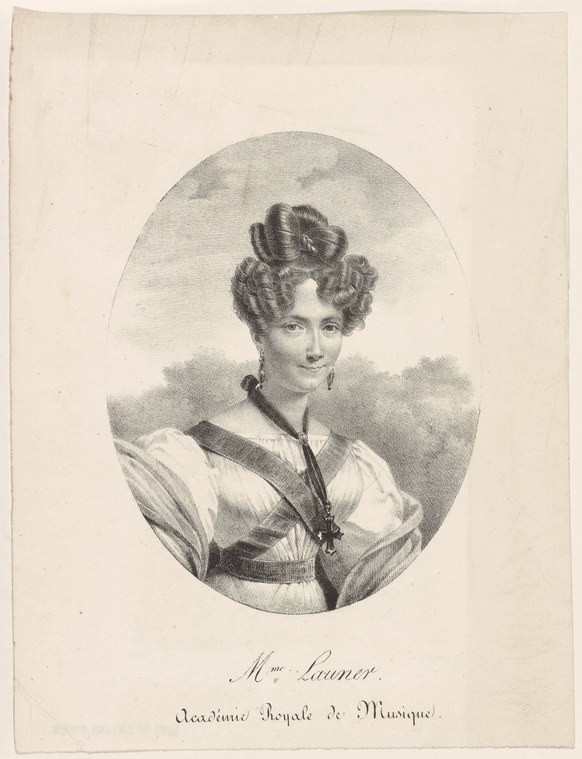
Mme. Launer. Académie Royale de Musique
Unknown artist
- Collection:
- Prints depicting dance
- Source:
- New York Public Library
- Rights:
- Public domain — free to use, share and adapt.
- Recorded as:
- Public Domain
While it does not depict dance in action, this print is a primary document of how female performers at the Paris Opera were publicly represented, dressed, and consumed as images in the early 19th century. It shows the sitter as a named individual with institutional affiliation, reflecting the professionalization and celebrity of stage performers in this period and the role of engraving in creating and distributing that celebrity.
What you are looking at
A young woman in early 19th-century dress is portrayed in a three-quarter-length oval format against a soft, clouded background. She wears a high-waisted white muslin gown typical of the Regency era, with a black ribbon or sash crossing diagonally from shoulder to waist. Her hair is arranged in elaborate loops and curls piled high on her head, a fashionable coiffure of the period. The woman's posture is upright and composed, her gaze directed toward the viewer with a subtle, refined expression. The image is rendered as an engraving, using fine parallel lines to model form and create tonal depth, particularly in the shadowing of the background and the subtle modeling of her face and neck.
The dancing
The figure stands in a frontal, stationary pose rather than mid-movement. Her shoulders are held level and back, her arms at rest along her sides, and her weight appears evenly distributed. There is no indication of active dance posture—no bent knees, no extension, no asymmetry of weight or frame. The stance is that of a posed portrait rather than a captured moment of dance.
The dance depicted
The image is labeled as depicting Mme. Launer of the Académie Royale de Musique, but it is not a representation of dance in motion. Mme. Launer was likely a performer or instructor at the Paris Opera during the early 19th century, and this engraving serves as a formal portrait rather than a documentation of her dancing. The work falls within the tradition of theatrical portraiture—prints of celebrated dancers published to circulate their likenesses among the public—but it captures the sitter in formal dress rather than performing costume or in the act of dancing.
How it was made
This is a line engraving, identifiable by the regular hatching and cross-hatching used to create tone and volume. The technique was the primary method for distributing theatrical portraiture in the early 19th century: individual prints could be produced in quantity and sold or collected, making actors and dancers recognizable to the public beyond those who attended live performances. The medium's precision and the refined execution here suggest a professional workshop production intended for a cultivated market.
About this work
This is a formal theatrical portrait engraving of a named performer at the Paris Opera in the early decades of the 19th century. It documents not a dance itself but the appearance and status of Mme. Launer—her dress, her bearing, her place within the institution of court and state-sponsored theatrical performance. It belongs to a large body of similar prints, collectively a visual archive of the Romantic-era stage and the dancers and musicians who populated it. These works circulated among the public as both souvenirs and status markers, making the faces and names of theatrical performers accessible in a way live performance alone could not.
How to look at it
Approach this as a portrait first and a document of theatrical culture second. The engraving's finish, the care taken in the rendering of fabric and hair, and the inscription below all signal that this is a formal publication—not a sketch or a quick record, but a finished product meant for purchase and display. Note the fashionable dress and the institutional attribution: this woman is being presented not as a generic performer but as a named member of a specific, prestigious institution. The oval frame, the neutral background, and the direct gaze are conventions of theatrical portraiture that emphasize the sitter's status and legibility as a public figure.
The artist
The engraver is not recorded. The style and production suggest a professional theater-print workshop, likely Parisian, working in the standard practice of the period: theater management or the performer themselves would commission an engraving for public sale, with the work executed by a jobbing engraver of competent skill but often not individually credited.
The period
The early 19th century saw an explosion in theatrical portraiture and celebrity, driven by the rise of Romanticism, the growth of urban leisure, and the expanding market for prints. The Académie Royale de Musique (the Paris Opera) was at the center of European dance innovation: it was the home of Romantic ballet, where Marie Taglioni and other celebrated dancers would premiere now-canonical works. Prints of performers served both as mementos of live performance and as circulation of image in advance of or independent of attendance. The high-waisted Empire silhouette and the elaborate hairstyle visible here date the work to approximately 1810–1820, placing it in the early Restoration period.
Where it lives
The work is held by the New York Public Library as part of its collection of prints depicting dance. The collection comprises diverse materials—engravings, lithographs, photographs—spanning centuries and geographies, united by dance as subject matter. This particular print is a representative example of early 19th-century European theatrical portraiture.
Questions about this work
Is this a dance image?
Not in the sense of depicting dance in motion. This is a formal portrait of a named performer at the Paris Opera, presented in fashionable dress of the period. It belongs to the genre of theatrical portraiture—prints of celebrated dancers and actors produced for public circulation. It documents the performer's status and appearance rather than capturing a moment of performance.
Who was Mme. Launer?
The print identifies her as affiliated with the Académie Royale de Musique (the Paris Opera), but no other biographical information is recorded. The inscription suggests she held sufficient status to merit a formal engraved portrait for public sale, a privilege not extended to all performers.
Why was this kind of print made and sold?
Theatrical portraiture served multiple functions: as mementos for patrons who had seen the performer on stage, as advertisements for future performances, and as luxury commodities for collectors of prints. They also created and reinforced the public celebrity of performers, making their faces and names familiar to people who might never attend a live performance.
More dance artwork





