49 works in this view — arrow keys or swipe to move between them.
Dance in Art
A black ball
Unknown artist
- Collection:
- Prints depicting dance
- Source:
- New York Public Library
- Rights:
- Public domain — free to use, share and adapt.
- Recorded as:
- Public Domain
This work does not depict dance and should not be catalogued within a dance gallery or collection. Its presence here suggests either a cataloguing error or a misunderstanding of the work's content.
What you are looking at
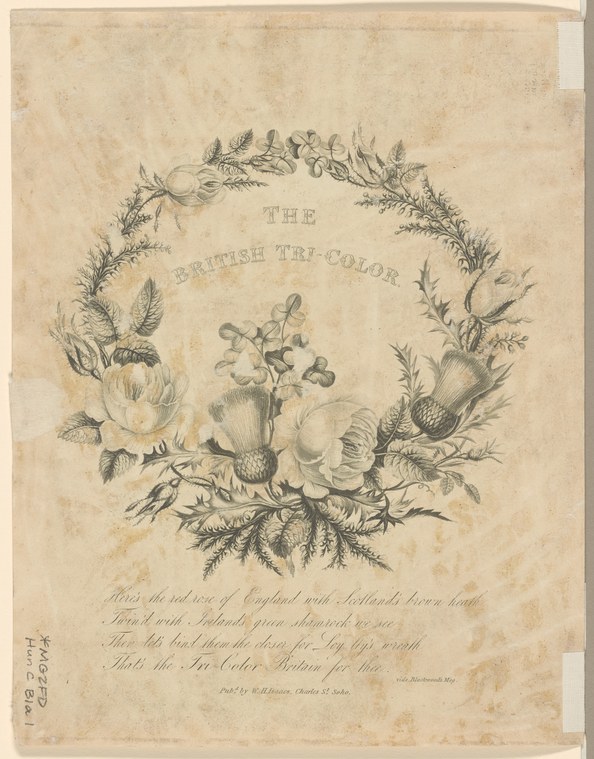
This is a title page or frontispiece for a work titled *The British Tri-Color*, rendered in black ink on aged paper. At the center stands an ornamental wreath composed entirely of botanical forms—roses, ferns, grasses, seed pods, and flowering stems—arranged in a roughly circular frame. The wreath is drawn with fine, delicate linework characteristic of engraving or etching. Within the wreath, the title appears in a lighter, spaced sans-serif typeface. Below the wreath, in fine cursive script, runs a dedication or explanatory text in four lines, too faint to read with certainty in reproduction but clearly integral to the work's meaning. The composition is symmetrical and formal, typical of 18th- or early 19th-century book ornamentation. The paper shows age and wear: foxing, stains, and discoloration across the surface suggest this is an archival object, not a modern reproduction.
The dancing
No human figures appear in this image. This is a decorative frontispiece or title page, not a scene of dancers or dance.
The dance depicted
No dance is depicted. The title *The British Tri-Color* and the botanical wreath suggest a patriotic or heraldic purpose, but the image contains no dancers, choreography, or movement. The work does not represent dance in any form.
How it was made
This appears to be an engraving or etching—likely engraving given the fine, uniform line weight and the precision of the botanical detail. The technique allowed for mass reproduction and was standard for book ornamentation in the 18th and 19th centuries, indicating this was produced for circulation among readers of some means. The age and condition of the paper suggest this is an original print or a very early impression, not a modern reproduction.
About this work
This is a decorative title page or frontispiece from a book or publication titled *The British Tri-Color*, rendered as a fine engraving or etching. The work is framed by an ornamental wreath of meticulously drawn botanical forms—flowers, ferns, and grasses—arranged in a classical circular garland. Below the title runs a cursive inscription, now faint with age. The object is archival: it bears the marks of centuries of handling and storage. It is catalogued as a print depicting dance, but contains no dancers, choreography, or movement of any kind.
How to look at it
Attend to the precision and variety of the botanical forms: each leaf, petal, and stem is individually drawn. Notice how the wreath achieves balance and movement through the arrangement of forms of different weights and textures, rather than through rigid geometry. The faint inscription below the wreath is part of the work's meaning and deserves attention, though it is now difficult to read.
The artist
The artist is not recorded. The engraving is competent and professional, suggesting work produced by a trained printmaker for commercial or institutional publication in the 18th or 19th century. The botanical precision and the refined line technique suggest a specialist in decorative ornament or book illustration.
The period
The style of the engraving, the typeface, and the condition of the paper all point to production in the late 18th or early 19th century, the era of refined neoclassical ornament and the height of British commercial printing. The title *The British Tri-Color* suggests a patriotic context, possibly during or after the Napoleonic Wars or in relation to British national identity in this period. The botanical wreath is typical of the period's taste for naturalistic ornamentation framed in classical symmetry.
Where it lives
The work is held in the New York Public Library's collection of *Prints Depicting Dance*. The catalogue record is minimal and contains no medium specification. This suggests the work may have been acquired as part of a broader collection without careful subject verification.
Questions about this work
Why is this in a dance collection if it shows no dancers?
This appears to be a cataloguing error. The work is a decorative title page with no choreographic or kinetic content. It may have been acquired as part of a larger collection and misfiled, or the cataloguer may have misread the title or context.
What does 'The British Tri-Color' refer to?
The exact meaning is unclear without access to the full text or inscription. 'Tri-color' typically refers to a flag or emblem of three colors. The work may relate to British heraldry, nationalism, or a specific historical event. The inscription, now faint, likely clarifies the reference.
Is this an original print or a reproduction?
Based on the condition of the paper, the foxing, and the handling marks, this appears to be an original 18th or 19th-century print, not a modern reproduction. The NYPL's conservation practices and catalogue suggest it is an archival object of some age and value.
More dance artwork





