49 works in this view — arrow keys or swipe to move between them.
Dance in Art
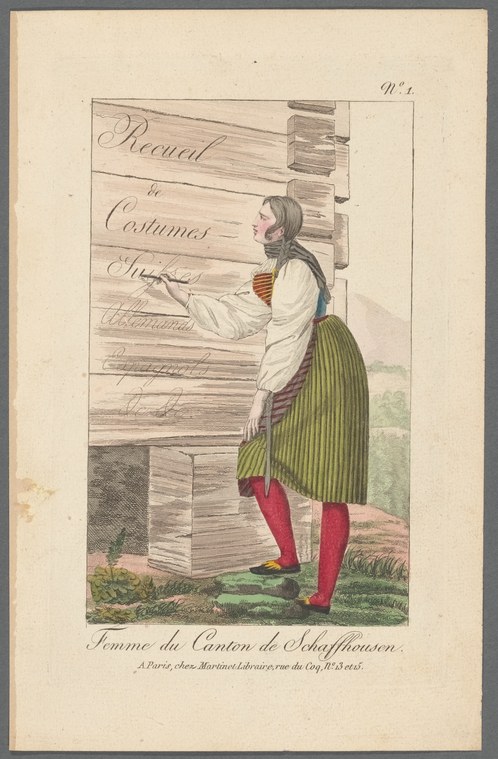
Femme du Canton de Schaffhousen [sic]
Unknown artist
- Collection:
- Prints depicting dance
- Source:
- New York Public Library
- Rights:
- Public domain — free to use, share and adapt.
- Recorded as:
- Public Domain
The work documents a specific moment when Swiss folk identity was being systematized and made visible through costume—a process parallel to the emergence of national folk dance traditions across 19th-century Europe. For dancers and historians, it provides exact visual evidence of what was worn during the period when Alpine folk dance was being codified and performed in formal contexts, rather than relying on written description alone.
What you are looking at
A woman stands in profile against a wooden plank wall, holding a sheaf of papers or documents labeled in French: 'Recueil de Costumes Suisses' (Collection of Swiss Costumes) and other partially legible text. She wears the traditional dress of the Canton of Schaffhausen: a white linen blouse with puffy sleeves, a fitted burgundy or wine-colored bodice with gold trim, and a full skirt in vertical green pleats that falls to mid-calf. Her legs are covered in red or burgundy stockings, and her dark hair is drawn back simply. The figure is rendered in hand-colored engraving or aquatint, with delicate flesh tones and careful detail to the textile weaves and folds. The background is plain and neutral, focusing all attention on the woman and the costume she displays. A small landscape vignette appears at the bottom, suggesting a Swiss Alpine setting.
The dancing
The woman stands upright, facing stage right, with her body in a relaxed but formal pose. Her right arm is raised and extended slightly away from her body to hold the documents; her left arm hangs naturally at her side. The posture is that of a display or presentation rather than active movement—she is a model showing costume rather than a dancer captured mid-motion. There is no visible engagement with a partner or group.
The dance depicted
This is not a depiction of dance but rather a costume study. The work documents regional Swiss dress of the early 19th century, specifically the folk costume of the Canton of Schaffhausen. Although such regional costumes were worn during folk celebrations and dances, the woman is posed as a static model, not in the act of dancing. The documents she holds suggest this is part of a larger illustrated collection or encyclopedia of Swiss regional dress, likely created for ethnographic or artistic documentation rather than to capture a specific dance practice.
How it was made
This is a hand-colored engraving or aquatint, identifiable by the fine line work, the controlled use of hatching for shadow, and the selective application of watercolor or hand-applied pigment. The technique allows for precise rendering of textile detail—the weave of the linen, the pleating of the skirt, the embroidery or trim on the bodice are all carefully delineated. The presence of printed French text and the professional finish suggest this was produced for publication, likely as part of a series of costume studies intended for a European audience interested in ethnographic or artistic documentation of regional differences.
About this work
This is a hand-colored engraving documenting the traditional dress of the Canton of Schaffhausen, Switzerland, likely dating to the early 19th century. The work is part of a larger documented collection ('Recueil de Costumes Suisses'), as indicated by the papers the model holds. Although folk costumes are intimately associated with regional dance traditions, this particular work functions as a costume study rather than a dance scene: the figure is posed formally as a display model rather than captured in movement. The work belongs in a dance history collection because costume is inseparable from the social and performative context of folk celebration, and because such compilations of regional dress were created during a period when European nations were increasingly conscious of folk identity and tradition as markers of national character.
How to look at it
The viewer should attend to the extreme care taken in rendering textile detail: the precise pleating of the green skirt, the embroidered or trimmed edge of the bodice, the fall of the white linen sleeves. These details are not merely decorative but constituted the actual dress worn in regional celebrations and dances. The formal, static pose is deliberate—the artist is making the costume itself the subject, inviting close examination of cut, color, and construction. The documents the woman holds signal that this is one of a series, part of a systematic project to document and preserve regional variation. The small landscape vignette at the bottom places the costume in a vaguely Alpine context, suggesting connection to place and tradition without depicting a specific event.
The period
The early 19th century saw a sustained European fascination with regional and national costume, driven by Romanticism's interest in folk authenticity and national identity. Publishers across France, Germany, and Switzerland produced lavishly illustrated costume collections, often arranged by canton, region, or nation. These were created partly for artists and theatrical designers seeking authentic detail, partly for an emerging bourgeois audience interested in picturesque 'types' and ethnic difference, and partly in service of nationalist projects that sought to codify and preserve folk traditions. Swiss costume studies were particularly popular, as Switzerland's Alpine geography and political federation made regional variation visually distinct and commercially interesting. The careful documentation of dress, embroidery patterns, and accessories in works like this one provided a visual record that informed both theatrical costume design and the preservation of folk practice.
Where it lives
The work is held in the Prints collection at the New York Public Library. The title and inscribed text identify it as part of a larger French-language publication documenting Swiss regional costume, suggesting it was created for circulation among French and European audiences rather than for local Swiss consumption.
Questions about this work
Is this a depiction of a dance?
No. Although the woman wears traditional Swiss costume that would have been worn during folk celebrations and dances, she is posed as a static model displaying dress rather than captured in movement. The work is a costume study, not a dance scene.
What region of Switzerland is documented here?
The Canton of Schaffhausen, located in northern Switzerland near the German border. The title 'Femme du Canton de Schaffhousen' identifies the wearer and the geographic origin of the costume.
Why would a dance history collection include costume studies that are not dance scenes?
Because costume is inseparable from dance practice and identity. Regional folk dances emerged from and expressed the culture of specific communities; their costumes are documentary evidence of that culture. Works like this one preserve detail about what people wore and how they presented themselves in public performance and celebration.
What are the documents the woman is holding?
The inscribed text identifies them as part of a 'Recueil de Costumes Suisses'—a collection of Swiss costumes. The woman is posed as if presenting or displaying costume samples, signaling that this engraving is one image within a larger, systematic publication.
More dance artwork





