49 works in this view — arrow keys or swipe to move between them.
Dance in Art
Iphigénie
Unknown artist
- Collection:
- Prints depicting dance
- Source:
- New York Public Library
- Rights:
- Public domain — free to use, share and adapt.
- Recorded as:
- Public Domain
This engraving documents the visual culture in which neoclassical ballet developed—the shared language of classical drapery, architectural grandeur, and heroic gesture that informed both theatrical design and dance composition. For historians of court ballet and the reform movement of the 18th century, the work shows how mythological subjects and formal posture were deployed across multiple art forms.
What you are looking at
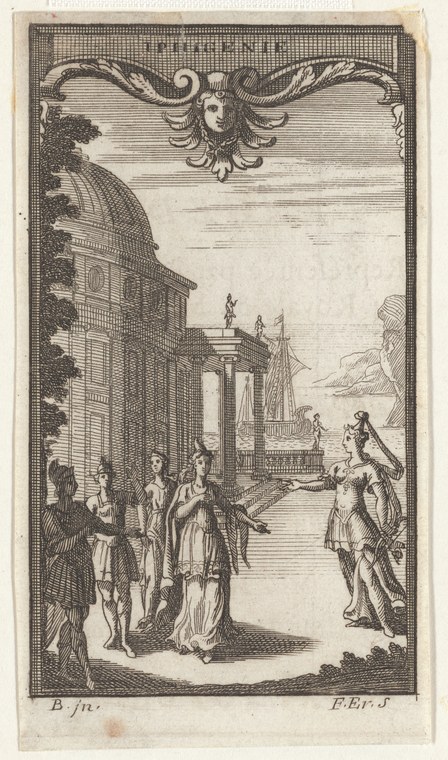
A classical architectural setting frames a ceremonial or theatrical scene rendered in fine engraving technique. The composition is dominated by a colonnade with prominent fluted columns on the left, receding into a landscape with mountains visible in the distance. In the foreground, a group of elegantly dressed figures in classical or neoclassical costume gathers in conversation or formal arrangement. The figures wear flowing drapery and the women's silhouettes suggest the late 18th century. A double-headed eagle emblem appears at the top center of the composition, framed within decorative scrollwork—a heraldic or imperial marker. The light is even and clear, typical of engraved work, with shadow created through careful line-work rather than wash. The scene reads as a moment of court ceremony or tragic tableau, combining architectural grandeur with intimate human drama.
The dancing
Seven to nine figures occupy the foreground, arranged in loose spatial relationship around the colonnade. Most wear high-waisted neoclassical dress; the women stand in graceful, upright postures with arms extended or draped, while the men wear shorter coats and stockings. No closed holds or partnered frame is evident. The gestures are restrained and formal—a raised arm here, a turning torso there—suggesting declamation or formal address rather than social dance. The composition favors standing poses and processional arrangement over active movement or footwork.
The dance depicted
This does not depict social or theatrical dance in the modern sense. The scene appears to illustrate a dramatic or mythological narrative—the title *Iphigénie* suggests the Greek tragic figure—rendered in the neoclassical idiom of the late 18th century. If movement is present, it is the formalized gesture of classical theatrical declamation or ceremonial procession, not choreographed dance. The figures' stances and drapery suggest influence from classical rhetoric and pantomime rather than dance technique of the period.
How it was made
This is a line engraving, executed with fine parallel hatching and cross-hatching to create tonal gradation and volume. The technique is characteristic of 18th-century reproductive prints, likely engraved after a painting or drawing. Engravings of this quality and subject matter were mass-produced for educated collectors and circulated through the print trade across Europe. The presence of a signature mark ('B. fin.' and 'E. Er.S' visible at lower left and right) suggests the work of two practitioners—one likely the designer, one the engraver—a standard division of labor in the period.
About this work
This is an 18th-century engraving of a neoclassical dramatic scene, likely illustrating Racine's tragedy *Iphigénie* or a contemporary theatrical adaptation. The work sits at the intersection of classical revival, theatrical design, and courtly ceremonial—a moment when dance, theater, and visual art shared vocabulary and aesthetic ideals. The architectural setting and classical drapery are direct references to the aesthetics of court ballet and neoclassical reform in the decades around 1750–1800. While the figures do not actively dance, the composition reflects the formal postures and gestural language that court ballet of this era adopted from antique rhetoric and mythological narrative.
How to look at it
Observe the careful arrangement of the figures in space: no pair forms a closed frame or active partnership; instead, the composition reads as a formal tableau or procession. Notice how the artist uses the architectural colonnade to create a stage-like setting—a technique borrowed directly from theatrical scenography. The drapery and posture of each figure echoes classical sculpture and neoclassical painting, conventions that 18th-century court ballet also adopted. The even, clear light and precise line-work allow you to read gesture and expression despite the formality of the medium.
The artist
The work is unsigned by the designer and bears only engraver's marks. The technique and style are consistent with the Parisian or Northern European print trade of the mid-to-late 18th century. The division of labor ('fin.' and engraver's mark) suggests professional workshop production for circulation among educated collectors and patrons of the arts.
The period
This engraving dates to the era of neoclassical reform in dance and theater (c. 1740–1800). In this period, dance theorists and choreographers such as Jean-Georges Noverre and Gaspare Angiolini called for reform of ballet toward greater naturalism and dramatic coherence, often drawing on classical literature and visual precedent. Simultaneously, engravers produced theatrical and mythological prints for collectors, creating a visual archive of how classical subjects were staged and costumed. The formal poses and draped costumes visible here reflect ideals that were being translated into choreographic vocabulary on stage.
Where it lives
This engraving is held in the New York Public Library's collection of prints depicting dance. It is part of a broader visual archive documenting the intersection of dance, theater, and printmaking in the 18th century.
Questions about this work
Is this a depiction of an actual dance?
No. While the scene reflects the formal postures and neoclassical aesthetics that influenced 18th-century court ballet, the figures are arranged in theatrical tableau or ceremonial formation rather than choreographed dance steps. The work illustrates a dramatic narrative (likely Racine's *Iphigénie*) in the visual language of neoclassical theater.
What does the double-headed eagle at the top mean?
The heraldic eagle is a marker of imperial or royal patronage, indicating that this theatrical or mythological scene was commissioned or approved by a court, likely French or a court aligned with French cultural ideals. It confirms the work's origin in elite visual culture.
Who created this print?
The engraver's marks at the bottom ('E. Er.S') identify the engraver, but the designer remains unrecorded in the catalogue. This division—designer and engraver—was standard practice in 18th-century print production, allowing rapid circulation of fashionable designs.
Why is this in a collection of dance imagery?
Although it does not depict active dance, this engraving belongs to the visual and cultural history of dance because it shows how the formal posture, drapery, and gesture of neoclassical ballet were developed from theater, classical art, and courtly ceremony. For historians of dance aesthetics and reform, it is an essential document.
More dance artwork





