49 works in this view — arrow keys or swipe to move between them.
Dance in Art
Miroir
Unknown artist
- Collection:
- Prints depicting dance
- Source:
- New York Public Library
- Rights:
- Public domain — free to use, share and adapt.
- Recorded as:
- Public Domain
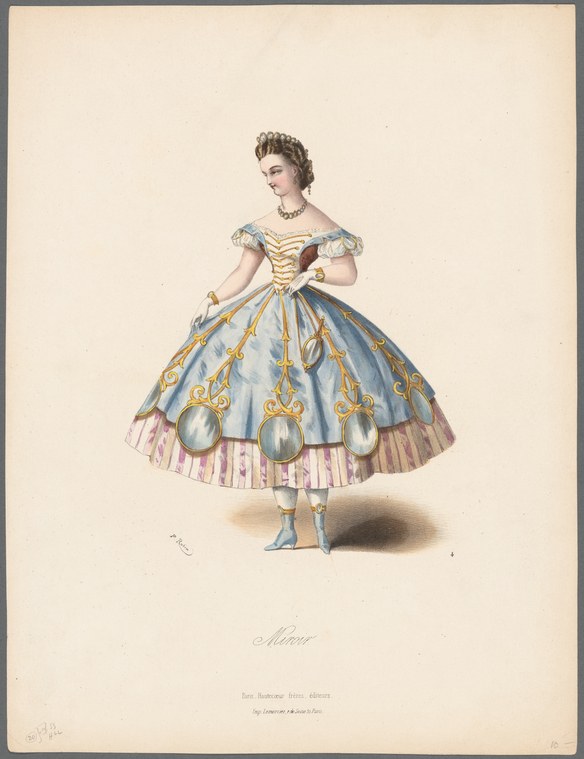
This print is evidence of how Romantic-era ballroom dancing was marketed, taught, and imagined: not as athletic virtuosity but as elegant feminine display. The title's invocation of the mirror suggests the dancer's self-awareness and the viewer's identification with her ideal appearance, revealing how social dance was tied to beauty, costume, and the performance of refinement. For historians of dance fashion and the social ballroom, this image documents the silhouette, ornament, and posture valued in mid-19th-century ballroom culture.
What you are looking at
A single female dancer stands centered against a plain background in a three-quarter pose, her body angled slightly to the left. She wears an elaborate mid-19th-century ball gown with a fitted bodice in pale yellow or cream with off-shoulder sleeves trimmed in white lace, and a voluminous skirt in pale blue silk. The skirt is decorated with gold scrollwork and adorned with three large oval medallions or lockets arranged around the hem, which is edged with pink and white striped fabric. She wears a pearl necklace and her hair is styled in the ringlets typical of the 1840s–50s, gathered with what appears to be a jeweled ornament. Her left arm hangs naturally at her side while her right arm is raised and bent, hand near her waist, in a pose suggesting movement or the moment of adjustment during dance. She wears pale blue stockings and small dancing slippers. The print is hand-colored, with soft shading that gives the figure dimension against the cream-colored paper. The inscription at the bottom reads "Miroir" in script.
The dancing
A single dancer is shown standing upright in an elegant, composed posture rather than in active motion. Her weight appears to rest evenly on both feet, with the right leg slightly bent and advanced, suggesting the moment just before or after a step. Her right arm is raised in a graceful arc, positioned somewhere between a frame position and a pose of self-regard—the gesture reinforces the title "Miroir" (Mirror), suggesting she is admiring or observing herself. The overall stance is one of formal presentation rather than narrative action, emphasizing the elegance of the costume and the refinement of the pose.
The dance depicted
This appears to be a record of social ballroom dance costume and deportment from the Romantic era, likely depicting a woman dressed for and posed as if performing a waltz, quadrille, or other ballroom dance of the 1840s–50s. The title "Miroir" (Mirror) suggests a self-aware moment within the dance, or the image itself functions as a "mirror" showing the ideal feminine dancer. The absence of a partner and the formal, almost static presentation suggest this is a fashion or dance record rather than a scene of active dancing. The styling is consistent with the ballroom repertory of the mid-Victorian era.
How it was made
This is a hand-colored lithograph or engraving, as indicated by the line work visible in the dress ornaments and hair, combined with applied watercolor or hand-coloring in the costume details. The technique allowed for mass reproduction of fashion and dance imagery, making this likely a commercial print circulated among dancers, dance teachers, and the fashionable classes. The refined hand-coloring and the careful rendering of lace, silk, and metallic ornament suggest this was a relatively expensive production aimed at an audience with purchasing power. The signature mark at the lower left corner indicates this was a published work with a named (though here unnamed or illegibly signed) artist.
About this work
"Miroir" is a hand-colored lithograph or engraved print from the mid-19th century depicting a fashionably dressed woman in the formal pose and costume of a Romantic-era ballroom dancer. Rather than capturing a moment of active choreography, the artist has chosen a moment of stillness and self-presentation, using the dancer's upright posture and elegantly raised arm to suggest grace and refinement. The elaborate decoration of the ball gown—the scrollwork and hanging ornaments of the skirt, the delicate lace sleeves, the jeweled hair ornament—indicates that this was as much a fashion plate as a dance record. The work belongs in a gallery of dance imagery because it documents the visual ideal of feminine ballroom dancing in its period, showing how dancers dressed, how they carried themselves, and how the dancing body was aestheticized in mid-Victorian visual culture.
How to look at it
Observe the pose carefully: the dancer is not captured mid-step or in the grip of a partner, but standing in a moment of composed presentation, as if pausing to admire her own reflection or to be admired. The raised right arm is key—it is neither the arm position of an active waltz nor a quadrille figure, but something closer to a portrait pose, suggesting introspection or self-regard. Notice how the artist has lavished detail on the costume: the scrollwork is rendered in gold leaf or gold paint, the three oval ornaments hang with almost sculptural weight, and the layered hem in striped fabric catches light. This attention to ornament over action tells you that the image is as much about fashion and display as about choreography.
The period
This print dates from the height of the Romantic ballet era (roughly 1830–1860), when the aesthetic of ethereal feminine grace dominated both theatrical and social dance. In ballrooms, the waltz and quadrille were the dominant social dances, performed by couples and sets dressed in increasingly elaborate costumes. This print sits at the intersection of dance and fashion media: lithographs and hand-colored engravings of dancers were commercial products, circulated as costume inspiration, teaching aids, and aspirational imagery for the dancing classes. The emphasis on costume detail and pose rather than action reflects both the technical limits of the medium and the cultural association of social dancing with display and refinement rather than narrative or virtuosic performance.
Where it lives
This print is held in the New York Public Library's collection of prints depicting dance. It appears to be a mid-19th-century commercial lithograph or engraving, likely produced in Europe (possibly France, given the French title and the style of the print) and circulated as a fashion and dance reference. The collection itself documents the history of dance imagery as a category of commercial and artistic production.
Dance in this work
Questions about this work
Is this a real dance, or is the pose invented?
The pose is stylized for presentation rather than documenting active choreography. The raised arm and upright stance suggest a moment of stillness within or between dances, or a formal pose for the sake of showing the costume and the dancer's carriage. Ballroom dancers of this era would have held such poses at moments of transition or rest, so the gesture is plausible, but the image is designed as a fashion and deportment record rather than a scene of dancing.
What does the title 'Miroir' mean?
"Miroir" means "mirror" in French. The title suggests that the dancer is observing herself, or that the image itself functions as a mirror—a record of ideal feminine beauty and ballroom elegance for viewers (particularly other dancers and the fashionable classes) to see themselves reflected in. It emphasizes the visual and self-aware aspect of social ballroom dance.
What dance is this?
The costume and era suggest this is ballroom dance of the 1840s–50s, most likely either a waltz or quadrille, the two dominant social dances of the Romantic period. The costume is too elaborate and formal to indicate any other dance tradition, and the lack of a partner visible suggests the pose is a costume and deportment record rather than a scene of a specific choreographed dance.
Who is this dancer?
The artist and the identity of the dancer are not recorded in the catalogue. This is a commercial fashion and dance print, likely representing an idealized type rather than a specific named performer. The print was produced for circulation among dancers and the fashionable classes, not for the documentation of a celebrity or notable dancer.
More dance artwork





