49 works in this view — arrow keys or swipe to move between them.
Dance in Art
Leopoldine Lesensky
Unknown artist
- Collection:
- Prints depicting dance
- Source:
- New York Public Library
- Rights:
- Public domain — free to use, share and adapt.
- Recorded as:
- Public Domain
Lesensky is an obscure figure in dance history, and this print may be one of the few surviving images documenting her appearance and the visual conventions surrounding performers of her generation. Early theatrical portraits are rare and valuable evidence of how dancers dressed, how they were styled for public consumption, and how they wished to be seen. The print itself—its technique, format, and circulation—tells us as much about the economics and culture of dance publicity in this period as it does about the individual.
What you are looking at
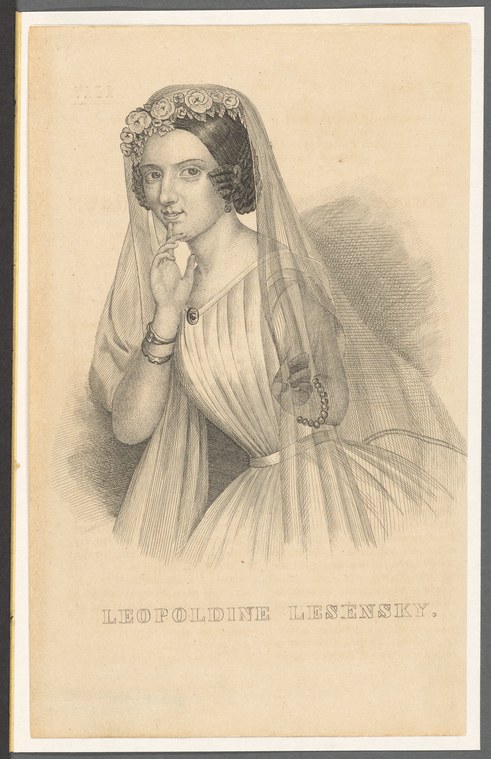
A three-quarter-length portrait of a young woman in early 19th-century dress, shown in a contemplative pose with her hand raised to her face. She wears a white or pale gathered dress with vertical pleating and a low neckline typical of the Regency period. A delicate veil or headdress drapes from an ornamental circlet of flowers or jewels that crowns her head, falling softly down her back and over her shoulders. The background is plain and neutral, rendered in soft shading that emphasises the figure. The woman's expression is pensive, her gaze directed downward or away, suggesting a moment of reflection rather than active movement. The entire composition is rendered as an engraving or lithographic print, with fine linear work defining the fabric textures and facial features.
The dancing
The figure stands in a relaxed contrapposto, weight settled on one leg, with one arm bent and hand raised to her cheek in a gesture of contemplation or mild melancholy. The pose is posed and mannered rather than energetic—a moment of stillness typical of early 19th-century portraiture. Her posture is upright and dignified, with shoulders drawn back. There is no indication of active dance movement, weight shifts, or the dynamic frame and tension that would characterise a dancer mid-performance.
The dance depicted
This is a portrait rather than a dance scene. While the figure's dress and the elegant draping of the veil suggest the formal ballroom context of the Regency era, there is no visible dance movement, partnering, or dynamic gesture. The contemplative pose and lowered gaze are incompatible with the active, socially engaged presentation required of dancers in contemporary dance imagery. The work may document the costume and aesthetic of a performer or society woman of the period, but it does not depict an act of dancing.
How it was made
The work is a black-and-white engraving or lithograph, likely produced from a drawn or painted original. The technique employs fine cross-hatching and linear detail to model the figure and suggest fabric texture, particularly in the pleated dress and flowing veil. This reproductive medium was standard for circulating theatrical and society portraits in the early 19th century, allowing multiple copies to reach a broad audience. The quality of the line work and the careful attention to costume detail suggest this was a professionally executed print, not a sketch.
About this work
This is a Regency-era portrait print of Leopoldine Lesensky, a woman known to the dance world of the 1820s–1830s. The image documents the aesthetic and dress conventions of early 19th-century performance culture, where elevated, decorative costume and refined deportment were essential to a dancer's or performer's public identity. Although the subject may have been a dancer, this particular work is a formal portrait, not a dance scene. It belongs in a dance archive as a document of how performers of this era were presented to the public and remembered in print—an indirect but valuable witness to the visual culture of Romantic-era theatre.
How to look at it
Attend to the costume details—the ornamental headdress, the pleated white dress, the delicate veil—which encode the aesthetic and status aspirations of Regency performance. The contemplative downward gaze is a portrait convention signalling refinement and interiority rather than a dance moment. The overall effect is designed to present the subject as both beautiful and melancholic, a visual language borrowed from high romantic art but applied here to a theatrical or society figure. The print technique itself, with its fine linear precision, elevates the subject through an association with fine art reproduction.
The artist
The artist is not recorded. The print was likely produced by a professional engraver or lithographer working in a European theatrical and society portrait trade, possibly in Vienna, Milan, or Paris, where Lesensky may have performed. The style and quality suggest competent commercial work rather than fine art.
The period
This print dates to the Romantic era in dance (roughly 1820–1850), when ethereal costume, vertical lines, and flowing drapery became markers of elevated taste and emotional refinement. The circlet headdress and pleated dress are characteristic of the fashion for Sylphide-like elegance that dominated theatrical performance after the success of *La Sylphide* (1832). Early 19th-century theatrical portraiture relied heavily on such engravings and lithographs to disseminate images of celebrated performers; these prints were sold at theatres, collected by enthusiasts, and reproduced in almanacs and periodicals. The work is thus both a portrait and a commodity in a newly commercialised visual culture of performance.
Where it lives
The print is held in the New York Public Library's collection of prints depicting dance. It survives as an example of early 19th-century commercial theatrical portraiture and reproductive printmaking.
Questions about this work
Who was Leopoldine Lesensky?
Little is documented. She appears to have been a performer active in the early 19th century, likely in Central European or Italian theatres. This print may be one of the few surviving records of her.
Is this an image of an actual dance?
No. This is a formal portrait. While the subject may have been a dancer or performer, the pose and setting are those of portraiture, not performance. The contemplative gesture and stillness are incompatible with dance imagery of the period.
What does the costume tell us?
The white pleated dress, ornamental headdress, and flowing veil are consistent with Romantic-era theatrical costume (1820s–1830s), reflecting contemporary ideals of ethereal elegance. This visual language became dominant in ballet and theatrical performance after *La Sylphide*.
How was this print made?
It is an engraving or lithograph, a reproductive technique that allowed theatrical portraits to be mass-produced and sold. The fine linear detail and professional quality suggest it was made by a trained printmaker working for a commercial publisher.
More dance artwork





