49 works in this view — arrow keys or swipe to move between them.
Dance in Art
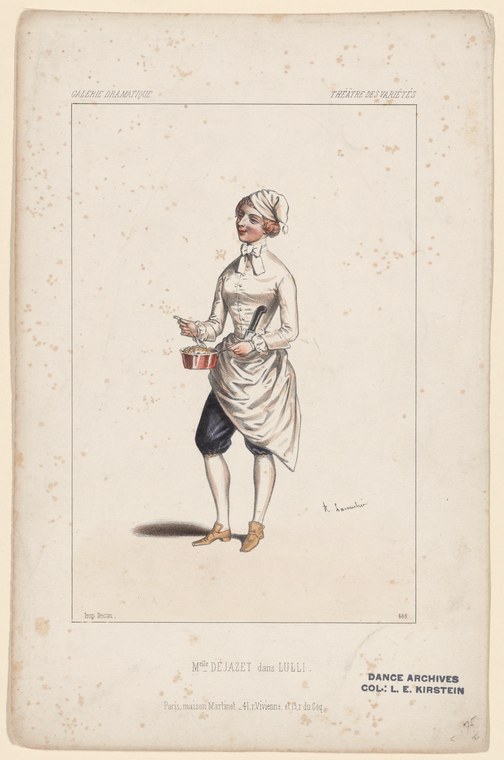
Melle Déjazet dans Lulli.: Théâtre des Variétés
Unknown artist
- Collection:
- Prints depicting dance
- Source:
- New York Public Library
- Rights:
- Public domain — free to use, share and adapt.
- Recorded as:
- Public Domain
This work documents the appearance and expected bearing of a professional female performer in late 18th-century Paris at a moment when women's roles on the commercial stage were expanding and becoming more diverse. It is evidence of how performers were marketed and consumed as public figures through mass-produced prints—a crucial mechanism of theatrical celebrity that shaped audience expectation and cultural memory.
What you are looking at
A woman in 18th-century theatrical costume stands in three-quarter view against a plain background, holding a small decorative object (possibly a fan or trinket box) in her right hand at waist level. She wears a pale, high-waisted chemise or shift dress with long sleeves and a deep neckline, topped with a small fichu or shoulder scarf tied at the neck. Her skirt is voluminous and slightly gathered or looped at the sides, revealing her lower legs and feet in heeled slippers. A dark underskirt or petticoat is visible beneath the pale outer layer. Her hair is styled upswept and pinned, with a cap or bonnet perched at the back of her head—a fashion typical of the 1780s–1790s. She stands with her weight on one leg, her posture elegant and composed, her gaze directed away to the left. The pose is one of repose rather than active movement, though her stance carries the controlled bearing of a professional performer.
The dancing
A single standing figure captured in a moment of stillness rather than dynamic motion. Her weight appears shifted onto her right leg, with the left leg relaxed and slightly advanced, a pose common in theatrical portraiture of the era. Her arms are at her sides with the right hand raised slightly to hold the small object; there is no suggestion of arm carriage associated with any particular dance technique. The posture is upright and dignified, with the shoulders back and the torso aligned—what one would expect of a trained performer in a formal or comic scene, but nothing here indicates active dancing.
The dance depicted
This is not a depiction of dance in progress. Rather, it is a theatrical portrait of the performer Mademoiselle Déjazet in character or costume from a production at the Théâtre des Variétés. The object she holds and the refined, composed pose suggest a dramatic or comedic scene requiring elegant standing and gestural business rather than dance. The reference to 'Lulli' in the title likely alludes to Jean-Baptiste Lully, the 17th-century French composer, though what role or narrative connection Déjazet had to Lully material in the 1780s–1790s (when this print appears to have been made) is unclear without further research into the Variétés repertory. The work documents theatrical costume and deportment of the period rather than a specific dance genre.
How it was made
This is a hand-colored engraving or etching on paper, recognizable by the fine linear hatching visible in the figure's rendering and the delicate line work of the composition. The technique allowed for wide distribution of theatrical portraits to an urban audience who attended the Parisian stage and collected prints of favorite performers—a common practice in late 18th-century France. The soft hand coloring (visible in the pale dress, flesh tones, and the red accent of the underskirt) distinguishes this from a simple black-and-white print, suggesting it was either a deluxe production or one aimed at a clientele willing to pay for color. The signature (partially legible) in the lower right indicates a named engraver, though the artist's name is not fully recorded in the catalogue.
About this work
This is a theatrical portrait print documenting a performer of the late 18th century in the costume and bearing expected of a professional actress at one of Paris's popular theatres. Mademoiselle Déjazet, a known entertainer of the period, is shown not in the act of dancing but in the poised, composed stance required of stage performers in dramatic or comedic scenes—the physical vocabulary of theatrical presence. The print belongs to a tradition of distributing images of celebrated performers to the theatre-going public, a practice that built celebrity and record of stage fashion and deportment. While dance may have been part of Déjazet's performances, this particular image captures a moment of stillness and dramatic poise rather than choreographed movement.
How to look at it
Attend to the pose: the slight weight shift and the composed, forward-gazing deportment that suggest a performer aware of being seen and evaluated. The careful attention to costume detail—the exact cut and trimming of the dress, the style of the cap, the color of the underskirt—reflects the importance of visual recognition in theatre; audience members bought prints to remember and collect images of performers they admired. The small object in her hand is a compositional anchor and a prop suggesting narrative or character; it adds specificity without explaining the narrative, leaving the viewer to supply context or knowledge of the performance.
The artist
The engraver's name is partially visible but not fully legible in the catalogue provided. The print comes from a commercial print trade in Paris, likely produced in the 1780s–1790s by one of the many workshop engravers who specialized in theatrical portraits. These artists worked from sketches or paintings by more celebrated portraitists and translated them into widely distributable engravings, often hand-colored in the studio. The work shows competent professional technique—the figure is proportioned correctly, the drapery is rendered with understanding of how cloth falls, and the costume details are precise—consistent with trained engravers working for the commercial theatre market.
The period
In the final decades of the 18th century, the Parisian commercial theatres (including the Théâtre des Variétés) served an expanding middle-class audience hungry for entertainment, spectacle, and novelty. The Variétés in particular was known for a mixed repertory of comedies, pantomimes, and light musicals, often featuring strong female performers in starring roles. The tradition of theatrical portrait prints reached its height during this period; every successful actor or actress expected to be immortalized in engraved form and sold at modest cost to fans and collectors. This was the age of the first modern theatre celebrities, and the print trade was the principal medium through which their images circulated before photography. Female performers occupied an ambiguous but increasingly visible position—they were celebrated and collected while simultaneously subject to moral scrutiny and legal restriction.
Where it lives
The work is held in the New York Public Library's collection of prints depicting dance, catalogued as coming from its broader holdings of theatrical and performance imagery. It is one of many similar portrait prints of Parisian performers produced for commercial sale in the late 18th century; such prints were often bound into albums or kept as loose sheets by collectors interested in theatre history and celebrity culture.
Questions about this work
Was Mademoiselle Déjazet a dancer or an actress?
The title and costume suggest she was a professional stage performer at the Théâtre des Variétés, a theatre known for comedy and light entertainment. The specific balance of dramatic acting and dance in her roles is not determined by this print alone. The Variétés frequently featured performers who combined spoken drama, pantomime, and dance in a single role, so she may have done all three; this image captures a moment of dramatic stillness rather than choreographed movement.
What does 'Lulli' in the title mean?
Jean-Baptiste Lully was a celebrated 17th-century composer associated with the French court and the origins of French opera and ballet. References to Lully in 18th-century theatre often invoked classical authority or nostalgia. Without access to records of the Théâtre des Variétés repertory for the relevant season, the exact nature of the connection between Déjazet and Lully material cannot be determined from the print alone.
How were prints like this used?
These theatrical portrait prints were sold cheaply to theatre audiences as souvenirs of performances and favorite performers. Collectors would buy them individually or have them bound into albums. They served as early versions of celebrity merchandise, allowing fans to possess and display images of performers they admired and helping to build and maintain a performer's public reputation between theatrical seasons.
Why is the image hand-colored if it is an engraving?
Hand-coloring was a common and economical way to add visual richness to engravings and etchings before color printing became standard. It was done in workshops by teams of colorists who applied watercolor or gouache to printed impressions by hand, allowing for rapid production of colored prints at modest cost while preserving the fine detail of the engraved line.
More dance artwork





