49 works in this view — arrow keys or swipe to move between them.
Dance in Art
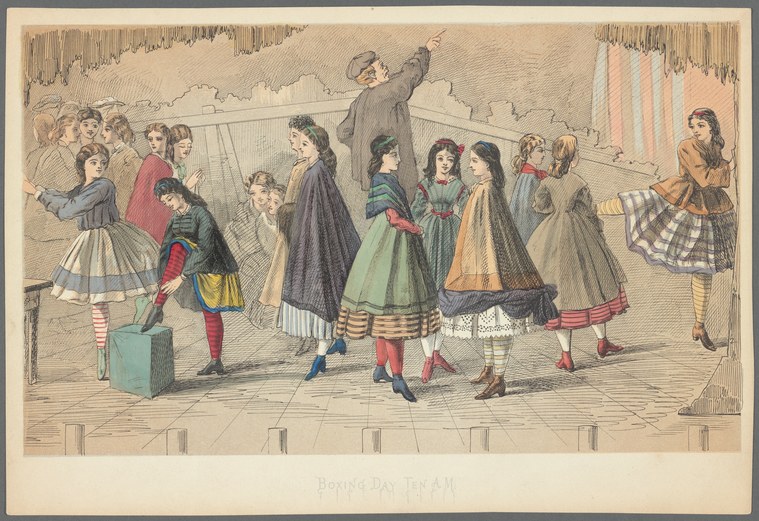
Boxing Day ten a.m.
Unknown artist
- Collection:
- Prints depicting dance
- Source:
- New York Public Library
- Rights:
- Public domain — free to use, share and adapt.
- Recorded as:
- Public Domain
This image is a rare record of recreational social dancing outside the ballroom and formal instruction contexts that dominate Victorian dance documentation. It shows dance as participants actually experienced it—as social, playful, and physical but not necessarily 'correct'—and captures the important role of holiday gatherings in young women's social lives. The vivid hand-coloring and the domestic scale of the print (suggesting it was created for family or parlor display) remind us that dance history includes the everyday and amateur as well as the professional and theatrical.
What you are looking at
A group of young girls and women, numbering around a dozen, stand and move together in what appears to be an indoor space—possibly a gymnasium or dance hall with high ceilings suggested by the architectural framework visible at top. The scene is dated Boxing Day (26 December), ten o'clock in the morning, as indicated by the inscription. The figures wear late Victorian or Edwardian era dress: high-necked bodices, full skirts reaching to the ankle, with many wearing colored petticoats visible beneath (reds, greens, yellows, oranges) and colored stockings—some striped, some solid. The composition suggests movement: several figures face inward toward the center of the group, others turn or tilt their heads, and the overall arrangement is informal and circular rather than arranged in formal lines. One figure at the back stands elevated, possibly on a bench or platform, with an arm raised. The hand-coloring in this print is bright and varied, emphasizing the festive quality of the occasion. The setting appears public or semi-public—institutional rather than domestic—with what may be a rope or net visible at the top, suggesting a gymnasium or sports facility repurposed for holiday entertainment.
The dancing
The dancers are arranged informally in a loose circle or conversational cluster rather than in formal pairs or sets. Most stand upright with relatively closed body positions, facing inward toward one another, suggesting social interaction rather than coordinated movement. Several have their heads tilted or turned toward neighbors. One figure at the rear stands on a raised platform with an arm raised in what might be a directing or encouraging gesture. The arms of most dancers hang at the sides or are held quietly; there is no evidence of the high-held arm positions or extended frames typical of formal ballroom dancing. The weight appears to rest evenly on both feet, and there is no visible indication of traveling steps or complex footwork—the impression is of static or near-static positioning punctuated by turning of the head and torso.
The dance depicted
This image most likely depicts a children's party game or recreational gathering rather than a formal dance style. The inscription 'Boxing Day Ten A.M.' places it on the day after Christmas, a major holiday for social gatherings and games in Victorian Britain. The arrangement, dress, and apparent informality suggest this may be 'Ring Around the Rosy,' 'Musical Chairs,' or another parlor game popular at children's holiday parties of the era, or possibly an informal group dance like the Cotillion or Quadrille being taught or organized. However, the lack of visible hand-holding, the absence of couples, and the generally static posture argue against a formal ballroom dance. Without clearer evidence of specific steps, holds, or formations, the dance content cannot be definitively identified, though the social and festive context is unmistakable.
How it was made
This is a hand-colored engraving or print, recognizable by the fine parallel line work visible throughout the composition and the even, controlled quality of the mark-making. The medium allowed for mass production and distribution, suggesting this was a popular or commercial image aimed at a broad audience—likely a newspaper illustration, periodical print, or affordable hand-colored print for domestic display. The hand-coloring (applied after printing in watercolor or similar medium) was a common and economical way to add visual appeal to black-and-white prints in the mid-to-late 19th century. The technique's accessibility and reproducibility indicate this image was created for a popular market, documenting a recognizable social scene of the period rather than a unique artistic composition.
About this work
This is a Victorian-era print documenting a Boxing Day children's party or recreational gathering, most likely from the 1880s–1900s based on the dress and illustration style. It captures an informal moment of social dancing or party games among young girls and women in what appears to be an institutional or semi-public space. The image is valuable not for depicting a specific codified dance style but for its documentary evidence of how ordinary Victorians—specifically young females of the middle class—celebrated holidays and participated in mixed-gender social recreation. The bright hand-coloring and cheerful composition celebrate the festive occasion, while the informality and variety of postures reflect the reality of social dancing as experienced by participants rather than as formally choreographed or instructed.
How to look at it
Observe the variety of postures and the lack of visual connection to a musician or formal instruction—this is not a 'lesson' or a performance, but a party. Notice the bright, varied colors of the underskirts and stockings, which suggest movement and liveliness but also individuality; each girl has chosen or been allowed her own combination. Look at the figure on the raised platform and consider whether she is leading, encouraging, or simply enjoying a better view. The informal circular arrangement is key: it is neither the rigid lines of a Quadrille nor the paired formation of Waltz or Polka, suggesting instead a game or a very relaxed social moment.
The period
The late Victorian and Edwardian era saw a revival of interest in traditional and informal social dances, particularly among the middle classes, as a reaction against both the rigid formality of high ballroom culture and the perceived vulgarity of music-hall entertainment. Boxing Day (26 December) was an important occasion for servants' balls, children's parties, and household celebrations, documented extensively in newspapers and illustrated periodicals of the era. The 1880s–1900s saw a proliferation of cheap, hand-colored prints aimed at the growing middle-class market, documenting fashion, social customs, and domestic life—precisely the audience and purpose this image served.
Where it lives
This hand-colored engraving is held in the New York Public Library's Prints collection as part of a broader holding of dance-related prints and illustrations. The collection documents visual representations of dance across periods and styles, and this image is catalogued as an example of 'dance' in a general sense, indicating the library's inclusive approach to dance as a category of visual culture.
Questions about this work
What is Boxing Day dancing?
Boxing Day (26 December) was a major occasion for social gatherings in Britain, including parties, games, and informal dancing. It was particularly important as a holiday for servants and working-class people, but middle-class families also held celebrations. Unlike formal ballroom dancing, Boxing Day entertainment was often informal, playful, and centered on games and group activities rather than refined technique.
Is this a specific dance or a party game?
It is difficult to identify a specific dance style from this image alone. The informal arrangement and static postures suggest this may be a party game like Musical Chairs or Ring Around the Rosy, or possibly an informal group dance like the Cotillion being organized informally rather than under strict instruction. The documentary nature of the print suggests it was capturing a real moment rather than illustrating a codified dance form.
Why are the girls wearing such colorful stockings and petticoats?
The bright colors are both fashionable and practical for a holiday celebration. Colored stockings and underskirts were fashionable elements of Victorian girls' dress, and they would have been visible during movement and dancing. The hand-coloring of the print also emphasizes these details, making the image more eye-catching and celebratory for contemporary viewers.
Who made this print?
The artist is not recorded in the catalogue. The style and subject matter suggest it was created as a commercial illustration for a newspaper, periodical, or affordable print market rather than as a unique artwork, which was typical for documentary social images of the period.
More dance artwork





