49 works in this view — arrow keys or swipe to move between them.
Dance in Art
Folk and ethnic dancing in wood engravings
Unknown artist
- Collection:
- Prints depicting dance
- Source:
- New York Public Library
- Rights:
- Public domain — free to use, share and adapt.
- Recorded as:
- Public Domain
For dance historians, this engraving is evidence of how European artists and audiences encountered and understood non-Western dance traditions in the 19th century. It captures the physicality and social context of Russian folk dance at a moment before such practices were systematized into ballet or formal performance. The image also reveals the visual codes—exuberance, asymmetry, folk dress, collective participation—by which "authenticity" and "folk" character were signaled to European viewers, codes that shaped how diaspora communities and their dances were later represented and consumed.
What you are looking at
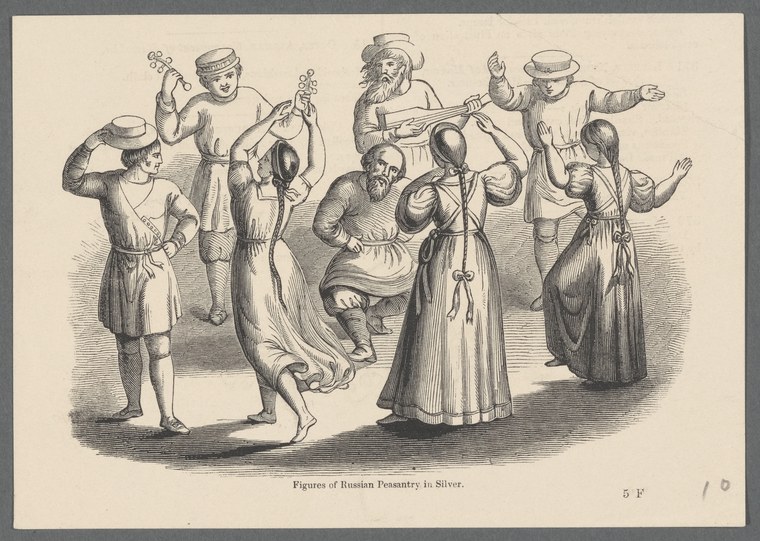
A wood engraving depicting Russian peasant dancers in a lively outdoor or tavern setting. Seven figures occupy the composition: at center, a bearded man in traditional dress plays a stringed instrument (likely a balalaika or similar folk fiddle) while seated or in a low crouch. Around him, peasants in simple tunics and long dresses gesture expansively, some with arms raised in celebration, others in poses suggesting active dance steps. The figures wear simple cloth hats and loose garments; the women's skirts are rendered with fine parallel lines suggesting movement and fullness. The engraving uses cross-hatching to create shadow and volume, with the background left plain to focus attention on the figures. The mood is one of rustic festivity and spontaneous music-making, captured in a moment of communal enjoyment.
The dancing
The dancers display open, exuberant postures characteristic of folk revelry rather than formal technique: raised arms, bent knees, and twisted torsos suggesting vigorous stepping and turning. One figure appears to be executing a low squat or knee-bending move (possibly a prisyadka or similar Slavic step). The poses are asymmetrical and varied rather than synchronized; each dancer occupies an individual moment within the collective celebration. No couple holds are visible; the dancers move independently around the central musician, their gestures emphasizing personal exuberance over partnered choreography.
The dance depicted
This depicts Russian peasant or folk dancing, most likely from the 19th century or earlier, when such scenes were frequently recorded by Western artists and engravers seeking to document "exotic" or picturesque rural life. The centrality of the musician and the informal, energetic postures suggest a village celebration or festival dance. The raised-knee and squatting movements hint at Slavic regional styles such as the prisyadka or Russian troika, though the engraving is too generalized to identify a specific named dance. The image records the participatory, music-centered nature of Russian folk dance rather than the formal structure of court or theatrical styles.
How it was made
This is a wood engraving on a fine-grained block, allowing for the precise parallel lines (hatching and cross-hatching) that define form and texture. The medium was widely used in the 19th century for book and periodical illustration, making such scenes accessible to a mass educated audience in Britain and Europe. The technique's capability to render fine detail and tonal gradation made it ideal for ethnographic and picturesque documentation. The print's circulation as a published illustration (suggested by the plate mark and formal numbering "5 F") indicates it was part of a series or collection aimed at European readers curious about non-Western or rural cultural practices.
About this work
This wood engraving presents Russian peasant dance as picturesque spectacle for a 19th-century European audience. The work belongs to a long tradition of artists depicting folk life and "authentic" rural culture—practices that both celebrated and exoticized non-aristocratic peoples. The image captures genuine elements of Russian celebration: the prominent musician, the spontaneous and individual movement vocabulary, the communal festivity. Yet it does so through the formal conventions of European printmaking, rendering the scene legible and aesthetically orderable for viewers unfamiliar with Russian village life. The work thus sits at the intersection of documentary impulse and romantic idealization.
How to look at it
Attend first to the central musician: he anchors the scene and makes clear that this is music-centered dance, not movement prescribed by a choreographer. Notice the variety of arm positions and levels—no two dancers mirror each other. The bent knees, raised heels, and twisted torsos suggest a movement vocabulary emphasizing natural exuberance and individual expression rather than the extended lines and turned-out legs of European academic dance. The engraver's choice to show the moment of maximum energy and raised arms, rather than a symmetrical or stationary pose, conveys the festive, uncontrolled character the image wishes to convey.
The artist
The artist is not recorded. The engraving's style and numbering suggest it was part of a commercial illustrated series or compilation, possibly a mid-to-late 19th-century ethnographic or travel publication. Such series often employed staff engravers working from sketches or earlier images rather than original observation, meaning this scene may be derivative or composite rather than firsthand documentation.
The period
The 19th century saw intense European interest in folk culture and national character, fueled by Romanticism and the nascent study of ethnography. Russian dance was particularly fashionable in Western European circles following increased contact with Russia after the Napoleonic Wars and later through diplomatic and cultural exchange. In the 1830s–1860s, Russian Imperial Ballet was itself drawing on folk motifs (as in La Sylphide and Giselle's "peasant" scenes), even as Western artists sought to document the "original" village dances from which these theatrical versions derived. The wood engraving sits within this double movement: toward both the romanticization of folk authenticity and the incorporation of folk elements into formal ballet.
Where it lives
The work is held as part of the New York Public Library's collection of prints depicting dance. The plate number "5 F" and formal layout suggest it is one plate from a larger series; the catalogue record does not provide the series title, publication date, or original publisher. It is catalogued as belonging to a broader category of historical folk and ethnic dance imagery.
Dance in this work
Questions about this work
Is this a real dance or a Western invention?
The elements depicted—the musician, the knee-bending steps, the communal participation—reflect genuine features of Russian folk dance. However, the image is a Western engraver's interpretation, not a documentary photograph. It simplifies and aestheticizes the scene for European viewers, emphasizing the picturesque and the exotic. It should be read as evidence of how Europeans saw Russian dance, not as a complete or unmediated record of it.
Why is the musician seated at the center?
In Russian village celebrations, the musician (playing a balalaika, domra, or fiddle) was often the anchor of the gathering. Dancers moved around and responded to the music live, rather than dancing to preset choreography. Centering the musician in the composition emphasizes the music-driven, participatory nature of the form—quite unlike the choreographer-centered ballet that was taking shape in formal theaters at the same time.
Could this be a ballet scene rather than actual folk dance?
The caption explicitly names it "Russian Peasantry in Silver," suggesting the artist intended to document actual village life. However, the engraving's level of formal composition and the refined rendering suggest European artistic conventions at work. It may be based on a traveling artist's sketches, an earlier painting, or even a stylized reconstruction. It represents a Western idea of Russian peasant dance as much as the thing itself.
More dance artwork





