49 works in this view — arrow keys or swipe to move between them.
Dance in Art
Amalia Brugnoli Samengo
Unknown artist
- Collection:
- Prints depicting dance
- Source:
- New York Public Library
- Rights:
- Public domain — free to use, share and adapt.
- Recorded as:
- Public Domain
This print documents the veneration of the Romantic-era ballerina as a celebrity figure worthy of commemorative portraiture. It shows how 19th-century print culture elevated and circulated the images of dance performers, helping to establish them as public personalities and cultural icons rather than merely skilled practitioners.
What you are looking at
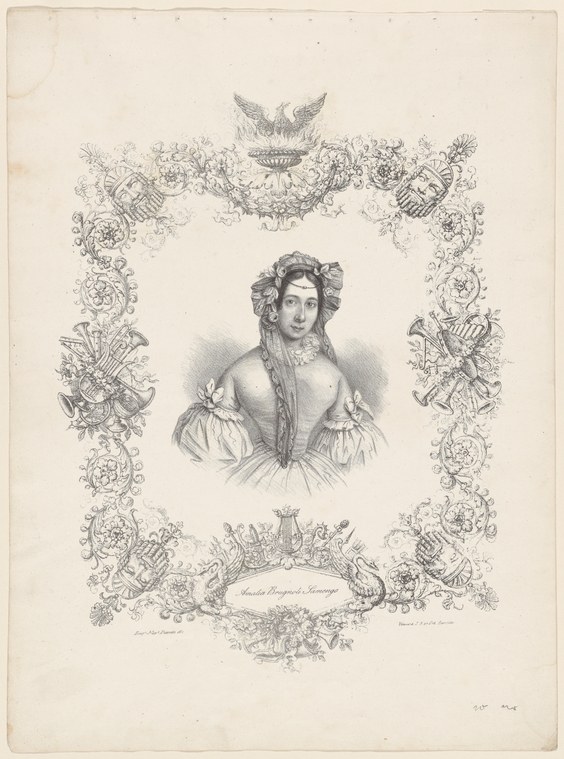
A portrait of a woman occupies the center of this engraving, framed by an elaborate ornamental border of botanical and allegorical elements. The sitter wears her dark hair in ringlets and gazes directly outward, her shoulders bare or loosely draped. She is dressed in what appears to be a corseted bodice with voluminous sleeves or shoulder treatment typical of early 19th-century theatrical costume. The ornamental frame surrounding her is densely populated with scrollwork, floral garlands, theatrical masks, musical instruments, cornucopias, and military emblems — visual references to performance, abundance, and spectacle. At the top of the frame, a classical eagle spreads its wings. At the base, a cartouche contains text that appears to read "Amalia Brugnoli Samengo" or similar. The overall composition is characteristic of a celebrity portrait or theatrical souvenir, designed to circulate as a print.
The dancing
The central figure is a three-quarter-length portrait showing the upper body and head. Her posture is upright and frontal, with a composed, direct gaze typical of formal portraiture rather than action. There is no visible movement, no partner, and no indication of active dance; this is a portrait of a named individual rather than a depiction of dance itself. The costume and presentation suggest a professional performer, likely a dancer given the theatrical context of the frame.
The dance depicted
This is a portrait of a performer rather than a scene depicting dance. The subject is identified as Amalia Brugnoli Samengo, an Italian ballerina of the 19th century known for Romantic-era ballet. The ornamental frame—with its theatrical masks, musical instruments, and allegorical flourishes—identifies her as a celebrity of the stage, and the high-quality engraving suggests she was a figure of sufficient prominence to warrant a commemorative print. No specific dance or moment is illustrated; instead, the work celebrates the dancer's identity and status.
How it was made
This is a steel or copper engraving, a reproductive print technique that allowed multiple impressions to be made from a single plate. The fine hatching visible in the modeling of the face and the delicate rendering of the ornamental border demonstrate skilled line-engraving. The technique was ideal for creating affordable, widely distributed celebrity portraits and theatrical souvenirs in the early-to-mid 19th century. Engravings of this type were common souvenirs collected by ballet enthusiasts and circulated commercially as sheet prints.
About this work
This is a commemorative engraved portrait of Amalia Brugnoli Samengo, an Italian ballet dancer of the 19th century. It does not depict an act of dancing but rather immortalizes the performer herself through a formal portrait framed in a celebration of theatrical culture. The ornate border—crowded with the symbols of music, drama, and spectacle—positions her within the world of Romantic-era performance and suggests her significance as a stage celebrity. Such prints were essential to the cult of the dancer in the 19th century: they circulated widely, were collected, and helped establish the public image and prestige of celebrated performers.
How to look at it
Do not expect to see dance in action here. Instead, observe the frame: what it contains tells you what a 19th-century viewer understood about ballet and its glamour. The theatrical masks and musical instruments signal the world of performance; the eagles and cornucopias invoke classical authority and abundance. The sitter's formal pose and direct gaze model the professional distance and composed dignity expected of a celebrated performer. This is a portrait designed to be looked at as a flattering image of a famous person, not as a record of movement.
The artist
The artist is not recorded in the catalogue. The engraving is competently executed in the style of 19th-century theatrical portraiture, and the quality suggests a professional printmaker working for a commercial publisher. Many such celebrity ballet prints were produced anonymously or attributed only to the publisher.
The period
This print was made during the height of the Romantic ballet era (early-to-mid 19th century), when the ballerina became a central figure in European entertainment and culture. Amalia Brugnoli was an Italian dancer known for virtuosity in the Romantic repertoire. The 19th century saw an explosion in theatrical portraiture and souvenir prints—images of famous singers, dancers, and actors were collected by fans and helped establish the modern celebrity. This engraving is part of that cultural phenomenon, in which the dancer's image became a commodity and a form of cultural capital.
Where it lives
The work is held in the New York Public Library's collection of prints depicting dance. It is an example of the commercial theatrical portraiture and dance ephemera that formed the culture of 19th-century performance.
Questions about this work
Who was Amalia Brugnoli Samengo?
An Italian ballerina of the 19th century, active during the height of Romantic ballet. She was celebrated enough to merit a commemorative engraved portrait, indicating she was a star performer of her era. The print is one of the ways her image and fame were distributed and preserved.
Why doesn't this show her dancing?
This is a celebrity portrait, not a genre scene. It celebrates the dancer as a person and a public figure rather than documenting a specific performance or dance technique. The ornate frame does the work of evoking the theatrical world; the portrait itself emphasizes the individual's dignity and star status.
What are all the symbols in the frame?
The frame is crowded with theatrical imagery: masks (drama and comedy), lyres and musical instruments (music), cornucopias (abundance and prosperity), eagles (classical grandeur and imperial power), and wreaths and scrollwork (honor and celebration). Together they create a visual claim that this person is a celebrated artist worthy of classical tribute.
More dance artwork





