49 works in this view — arrow keys or swipe to move between them.
Dance in Art
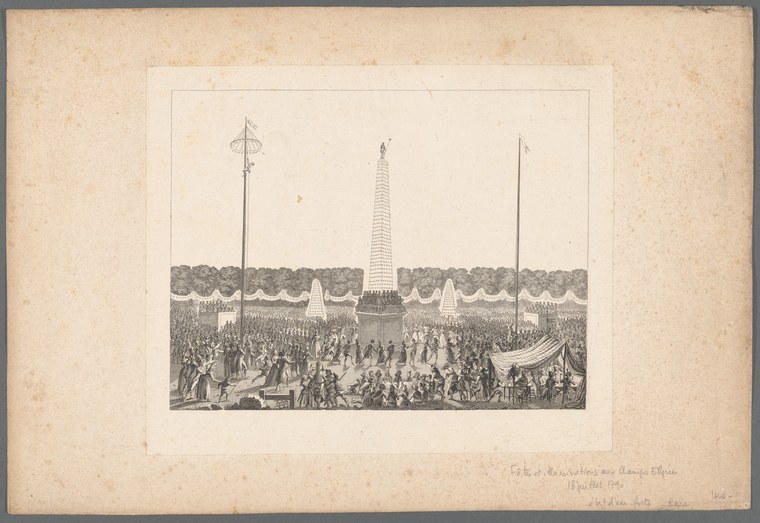
Fêtes et illuminations aux Champs-Elysées, le 18 juillet 1790
Unknown artist
- Collection:
- Prints depicting dance
- Source:
- New York Public Library
- Rights:
- Public domain — free to use, share and adapt.
- Recorded as:
- Public Domain
This image shows how Revolutionary ideology mobilized the bodies and presence of ordinary citizens in public space, replacing aristocratic court ritual with mass civic spectacle. For historians of dance and society, it documents the visual language of Revolutionary gatherings and the shift from elite ballroom to popular public assembly—a transformation central to understanding how dance and ceremony became tools of political change.
What you are looking at
A vast crowd gathers in an open space marked by three tall flagpoles—one ornately decorated, two plain—beneath which stands a massive obelisk or needle monument at the center. The engraving depicts the Champs-Élysées during the Festival of the Federation on 14 July 1790 (the manuscript annotation reads "18 juillet 1790," but this commemorates the first anniversary, celebrated on 14 July). Thousands of figures populate the scene in loose clusters and processional groups. The crowd wears the dress of the Revolutionary period: high-crowned hats, loose coats, and the long dresses typical of the 1790s. Some figures carry flags or standards; others process in formation. The composition emphasizes the scale and spectacle of civic celebration rather than the specific movements of individual dancers. Trees border the scene along the top edge, and the entire space has the character of a public ceremony organized for collective participation rather than a performance watched from a fixed viewpoint.
The dancing
The thousands of individual figures are rendered in summary form—mostly standing, clustering, or moving in loose procession. No closed ballroom holds are visible, and the bodies do not display the codified postures of theatrical dance. Instead, the crowd appears to move as an undifferentiated mass, with some figures distinguishable by dress or position but none executing recognizable choreography. This is a crowd in motion at a civic festival, not an ensemble of trained dancers.
The dance depicted
This image documents not a dance performance but a public festivity and civic procession. The Revolutionary festivals of the early 1790s, particularly the Festival of the Federation (established in 1790), combined patriotic ceremony, military display, and popular participation. While illuminations, music, and processional movement would have been part of the experience, this engraving does not show structured dance as a primary activity. If dancing occurred during the evening festivities, it is not the subject of this representation, which focuses instead on the monumental gathering and the symbolic landscape of flags and obelisk.
How it was made
This is an engraving, rendered in fine lines on paper. The technique allows for precise representation of architectural and crowd detail at small scale, making it suitable for circulation as a broadsheet or print commemorating a major public event. The fine hatching and linear detail suggest professional execution and a relatively wide intended audience—such prints were distributed to document and celebrate Revolutionary civic ceremonies. The survival of a manuscript annotation on the print indicates this is a working copy or archive copy, not a finished commercial impression.
About this work
This engraving depicts the Festival of the Federation celebrations on the Champs-Élysées in Paris in 1790, a pivotal moment in Revolutionary civic spectacle. Rather than representing choreographed dance, it documents a vast public gathering organized around patriotic symbols—the flagpoles and obelisk monument—and the participation of thousands of ordinary Parisians. The print belongs to a category of Revolutionary commemorative prints that aimed to publicize and legitimize the new regime through images of collective civic participation. For dance historians, it is valuable as evidence of how public space, crowd movement, and festival culture intersected in the 1790s, even when formal dance was not the primary activity being depicted.
How to look at it
Attend first to the monumental center—the obelisk and three flagpoles—which organize the composition and the crowd's movement. Note the effort to represent thousands of distinct figures rather than a choreographed group; the artist's challenge was to show mass without loss of legibility. The scattered flags and standards suggest processional order, but the overall composition emphasizes gathering and presence rather than synchronized movement. The high viewpoint—as if from above—is typical of prints documenting civic or military assemblies, and it reinforces the sense of scale and collective participation rather than spectatorial viewing.
The artist
The artist is not recorded. The print was likely produced by a professional engraver working in Paris during the Revolutionary period, when demand for commemorative and political prints was high. Many such prints were published anonymously or with only the publisher credited.
The period
The Festival of the Federation was instituted in 1790 to commemorate the storming of the Bastille and the Declaration of the Rights of Man. These festivals were explicitly designed as replacements for aristocratic court ceremony and became key expressions of Revolutionary civic ideology. They combined military parades, religious services, and public assembly—with music and spontaneous social dancing often occurring in the evenings. The use of monumental symbols (obelisks, flags) reflected the Revolutionary ambition to transform public space and collective experience. This engraving belongs to a large corpus of prints documenting Revolutionary spectacles and ceremonies, produced to circulate images of the new regime's power and legitimacy.
Where it lives
The print is held in the New York Public Library's collection of prints depicting dance. The manuscript annotation on the print identifies the date and location and may represent cataloguing or archival marking by a previous owner or the library itself.
Questions about this work
Is this actually a dance image?
Not primarily. It documents a civic festival and public gathering. While music and social dancing may have occurred during the festivities, this engraving focuses on the ceremonial assembly and monumental landscape rather than choreographed or folk dance. It is valuable for understanding how public space, crowd movement, and festival culture related to dance and ceremony in the Revolutionary period.
What is the obelisk in the center?
The monument is likely a temporary or symbolic structure erected for the Festival of the Federation. The Revolutionary festivals used monumental symbols—obelisks, arches, altars—to reinvent public space and replace aristocratic court ritual with civic ceremony.
Why is there a discrepancy between the title (July 18) and the Festival of the Federation (July 14)?
The Festival of the Federation was celebrated annually on 14 July; if the annotation reads '18 juillet 1790,' it may refer to a related ceremony or secondary celebration, or the annotation may be an archival error. The image itself commemorates the Festival of the Federation, the major civic ceremony of 1790.
More dance artwork





