49 works in this view — arrow keys or swipe to move between them.
Dance in Art
European folk dancing in prints
Unknown artist
- Collection:
- Prints depicting dance
- Source:
- New York Public Library
- Rights:
- Public domain — free to use, share and adapt.
- Recorded as:
- Public Domain
These prints matter chiefly as evidence of 19th-century European visual culture, costume, and social geography rather than as dance documentation. However, the incidental figures in fashionable period dress offer a window into how Romantic-era painters and engravers positioned human society within sublime landscape—a context in which dance and social gathering occurred but are not the primary subject.
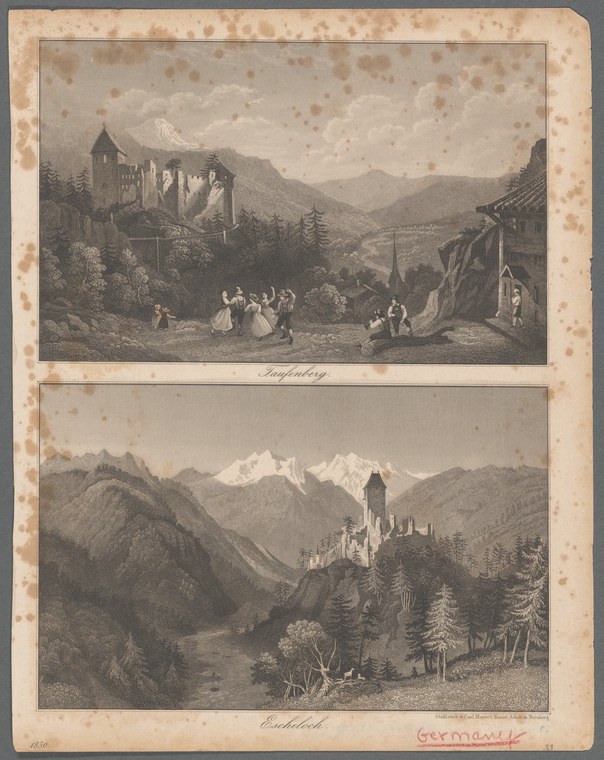
What you are looking at
Two Romantic-era landscapes engraved in sepia or brown ink, stacked vertically on a single page. The upper print, titled "Tannhäuser," shows a Gothic castle with crenellated towers nestled in a densely forested valley, its architecture suggesting medieval Germany. In the foreground, a group of figures in period dress gathers on a grassy slope—some standing, some seated—watching or conversing. Snow-capped mountains rise in the distance. The lower print, "Neuschwanstein," depicts a fairy-tale castle perched dramatically on a rocky crag above a river valley, with steep forested slopes framing the composition and Alpine peaks visible beyond. The castle's multiple spires and turrets dominate the landscape; small figures appear near the base and in the valley, conveying the vast scale of the setting. Both prints employ atmospheric perspective with detailed foreground foliage and progressively lighter, hazier distant peaks typical of 19th-century Romantic landscape engraving.
The dancing
In the upper print, the foreground group contains roughly eight to ten figures in Romantic-era dress—women in long skirts and fitted bodices, men in coats and hats. They are arranged in loose conversation or promenade formation rather than in any structured dance hold or configuration. No bodies display the frame, posture, or alignment of formal ballroom or folk dance; instead, they suggest leisurely social gathering in a landscape setting. The figures are small in scale relative to the architectural and natural features, emphasizing the sublime scale of the scenery over choreographic detail.
The dance depicted
No recognisable dance is depicted in either print. While the upper image includes human figures in a social gathering, their arrangement and posture show no evidence of structured choreography, formal dance hold, or folk movement vocabulary. The figures appear to be promenading or conversing—a common motif in Romantic landscape prints meant to provide narrative interest and scale. These are landscape prints with incidental figures, not dance documentation or genre scenes devoted to depicting dance.
How it was made
Both prints are engravings or possibly steel engravings executed in brown or sepia ink, characteristic of 19th-century topographical and Romantic landscape prints. The technique—fine line work, cross-hatching for tone and shadow, careful atmospheric perspective—suggests these were mass-produced illustrations, likely from a series of German or Alpine views intended for a broad middle-class audience. The page bears yellowing and foxing consistent with age and archival storage. The paired vertical composition suggests these images were part of a bound collection or portfolio.
About this work
This object is a page of two 19th-century landscape engravings depicting German Romantic sites—the Tannhäuser and Neuschwanstein castles—framed by narrative figures and Alpine scenery. The prints belong to the Romantic movement's fascination with Gothic revival architecture, sublime nature, and the picturesque. While they include human figures in period dress, the works are primarily landscape and architectural in purpose, not devoted to depicting or documenting dance. Their inclusion in a collection about dance in art appears to reflect a broader thematic sweep—European culture, costume, and social custom—rather than a focus on choreographic content.
How to look at it
View these as landscape prints first: attend to the composition, the placement of the castle as focal point, the recession into distance, and the use of human figures to establish scale and narrative atmosphere. The figures in the upper print are positioned to suggest leisurely observation—they face the castle and landscape, gathering as spectators rather than performers. The lower print subordinates figures almost entirely to architectural and natural grandeur. The artist's choice to populate these scenes lightly with period-costumed figures reflects Romantic convention—landscape as stage for human experience—rather than any intention to document social movement or dance.
The period
These engravings belong to the early-to-mid 19th century, an era of intense European Romanticism, German nationalism, and fascination with medieval history. The Tannhäuser legend—the subject of Wagner's 1845 opera—was part of a broader medieval revival in German culture. Neuschwanstein Castle was commissioned by King Ludwig II of Bavaria in 1869 as a neo-Gothic fantasy, making prints of it popular after the 1870s. The engraving technique, paired composition, and sepia tone are consistent with luxury art book and travel portfolio production for educated European audiences. Dance in this period was shifting from court formality toward both academic ballet and renewed interest in folk tradition, though neither is visible here.
Where it lives
These prints are held in the New York Public Library's collection of prints depicting dance. The provenance and publication history are not recorded in the available catalogue entry. The page itself shows age-related wear and discoloration consistent with 19th-century archival storage.
Questions about this work
Are there dancers in this image?
No. The figures visible, particularly in the upper print, appear to be promenading or conversing in a landscape setting, not performing a structured dance. They are incidental to the landscape and architectural subject matter.
Why is this in a dance art collection?
The collection may include broader documentation of European cultural practice and costume across periods. These prints preserve images of 19th-century period dress and social gathering in a landscape context, which may be valuable for understanding the visual culture of an era when dance was evolving.
What is Tannhäuser?
Tannhäuser is a legendary medieval German figure whose story inspired Richard Wagner's 1845 opera. The castles and landscapes in both prints—real or imagined German Gothic sites—were subjects of intense Romantic fascination and visual documentation.
More dance artwork





