49 works in this view — arrow keys or swipe to move between them.
Dance in Art
Pistolees e las sequidillas boleras
Unknown artist
- Collection:
- Prints depicting dance
- Source:
- New York Public Library
- Rights:
- Public domain — free to use, share and adapt.
- Recorded as:
- Public Domain
This print documents the bolera and sequidilla as fashionable dances embedded in courtship ritual and social performance, while its satirical mode reveals contemporary awareness of the artifice in that performance. It is a rare visual source showing how 18th-century Spanish society itself understood these dances—not as folk traditions but as sites of affected, comic excess.
What you are looking at
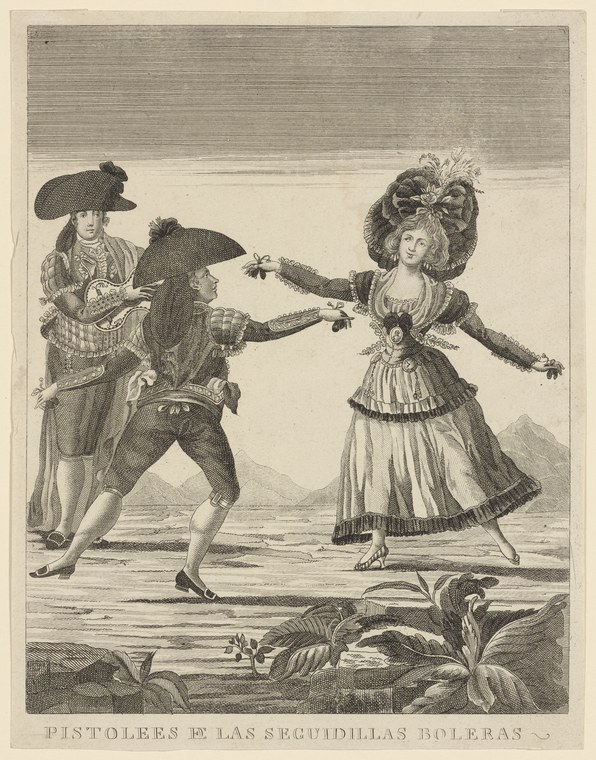
A satirical engraving depicting a theatrical courtship encounter between two men and a woman in fashionable 18th-century dress. The woman on the right, wearing an elaborate gown with vertical striping, a fitted bodice, and an enormous coiffure crowned with feathers and ornaments, strikes an exaggerated pose with arms extended. The two men flanking her wear tricorn hats and knee breeches; the man on the left holds a small pistol aimed at the woman while the man behind him gestures dramatically. The setting is sparse, with only a few flowering plants at the bottom of the composition suggesting an outdoor or garden space. The title inscribed below—"Pistolees e las sequidillas boleras"—suggests this is a parody of fashionable dancing and courtship, with the "pistols" a visual pun on the men's performative gestures and the boleras a reference to Spanish dance.
The dancing
The three figures are arranged in an exaggerated tableau of courtship theater. The woman's posture is highly artificial: her torso is tilted, her arms spread wide in an expansive gesture, her weight seemingly on one leg in an affected, unstable stance. The men are equally theatrical—the nearer man leans forward in a lunging position, arm extended with the pistol, while his companion behind gestures with equal drama. None of the figures exhibit the controlled, grounded posture of serious dancers; instead, they embody the satirized affectation of fashionable society.
The dance depicted
The title references sequidillas boleras, a Spanish dance form popular in the 18th century characterized by rhythmic footwork, castanets, and flirtation. However, this print is clearly a satire on the affectations of fashionable courtship dancing rather than a straight representation of the dance itself. The "pistols" in the title suggest a gun-play metaphor for the pointed gestures and exaggerated flirtation of stylized courtship. The image ridicules the pretensions of fashionable society through burlesque: the woman's enormous headdress, the men's theatrical posturing, and the overall staginess of the scene all mark this as social commentary on the performative excess of upper-class dance and manners.
How it was made
This is a line engraving, likely Spanish or produced for a Spanish-speaking audience in the 18th century, executed with fine parallel hatching to create tonal variation and volume. The technique allows for sharp detail in the costume and physiognomy while maintaining the crisp linear clarity essential for satirical prints intended for social circulation. The inscription in Spanish confirms an Iberian origin. Engravings of this type were widely distributed as prints and would have been accessible to a broad educated audience, making them effective instruments for social satire.
About this work
This is an 18th-century satirical engraving that deploys dance and courtship imagery to mock the affectations of fashionable society. Titled "Pistolees e las sequidillas boleras" (a pun combining firearms with the Spanish bolera, a popular dance), it presents three figures in grotesquely exaggerated poses—the woman with an absurd headdress and affected stance, the men with theatrical gestures—to ridicule the performative excess of aristocratic fashion and flirtation. The print belongs to a broader tradition of Iberian satire on fashion and social pretension that uses bodily excess and visual pun to expose the ridiculous in supposedly refined behavior.
For dance historians, the work is valuable as evidence of how boleras and similar Spanish dances were understood in popular culture: as sites of stylized flirtation and courtship performance. The print's mockery of exaggerated posture, artificial beauty standards (the headdress), and theatrical gesture tells us that contemporary audiences recognized these dances as performances of social role rather than as athletic accomplishment.
How to look at it
Attend to the exaggeration in every element: the woman's headdress is impossibly tall, her pose unstable and contorted, her costume vertically striped to emphasize elongation. The men's gestures are equally mannered—the gun held at arm's length is not a threat but a stylized pose of courtship. The artist has frozen a moment of intensified theatrical gesture, the sort of moment that makes sense only within the artificial world of fashionable society. This is satire through bodily excess: the more exaggerated the pose, the sharper the critique of the social conventions it represents.
The period
The bolera and sequidilla were popular Spanish dances in the 18th century, associated with courtship and social dancing in aristocratic and upper-middle-class contexts. They became fashionable across Europe and appear frequently in art and literature of the period. Satirical prints on fashion and manners were a major genre in Spanish and Spanish-American printmaking, used to criticize the follies and affectations of fashionable society. The enormous female headdresses parodied here are characteristic of mid-to-late 18th-century fashion, particularly the elaborate coiffures that became vehicles for social satire.
Where it lives
The work is held in the New York Public Library's collection of prints depicting dance. It is a period engraving, likely Spanish or produced in a Spanish-speaking territory in the 18th century.
Dance in this work
Questions about this work
What is a sequidilla bolera?
A sequidilla bolera is an 18th-century Spanish dance associated with courtship and social dancing. It featured rhythmic footwork and flirtation between partners. This print's title uses the form satirically, combining it with "pistolees" (a pun on guns and pointed gesture) to mock the artificial affectation of fashionable dancers. The dance was popular across Europe during this period.
Why are the figures posed so strangely?
The exaggerated poses are intentional satire. The artist ridicules the affectations of fashionable courtship dancing by pushing the theatrical posturing to an absurd extreme. The woman's unstable stance, the men's dramatic gestures, and the overall staginess are meant to expose the artificiality and pretension underlying fashionable society's self-presentation.
Is this a serious dance instruction image?
No. This is a satirical print mocking fashionable society's pretensions, not a guide to dance technique. It uses dance and courtship as the vehicle for social critique, deploying visual pun and bodily excess to make its point about the comic follies of aristocratic fashion and behavior.
More dance artwork





