49 works in this view — arrow keys or swipe to move between them.
Dance in Art
European folk dancing in prints
Unknown artist
- Collection:
- Prints depicting dance
- Source:
- New York Public Library
- Rights:
- Public domain — free to use, share and adapt.
- Recorded as:
- Public Domain
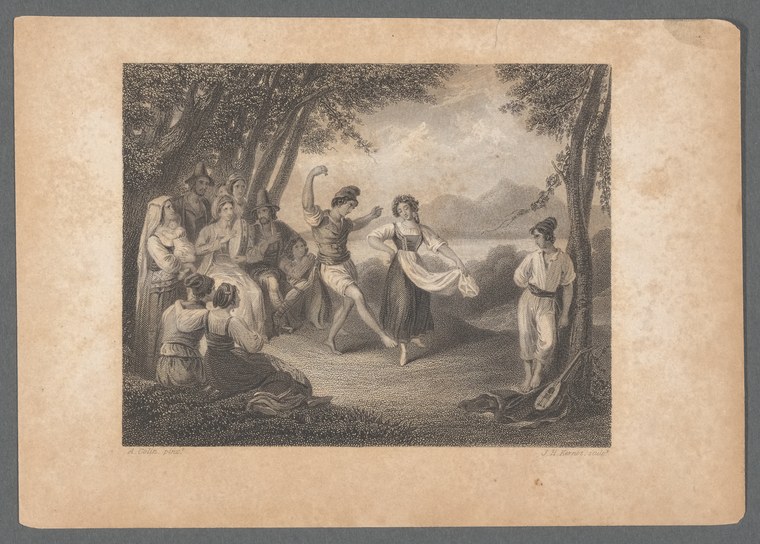
This print provides rare visual documentation of the embodied character of pre-ballroom European social dance—the verticality, the open spatial arrangement, the role of spectators, and the outdoor, festive contexts in which folk dances took place. It captures a moment of transition, when Romantic and antiquarian aesthetics were beginning to document and preserve folk traditions that were disappearing or being transformed. For historians, it is evidence of how educated European audiences imagined and valued their own rural past.
What you are looking at
A woodland clearing hosts an outdoor celebration of dance and music. Tall trees frame the composition on both sides, their foliage creating deep shadow; the background opens to distant hills under a luminous sky. A group of figures occupies the sunlit center: at least a dozen people are distributed across the glade in clusters of animation. Some are seated or reclining on the ground to the left, watching; others stand and move in the middle distance. The figures wear simple, draped white and pale garments—classical or neo-classical dress rather than contemporary costume. Several women appear to be in motion, their limbs extended, skirts caught mid-swing. The composition suggests a moment of festive release: some figures gesture expansively upward, one or two seem to be in a suspended leap or pirouette, and the overall rhythm moves from stillness at the edges to energetic movement in the center. The technique—fine engraving or etching, with careful cross-hatching for shadow—renders the scene in monochrome, giving it the character of a print from the late 18th or early 19th century.
The dancing
The dancers occupy an open, informal space without rigid partnering. Several figures show raised arms and high leg positions; at least two appear to be in or near elevation—one woman's body is elongated, suggesting a leap or bound. The women wear flowing, high-waisted gowns typical of the Regency or Romantic era, which permits visible footwork and articulation of the legs. The men are dressed in breeches and appear to be in more grounded postures, though some gesture with raised arms. There is no evidence of ballroom closed hold; the dancers move with an openness and spatial generosity that suggests country dance, reel, or other folk tradition rather than formal partnered technique. Spectators recline or sit, implying this is social entertainment rather than theatrical performance.
The dance depicted
This appears to depict a country or folk dance celebration—most likely English or continental European rural festivity—rather than a specific named dance. The informal outdoor setting, mixed ages, and variety of posture (some dancing, some watching, some with musical instruments implied) suggest a seasonal or social occasion such as a maypole, revel, or harvest feast. The elevated leaps and suspended poses visible in several figures are characteristic of galliards, jigs, or other vigorous social dances of the Baroque and Regency periods. The print's title references 'European folk dancing,' which aligns with a 19th-century antiquarian or romantic interest in documenting rural and traditional customs. Without inscription or specific costume markers, the exact regional tradition cannot be determined, but the visual language—leaping, open arms, informal grouping—belongs to the pre-ballroom social-dance repertoire.
How it was made
This is a fine engraving or etching, executed with careful parallel lines and cross-hatching to achieve tonal range and atmospheric depth. The technique allows fine detail in drapery and gesture while maintaining clarity of composition across the full scene. The monochromatic nature and the quality of the line suggest a work made for circulation as a print—likely part of a series or publication on manners, customs, or artistic subjects. Engravings of this quality were expensive to produce and distribute, implying an educated or cultured audience. The romantic framing of the woodland and the pastoral mood suggest the print dates from the late 18th or 19th century, when such antiquarian and picturesque documentation was fashionable among European audiences.
About this work
This engraving documents a festive moment of European rural dance, most likely from the Regency or early 19th century. The scene captures the informal, energetic character of folk celebration—leaping figures, open spatial arrangement, and a mixed company of dancers and spectators in a natural setting. The work belongs to a tradition of picturesque and antiquarian prints that sought to record and romanticize country customs and traditions at a moment when industrialization was beginning to displace them. For dancers and historians, it offers visual evidence of the lightness, verticality, and social informality of pre-ballroom European social dance, and of the contexts in which such dances took place.
The print is part of a broader 19th-century artistic interest in folk culture and the picturesque. The woodland setting, the neo-classical dress, and the emphasis on spontaneous joy reflect Romantic-era aesthetics as much as documentary intention. It records not simply what people danced, but how Romantic artists wanted to imagine the past and the countryside—as spaces of freedom and natural grace, in contrast to urban formality.
How to look at it
Attend first to the arrested moment of movement: several figures are captured mid-leap or in extended arm positions, and the artist has used line and shadow to suggest the trajectory of bodies in motion. Notice the spatial openness—dancers are not in closed ballroom hold, but distributed across the glade with freedom of movement. Observe also the social composition: spectators are as much part of the scene as dancers, suggesting this is communal festivity rather than performance. The woodblock or engraved line is fine and deliberate; the artist has rendered each figure with attention to drapery and individual gesture, creating a sense of living observation rather than mere type.
The period
This work dates from the era of Romantic interest in folk culture and picturesque scenery, likely early to mid-19th century. At this moment, the ballroom dances—waltz, quadrille, cotillion—were becoming the dominant social-dance forms across Europe, and peasant and folk traditions were being collected, documented, and sometimes sentimentalized by middle-class and aristocratic audiences. The woodland setting and the emphasis on natural grace reflect the Romantic privileging of the countryside and the 'natural' over urban artifice. Simultaneously, the neo-classical dress and the refined engraving technique indicate this is a work of artistic interpretation for a cultured public, not a literal record of actual rural practice.
Where it lives
The work is held as part of a print collection at the New York Public Library, catalogued under the heading 'Prints depicting dance' but without specific artist, date, or medium attribution recorded. It is a European engraving or etching of the 18th or 19th century, circulated as a print—a format that implies broad (if educated) audience and reproducibility.
Dance in this work
Questions about this work
Is this showing a real dance tradition or an artist's fantasy?
Almost certainly both. The print appears to document actual folk-dance traditions—the postures, the outdoor setting, and the social composition are consistent with historical accounts of country dances. However, the artist has rendered the scene through Romantic aesthetics: the woodland framing, the pale classical dress, the emphasis on lightness and grace all reflect 19th-century idealization of the countryside. The work is both documentation and interpretation.
What dance style is this?
The specific tradition cannot be identified without inscription or more detailed costume markers. However, the leaping, open-armed postures, and informal grouping are consistent with country dances, galliards, jigs, or other vigorous social dances of the Baroque and Regency periods across England, France, and central Europe. The vertical leap is particularly characteristic of dances such as the galliard or the cotillion.
How does this compare to ballroom dance of the same era?
This represents an older, pre-ballroom tradition. Ballroom dances (waltz, quadrille, cotillion) are characterized by closed partnerships, formal partnering, and indoor performance. This print shows open spatial arrangement, mixed-age participation, and outdoor festivity—features of folk and country dances that predated the ballroom era and continued to exist alongside it, especially in rural contexts.
Who would have seen this print?
The quality of execution and the antiquarian subject suggest an educated, urban audience—collectors of prints, patrons of the arts, people interested in folklore and the picturesque. The circulation of such prints was limited compared to modern reproduction but wider than original paintings; they were relatively expensive and were collected by people of some cultural and economic means.
More dance artwork





