49 works in this view — arrow keys or swipe to move between them.
Dance in Art
European folk dancing in prints
Unknown artist
- Collection:
- Prints depicting dance
- Source:
- New York Public Library
- Rights:
- Public domain — free to use, share and adapt.
- Recorded as:
- Public Domain
It captures a moment when Alpine folk dances were beginning to be commercially reproduced and circulated as cultural documents, showing how partnered folk dances combined closed holds with energetic, springy footwork. It also reveals how folk dances were aestheticized and often sentimentalized for middle-class consumption, a pattern that shaped the survival and transformation of these traditions into the modern era.
What you are looking at
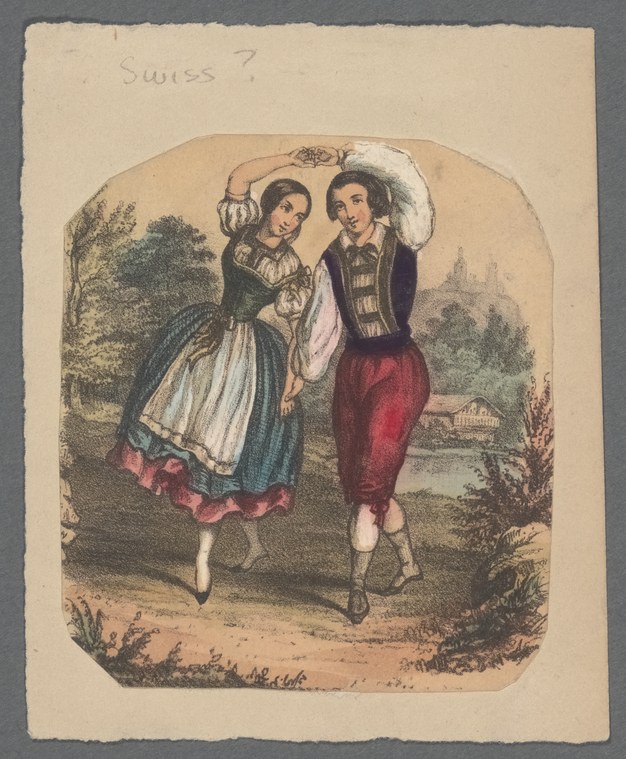
A young couple dances outdoors in a Romantic-era Alpine landscape. The woman wears a full-skirted dress in teal or dark green with a white apron and long-sleeved white chemise; her dark hair is pinned under a small bonnet or cap. The man wears fitted burgundy breeches, a dark waistcoat with patterned trim, and a light shirt. He holds her right hand elevated while his left arm encircles her waist—a closed ballroom position—as she appears to leap or spring upward beside him. The background shows mountainous terrain with a village or settlement nestled in a valley, rendered in soft greens and browns. The foreground is detailed with grasses and wildflowers. The print is hand-colored with soft washes, and the overall mood is one of courtship and alpine folk celebration, likely depicting a Swiss or South German dance.
The dancing
The couple is in a closed ballroom hold: the man's left arm at the woman's waist, their right hands joined at shoulder height. Her body is energetically inclined away from him, with her left leg extended or kicking, suggesting a springing or leaping movement. The woman's weight appears to be coming off the ground, and the man is solidly grounded, supporting her through the frame. His posture is upright and leading; hers is buoyant and trusting. The composition and energy suggest a lift or a bouncing, springy step rather than a gliding movement.
The dance depicted
This appears to be a depiction of an Alpine folk dance—most likely a Ländler or similar Swiss/Austrian/Bavarian couple dance, given the setting and dress. The closed hold and the woman's energetic upward spring are characteristic of these partnered folk traditions, which combined gentle rotations with springing or hopping steps. The image conveys the lightness and exuberance of folk courtship dance in the early 19th century, when such dances were central to rural social life and when they were being documented and romanticized by artists. The printed format and hand-coloring suggest this was a popular, commercially distributed view of folk culture for urban audiences.
How it was made
This is a hand-colored engraving or lithograph, likely from the 1830s–1850s based on the style of coloring and line work. The base image is printed—either from an engraved or lithographic stone—and then selectively colored by hand with watercolor or gouache, visible in the soft, sometimes uneven wash of the landscape and clothing. This hybrid technique was standard for popular prints of the period, allowing for multiple colored copies at moderate cost. The print was almost certainly produced for the middle-class market, probably as part of a series of European folk costumes or dances.
About this work
This is a popular print documenting Alpine folk dance, almost certainly Swiss or Austrian in origin, from the early 19th century. It belongs to a long tradition of Romantic-era artistic interest in rural and folk culture—part of the broader European enthusiasm for the *Volk* and national identity that shaped artistic production from the 1820s onward. The image was made for circulation and consumption by urban audiences as a window onto peasant life and courtship customs. For dance history, it is valuable evidence of how these dances were performed, understood, and marketed during their transition from living practice to historicized cultural symbol.
How to look at it
Notice the woman's lifted posture and the apparent lightness of her leap, set against the man's grounded, supporting frame. This is the characteristic moment of an Alpine couple dance—the woman airborne, momentarily weightless, held aloft by the man's steady lead. The artist has chosen to freeze the dance at its most exuberant point, emphasizing the joy and lift of the movement. The carefully rendered landscape behind them—the distant village, the mountains, the Alpine meadow—frames this dance as a moment of authentic rural life, a Romantic fantasy of nature and uncomplicated human happiness.
The period
This print belongs to the Romantic era's intense fascination with folk culture and national identity. In the 1820s–1850s, Alpine dances and costumes were rediscovered and idealized by artists, musicians, and writers across Europe. Publishers produced series of costume and dance prints to feed this appetite for images of authentic, pre-industrial life. Simultaneously, these dances were being performed in urban ballrooms and at court—refined and formalized—while rural versions continued in their original contexts. The print documents this moment of intersection between folk practice and urban imagination.
Where it lives
The print is held in the New York Public Library's collection of prints depicting dance, catalogued as part of a broader record of European folk dancing in prints. The loose inscription 'Swiss?' or similar in the upper margin suggests curatorial uncertainty about provenance, though the costume and setting strongly support a Swiss or South German origin.
Dance in this work
Questions about this work
What dance is this?
Most likely a Ländler, Waltz, or related Alpine couple dance. The closed hold, the woman's springing upward leap, and the Alpine setting are all consistent with Swiss and Austrian folk dances of the 19th century. Without more documentation, the specific dance cannot be identified with certainty, but the technique and costume are clear.
When was this made?
The style of hand-coloring, the printing technique, and the Romantic-era aesthetic suggest it dates to the 1830s–1850s. The exact date is unknown; the record lists it as unknown, but the print was almost certainly made during the height of European interest in folk culture.
Why are they depicted in mountain scenery?
The Alpine setting is not coincidental. By the early 19th century, the Alps had become symbols of authenticity, nature, and national identity in European Romantic thought. Placing this couple dance in a mountain landscape emphasized its status as genuine folk tradition, rooted in nature and the past, rather than as a fashionable urban novelty.
Was this a real way people danced, or a fantasy?
Both. Alpine couple dances with energetic springing steps and closed holds were real and widely performed in rural areas. However, this print was made for urban consumption and reflects a Romantic idealization of folk life—the landscape, the light, the sentimentality are all products of the artist's imagination and the tastes of the market.
More dance artwork





