49 works in this view — arrow keys or swipe to move between them.
Dance in Art
European folk dancing in prints
Unknown artist
- Collection:
- Prints depicting dance
- Source:
- New York Public Library
- Rights:
- Public domain — free to use, share and adapt.
- Recorded as:
- Public Domain
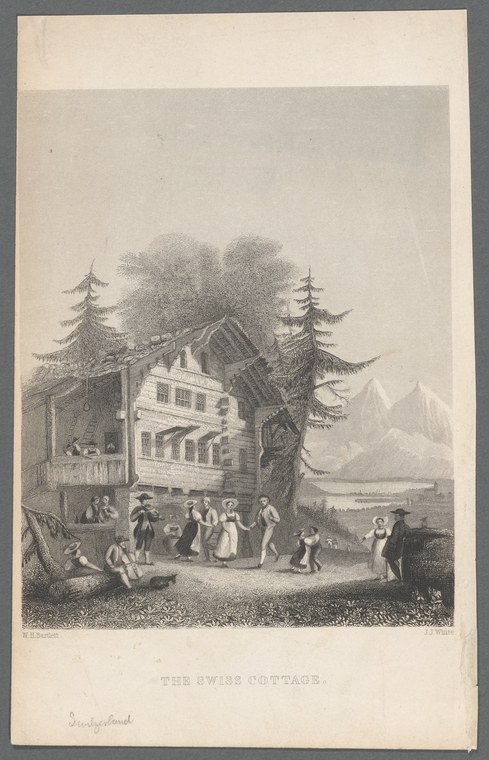
The print documents how 19th-century European art mediated the urban public's encounter with folk culture and rural dancing—not through direct observation but through romantic, picturesque convention. It reveals the aesthetic distance between folk practice and its representation in mass-produced prints, showing how idealized settings and soft focus on specific steps served the market for sentimental views of 'authentic' village life.
What you are looking at
A Swiss cottage built into or against a massive tree serves as the setting for a lively folk gathering. The house, a substantial timber-framed structure with shuttered windows and a pitched roof, nestles among towering conifers—two tall evergreens frame it on either side. The foreground shows a mixed group of figures in 19th-century dress (men in dark coats and hats, women in long dresses and bonnets) arranged in loose clusters around the cottage's base and entrance. Some figures appear to be dancing or in motion; others stand in conversation. A mountain peak rises in the distant background under a hazy sky. The composition balances the monumental natural elements—the ancient tree and conifers—against the human scale of the gathering, suggesting a moment of community life in an Alpine or Central European setting. The engraving technique creates strong contrasts between the densely shadowed foliage and the lighter figures and architecture.
The dancing
The figures are distributed across the scene without a single dominant dance group; instead, several smaller clusters suggest different activities. Some bodies are upright and still in conversation, while others lean or bend slightly as if in motion or turned toward partners. The dress—long skirts for women, formal coats and hats for men—limits the footwork visible; we cannot discern specific steps or hold patterns from the image. The overall effect is of a social gathering rather than a formally staged dance performance, with movement suggested by posture and proximity rather than by clear technique.
The dance depicted
This appears to be a 19th-century romantic vision of Alpine or Swiss folk life, likely depicting a folk festival or village celebration rather than a specific named dance. The title *The Swiss Cottage* suggests a picturesque or tourist-oriented subject, a common theme in 19th-century prints. While the gathering includes figures in motion, the image does not depict a recognizable ballroom dance, court dance, or codified folk style with clear technique. It is more accurately understood as a genre scene of folk life and festivity than as a dance document. The informal arrangement and mixed activities suggest a community gathering at which dancing occurred, rather than a formal performance or instruction in a particular dance form.
How it was made
This is an engraving, a technique established from the fine parallel lines (hatching and cross-hatching) used to model form and create shadow across the foliage, figures, and architecture. The engraver has achieved subtle tonal gradations through the density and direction of line work, which is characteristic of 19th-century reproductive engravings. The technique allowed for wide distribution as a print and suggests this was a commercial publication aimed at a broad audience interested in picturesque or sentimental views of European rural life. The inscription at the bottom and the formal framing indicate professional production and likely circulation as a loose print or in a book or periodical.
About this work
This engraving depicts a 19th-century folk gathering at a Swiss cottage, a scene that blends architectural fantasy (the cottage built into an ancient tree) with a romantic vision of Alpine community life. The figures—dressed in contemporary 19th-century clothing—are arranged in small social groups, some in motion, suggesting dancing or festive activity without depicting a specific dance form. The work sits at the intersection of genre painting (scenes of everyday or rural life) and dance imagery, capturing not a codified dance practice but the idea of folk festivity and spontaneous movement. It belongs in a dance collection as evidence of how 19th-century European art represented folk culture and social dancing to urban audiences, often through idealized and picturesque imagery rather than ethnographic accuracy.
How to look at it
Attend to the scale and framing: the tree is monumental, the cottage nestled within it, the figures small. This composition prioritizes the picturesque setting over the specifics of movement or dance form. Note the distribution of the figures across the composition—no single action or dance position dominates; instead, the eye moves among clusters of standing and moving bodies. The engraver has chosen to freeze a moment of festive sociability rather than a peak moment of movement, inviting the viewer to imagine rather than observe the actual steps and patterns of the dance.
The artist
The artist is not recorded. The professional quality of the engraving and the title inscription suggest this was a commercial print from a significant publisher, likely produced in the mid-19th century as part of a broader European print market in picturesque and genre scenes.
The period
This engraving dates to an era when Swiss and Alpine imagery became fashionable across Europe, fed by the Romantic movement's interest in nature, the picturesque, and rural life as repositories of authentic feeling and tradition. In the same period, folk dance was being collected, studied, and performed in urban and courtly contexts, often mediated through prints, lithographs, and illustrated books. The Swiss Cottage imagery aligns with a broader 19th-century cultural project of aestheticizing and consuming rural culture through the lens of urban sensibility.
Where it lives
The work is held in the New York Public Library's prints collection and is catalogued as a generic European folk dance print without detailed provenance information. It is inscribed with the title and artist attribution has not been recorded in the catalogue entry.
Dance in this work
Questions about this work
Is this a specific Swiss dance or just a romantic fantasy?
Almost certainly the latter. The picturesque composition—the cottage built into the tree, the mountain backdrop—is a Romantic-era invention designed to appeal to urban audiences seeking idealized images of rural life. While the figures suggest festive gathering and movement, the image does not document a specific dance form or technique. It is a genre scene of folk life, not a dance instruction or ethnographic record.
What dances would have actually occurred at such a gathering?
In Alpine regions during the 19th century, common folk dances included the Landler, Ländler variations, and other couple and group dances of Central European tradition. However, this print gives no detail specific enough to identify what was danced. It serves as a window into the *idea* of folk festivity rather than its practice.
Why is the cottage inside a tree?
This is a common motif in 19th-century picturesque art, combining the Romantic fascination with ancient nature, human habitation in harmony with landscape, and fairy-tale wonder. It has no basis in actual Swiss architecture and signals the image's function as sentimental fantasy for a European urban market.
More dance artwork





