49 works in this view — arrow keys or swipe to move between them.
Dance in Art
European folk dancing in prints
Unknown artist
- Collection:
- Prints depicting dance
- Source:
- New York Public Library
- Rights:
- Public domain — free to use, share and adapt.
- Recorded as:
- Public Domain
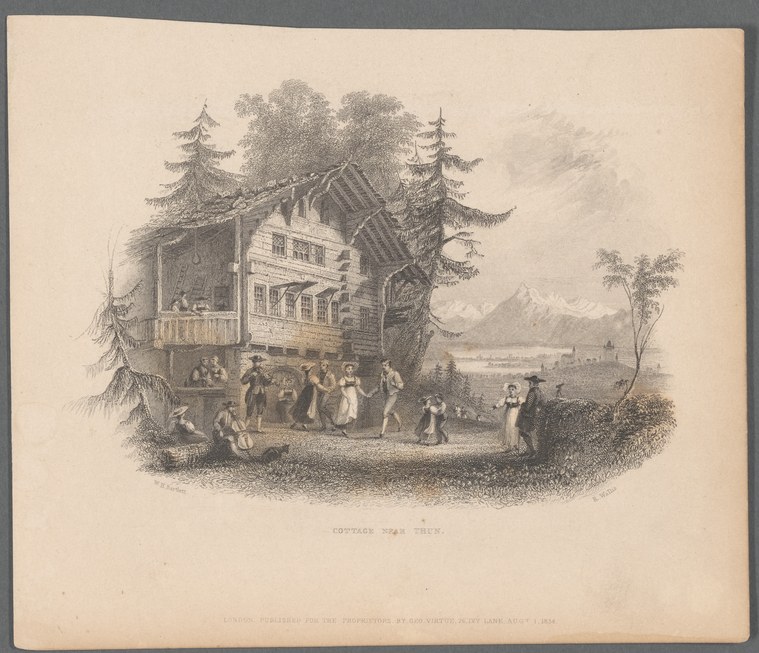
For dance historians, this work is evidence of how and where folk dance was contextualized and circulated—as a marker of authentic European rural community life, depicted for an audience far removed from it. The image shows the *social infrastructure* of dance: the mixed gathering, the outdoor country setting, the period costume, the informal grouping that characterizes pre-modern social dance. It is a reminder that much 19th-century European folk dance representation was aspirational or nostalgic rather than strictly documentary.
What you are looking at
This engraving depicts a lively outdoor gathering centered on a substantial timber building with a distinctive pitched roof and overhanging eaves, nestled beneath tall evergreen trees. The structure appears to be a country lodge or inn, with figures clustered around its entrance and scattered across the foreground. The scene is populated by men and women in 19th-century dress—the women in long skirts and bonnets, the men in coats and hats—arranged in loose groupings that suggest social interaction and informal merriment. A mountainous landscape with a lake or river recedes into the misty middle distance on the right, rendered in soft tonal gradations typical of the engraver's art. The composition radiates outward from the building, with foreground figures more sharply defined and background details dissolving into atmosphere, creating a sense of gathered community at leisure.
The dancing
The figures are mostly standing, conversing, or moving casually rather than in any formal dance alignment. Several couples appear to be positioned near one another in the foreground and around the building's base, but no clear closed holds or structured formations are visible. The women's postures are upright and decorous, with arms held naturally or gesturing in conversation. A few figures seem to be animated or in motion—weight shifts and turning gestures suggest social movement—but the composition does not arrest a moment of active dancing; rather, it captures the informal social space where dancing might occur.
The dance depicted
This image is titled *European Folk Dancing in Prints* and is catalogued under the genre "dance," yet the image itself shows no unambiguous dancing. The scene represents a social gathering of the sort in which folk dance would have taken place—an outdoor country venue with musicians potentially present (though none are clearly visible) and mixed company in festive dress. If folk dancing occurred at such venues, this engraving documents the *setting and participants* rather than the dance itself. The work may be a scene of preparation, assembly, or the social interlude between dances, or it may be a somewhat romanticized genre scene of European rural life that invokes the idea of folk festivity without depicting active movement.
How it was made
This is a steel or copper engraving, identifiable by its fine parallel hatching lines, the precise linear framework of the building, the delicate tonal gradations in the sky, and the subtle cross-hatching used to model form and distance. Engraving allows for the creation of intricate detail and subtle atmospheric effects, as seen in the feathery rendering of the foliage and the soft recession into mist. The technique produces a print suitable for circulation in periodicals, albums, or illustrated books—a popular medium for documenting European customs and landscapes in the 19th century. The inscription at the bottom indicates this is a published work, likely part of a larger series on European life and manners.
About this work
This engraving represents a European country gathering, likely Swiss or Alpine in setting, rendered in the popular 19th-century tradition of picturesque landscape and genre scenery. It belongs in a dance collection not because it depicts dancing, but because it documents the social and architectural context in which folk dances were performed and the dressed bodies, mixed-gender groupings, and festive atmosphere that constituted the folk dance occasion. The work is valuable as evidence of how European folk gathering-places were imagined and represented to a broad visual audience, and what social and spatial conditions surrounded dance practice.
The image sits at the intersection of two 19th-century visual traditions: the picturesque landscape print and the ethnographic or customs-of-the-people genre. It romanticizes rural life and folk sociability without pretending documentary precision, and it speaks to the era's fascination with authentic European peasant culture even as it packages that culture for urban consumption.
How to look at it
Attend first to the building and its role as a social anchor—it grounds the gathering and establishes the setting as a known, stable place where community regularly assembles. Note the distribution of figures: they are neither in a line nor in obvious partner pairs, but clustered in conversational groups, suggesting the social dimension of the occasion. The engraver's choice to include the distant landscape and to render the scene in soft, atmospheric tones emphasizes leisure and escape, positioning this gathering as removed from the urgencies of daily labor. The women's skirts and the men's formal coats indicate this is a dressed-up, intentional assembly, not a chance encounter—it is worth pausing on what "folk" and "festivity" meant to 19th-century eyes.
The period
This engraving dates to the 19th century, an era of intense interest in European folk customs, rural life, and national identity. The Romantic movement elevated the folk and the picturesque; collectors and artists sought to document and idealize what they understood as authentic peasant traditions before industrialization erased them. Illustrated books and periodicals on European customs and costume were enormously popular among educated urban audiences. Alpine and Alpine-adjacent settings—Switzerland, the Tyrol, the Carpathians—held particular appeal as repositories of unspoiled folk culture. Folk dancing was conceptualized as an authentic expression of national character and regional identity, and it was widely represented in prints, paintings, and illustrated books aimed at domestic consumption and travel.
Where it lives
This print is held by the New York Public Library as part of its collection of prints depicting dance. The inscription indicates publication in London, and the style suggests production in the mid-to-late 19th century. It is one of many such prints in circulation during the period, part of the broader apparatus by which European culture was documented, exported, and consumed as visual spectacle.
Questions about this work
Is there actual dancing happening in this image?
No clearly identifiable dancing is visible. The figures are standing, conversing, and grouped socially, but no couple or group is caught in an active dance hold or movement. The image documents the *occasion and setting* for folk dance rather than the dance itself.
Why is this in a dance collection if no one is dancing?
Dance history includes the spaces, occasions, and social practices surrounding dance, not only the movement itself. This print is evidence of 19th-century attitudes toward folk dance, the types of venues where it occurred, and how Europeans and artists imagined rural folk sociability. It is a document of the *context* of dance.
What is the building shown?
The structure is likely a country inn, lodge, or communal gathering place in an Alpine or sub-Alpine region, built in a traditional timber style with a broad overhanging roof suited to mountain weather. Such buildings served as centers of rural social life and were natural venues for community gatherings and dances.
More dance artwork





